The Maestro

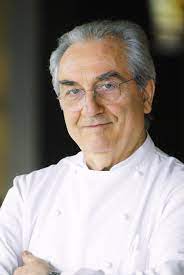
Our film class, a group of 6 American women who weekly discuss an Italian film in Italian, recently viewed the 2017 documentary, Marchesi: The Great Italian.  It recounts the life of Gualtiero Marchesi (1930 – 2017), widely believed to be the father of modern Italian cuisine who refined and personalized Italian regional cooking and elevated it to international acclaim.

Born in Milan, Marchesi began learning the cooking trade by observing and working in the kitchen of the restaurant in his parents’ small hotel.  He continued formal education in Switzerland, France and Japan. He then returned to Milan and opened his first restaurant in 1977.  It quickly earned a coveted star from Michelin, the French rating guide.  A second Michelin star soon followed. In 1985 when Marchesi’s restaurant became the first in Italy to receive a third Michelin star, he said, “this gives the prize not only to me but also to the renaissance of Italian cooking that has been in progress for the last 10 years.”

Marchesi’s philosophy of cuisine is based on simplicity and fresh ingredients first, then technique and elaboration.  His dishes became works of art or musical scores.  He believed that each ingredient has a role in the symphony, it must be clearly recognizable, and that to achieve harmony it must stand on its own in the contrast between flavor and texture.

Among Marchesi’s signature dishes are the famous Risotto Oro e Zafferano (Risotto Gold and Saffron) with an edible gold leaf over the rice; Raviolo Aperto (Open Raviolo), which has a filling of scallops between two sheets of pasta, a plain one and a spinach-flavored green one; and Spaghetti Freddi al Caviale (Cold Spaghetti topped by Caviar), seasoned with chives and shallot.  Dripping di Pesce (Fish Dripping) was a later invention inspired by painter Jackson Pollock; the background is a light mayonnaise enhanced by the white of squid and clams, the red of tomatoes, the black from cuttlefish ink, and the green from parsley.

Throughout his life, Marchesi was a whirlwind of projects and new initiatives.  He created a line of frozen foods and a signature liqueur.  He provided management services to other restaurants and created menus for cruise ships.  He opened a cooking school in Parma and restaurants in London and Paris.  He even created two new hamburgers and a dessert for McDonald’s restaurants in Italy.

But it was his high-end restaurants that drew attention and awards … and controversy.  In 1992 he closed his Milan restaurant and opened another one in a luxury hotel in Erbusco (province of Brescia), which also earned Michelin stars.  When Michelin downgraded the Erbusco restaurant in 2008, Marchesi announced that “I do not want to be judged by guides using points or stars.”  He repudiated the Michelin system and its stars, the first person in history to do so.

Marchesi led a very intense life and died at age 87 in 2017, shortly after the documentary was made.  Today Terrazza Gualtiero Marchesi is the only restaurant in the world to offer the entire menu of the most famous dishes of Marchesi.  It is hosted by the Grand Hotel Tremezzo, a five-star hotel overlooking Lake Como.  The restaurant is supervised by Enrico Dandolo, son-in-law of the Maestro.
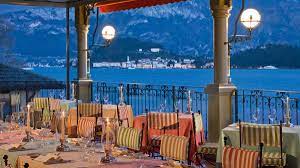
Marchesi’s legacy lives on in current chefs like Massimo Bottura and Carlo Cracco.  Marchesi embodied the philosophy of the great 19th-century chef Pellegrino Artusi: “Cooking in itself is a science…which only the best are able to transform into art.”

Posted in Arte, Cucina italiana, English, Film, Foto, Italia, Milano, Storia | Leave a comment

I murales perduti della Roma rinascimentale

Nel XV e XVI secolo molti palazzi ed edifici pubblici a Roma avevano elaborate facciate dipinte. La tecnica usata era l’affresco, una tecnica che lega la pittura con l’intonaco bagnato, formando una superficie dura una volta asciutta. I temi preferiti erano le battaglie e le gesta eroiche degli antichi romani. La maggior parte dei murales erano dipinti in semplici toni di grigio o marrone, scelti per simulare i rilievi in ​​pietra dell’antichità.

I dipinti più famosi della città dell’epoca sono per la maggior parte perduti.  Il clima alla fine hanno avuto il loro tributo sull’opera d’arte esposta. Questa attività artistica, giunta all’apice durante il Rinascimento, richiamava molti artisti a Roma per ammirare i murales o abbozzare copie da portare a casa. Così molti dei loro disegni e stampe hanno permesso di conservare “quei dipinti” la loro fama nei secoli successivi.

da Taddeo Zuccaro

Il J. Paul Getty Museum di Los Angeles ha presentato una mostra intitolata “The Lost Murals of Renaissance Rome” fino al 4 settembre 2022. La prima galleria ha mostrato i disegni e le stampe delle facciate dipinte degli edifici. La seconda galleria ha presentato la storia dagli stalli alle ricchezze del muralista rinascimentale Taddeo Zuccaro (1529 – 1566), illustrata dal fratello minore, Federico Zuccaro (c. 1541 – 1609).

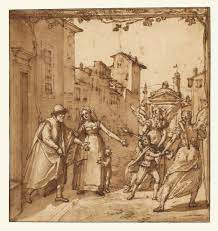
All’età di 14 anni, Taddeo lasciò la sua città natale di Sant’Angelo in Vado, nei pressi di Urbino (nelle Marche) per cercare fama e fortuna a Roma come artista. Uno dei primi disegni di Federico mostra Taddeo che esce di casa scortato da due angeli custodi. Federico si dipinse aggrappato alla gonna della madre; era uno degli 8 o 9 figli della famiglia. In tutta la serie di circa 20 disegni, Federico individuava Taddeo e se stesso, aggiungendo un testo per spiegare il contenuto delle scene. 

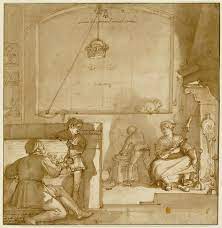
Taddeo incontrò molte difficoltà per diventare artista. Alla fine ebbe la possibilità di fare un apprendistato, ma in uno studio dove venne maltrattato facendo soffrire persino di fame. In Taddeo in casa di Giovanni Piero Calabrese lo si vede due volte: nella prima scena mentre mescola i colori in fondo alla stanza, vigilato dalla meschina moglie del pittore; e in una seconda scena mentre tiene una lampada a olio perché il suo maestro Calabrese possa studiare un disegno di Raffaello. Il testo centrale recita: “Mi privi di ciò che desidero di più”, riferendosi all’angoscia di Taddeo stesso per non avere la possibilità di studiare il disegno di Raffaello. Il pane è tenuto in un cesto appeso al soffitto, con una campana ad esso attaccata, in modo che Taddeo non potesse rubarlo. 

Taddeo alla fine ebbe successo come pittore murale e divenne uno degli artisti più famosi del suo tempo. Anche Federico, che divenne un artista famoso, progettò questa serie di disegni per gli interni del suo sontuoso palazzo romano. Voleva che l’edificio diventasse un’accademia e un ostello per i giovani artisti in visita in città, per salvarli dalle difficoltà che avevano colpito il suo amato fratello maggiore. Il progetto non si è mai avverato a causa di litigi tra i suoi eredi.

Federico racconta la storia di suo fratello in modo affascinante. La serie di disegni ci dà anche un’idea di come i giovani artisti avessero imparato a disegnare nella Roma rinascimentale, facendo copie di opere di Michelangelo, Raffaello e altri.

Posted in Uncategorized | Leave a comment

The Lost Murals of Renaissance Rome

In the fifteenth and sixteenth centuries, many palazzos and public buildings in Rome had elaborate painted facades.  The scenes were executed in fresco, a technique that binds paint with wet plaster, forming a hard surface when dry.  Favorite subjects were the battles and heroic feats of the ancient Romans. Most murals were painted in simple tones of gray or brown, which were chosen to simulate the stone reliefs of antiquity.

Among the most famous paintings in the city at the time, most of these narrative facades have now disappeared.  The elements eventually took their toll on the exposed artwork.  However, at their peak during the Renaissance, artists flocked to Rome to admire the murals and sketched copies to take home.  Their drawings and prints preserved their fame throughout the subsequent centuries.

Mural by Taddeo Zuccaro

The J. Paul Getty Museum in Los Angeles presented an exhibition called “The Lost Murals of Renaissance Rome” through September 4, 2022.  The first gallery showed the drawings and prints of the painted building facades.  The second gallery presented the rags-to-riches tale of the Renaissance muralist Taddeo Zuccaro (1529 – 1566), as illustrated by his younger brother, Federico Zuccaro (c. 1541 – 1609).

At the age of 14, Taddeo left his provincial hometown of Sant’Angelo in Vado, near Urbino (Le Marche) to seek his fame and fortune in Rome as an artist.  One of the first drawings by Federico shows Taddeo Leaving Home Escorted by Two Guardian Angels.  Federico depicted himself clinging to his mother’s skirt; he was one of 8 or 9 children in the family.  Throughout the series of about 20 drawings, Federico inscribed them, labeling Taddeo and himself and adding text to explain the contents of the scenes.

Taddeo suffered many hardships on his journey to become an artist.  He eventually secured an apprenticeship, but in a studio where he was starved and mistreated.  In Taddeo in the House of Giovanni Piero Calabrese, he is seen twice: grinding colors at the back of the room, watched over by the mean-spirited wife of the painter; and holding an oil lamp so that his master, Calabrese, can study a drawing by Raphael.  The center text reads, “You deprive me of that which I desire most,” referring to Taddeo’s anguish at not being able to study the Raphael drawing himself.  Bread is kept in a basket hanging from the ceiling—with a bell attached, so that Taddeo could not steal it.

Taddeo eventually achieved success as a mural painter and became one of the most famous artists of his time.  Federico, who also became famous as an artist, planned this series of drawings in the Getty collection as designs for the interior of his lavish Roman palace.  He intended the building to become an academy and hostel for young artists visiting the city, to save them from the trials that befell his beloved older brother.  The project never came to pass due to squabbles among his heirs.

Federico tells the story of his brother in a charming fashion.  The series of drawings also gives us insight into how young artists learned to draw in Renaissance Rome by making copies of works by Michelangelo, Raphael and others.

Posted in Architecture, Arte, English, Foto, Italia, Roma, Storia | 2 Comments