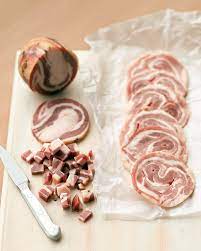
Pancetta e Guanciale

Queste due carni italiane hanno molte somiglianze, ma anche molte differenze. Entrambe provengono dal maiale e sono stagionate per prevenire la crescita dei batteri e per ottenere i loro gusti distinti. Entrambe sono salate e grasse ma senza l’affumicatura della pancetta americana. Entrambe conferiscono sapori distinti alle classiche ricette italiane.  (A proposito, la ventresca di maiale è un tipo di pancetta arrotolata, tipica dell’Umbria e altre regioni.)

La pancetta è fatta con la pancia di maiale, mentre il guanciale è fatto con le guance di maiale ed è più grasso. Oltre al sale, le spezie per condire la pancetta sono tipicamente pepe, finocchio, pimento e noce moscata. Il guanciale è tradizionalmente curato con pepe, rosmarino, timo e aglio. La combinazione di spezie può variare a seconda della regione d’Italia in cui viene prodotta. Il processo di stagionatura è simile: la carne viene strofinata con abbondanti quantità di sale e spezie e poi appesa ad asciugare in un locale fresco e asciutto. La pancetta stagiona per circa quattro settimane; il guanciale di solito si cura per un periodo più lungo, anche fino a sei mesi.

I salumi si conservano naturalmente grazie ad una grande quantità di sale e all’eliminazione dell’acqua in eccesso. I microrganismi non possono riprodursi in queste condizioni, consentendo alla carne di essere conservata al sicuro in un locale fresco per mesi nella confezione originale. Tuttavia, devono essere consumati entro due settimane dall’apertura.

Sia la pancetta che il guanciale sono tra le carni più grasse che si possono trovare. La pancetta contiene 426 calorie e 39 grammi di grasso per cento grammi…più che in una quantità equivalente di cioccolato. Il guanciale contiene 589 calorie e 59 grammi di grasso per cento grammi, quasi il doppio della stessa quantità di panna montata. Tuttavia, il grasso in entrambe le carni non è saturo e può essere tranquillamente consumato in porzioni inferiori a 45 grammi al giorno. A causa dell’alto contenuto di sale, queste carni non sono consigliate a persone con malattie renali, problemi cardiaci cronici o diabete.

Il guanciale è principalmente una specialità del centro Italia, mentre la pancetta è ampiamente utilizzata in tutto il paese. La pancetta è più facilmente reperibile del guanciale negli Stati Uniti e viene venduta a fette sottili, tagliata a cubetti e occasionalmente trovata in una lastra. Poiché entrambe le carni sono stagionate, possono essere mangiate da sole, servite su un piatto di carne o consumate con il pane. Di solito, però, si cucinano con altri ingredienti. 
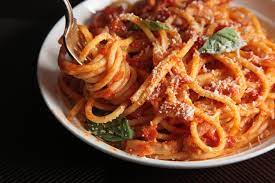
A causa delle differenze di sapore e consistenza, la pancetta e il guanciale sono tradizionalmente utilizzati in piatti diversi. Tuttavia, molte ricette specificano che ciascuna può essere un sostituto dell’altra. Entrambi sono usati in pasta, zuppa, insalata e numerosi altri piatti. Il guanciale è famoso in alcuni piatti romani come i bucatini all’amatriciana, gli spaghetti alla carbonara e i rigatoni alla zozzona. La pancetta compare nelle fettuccine all’abruzzese e più in generale nei risotti, nelle verdure e nei primi piatti come le pappardelle con piselli, asparagi e pancetta.

Sia la pancetta che il guanciale sono amati dai non vegetariani in Italia e in America, soprattutto tra italofili e buongustai.

Posted in Cucina italiana, Foto, Italia, Italiano, Roma, Umbria | Leave a comment

Pancetta vs. Guanciale

These two Italian meats have many similarities, but also many differences.  Both come from pork and are cured to prevent bacteria growth and to achieve their distinct tastes.  Both are salty and fatty but without the smokiness of American bacon.  Both lend distinct flavors to classic Italian recipes.

Pancetta is made from pork belly, whereas guanciale is made from pork cheeks and is fattier.  Besides salt, the curing spices for pancetta typically are pepper, fennel, allspice and nutmeg.  Guanciale is traditionally cured using pepper, rosemary, thyme and garlic.  The spice combination can change depending on the region of Italy where it is made.  The curing process is similar:  The meat is rubbed with generous amounts of salt and spices and then hung to dry in a cool, dry room.  Pancetta cures for about four weeks; guanciale usually cures for a longer period, even up to six months.

The cured meats are naturally preserved thanks to a large amount of salt and to the removal of excess water.  Microorganisms cannot breed in these conditions, allowing the meat to be stored safely in a cool room for months in the original packaging.  However, they must be consumed within two weeks after they are opened.

Both pancetta and guanciale are among the fattiest meats you can find.  Pancetta contains 426 calories and 39 grams of fat per 3.5 ounces…more than in an equivalent amount of chocolate.  Guanciale contains 589 calories and 59 grams of fat per 3.5 ounces, nearly twice more than the same amount of whipped cream.  However, the fat in both is non-saturated and can safely be consumed in servings of less than 1.5 ounces per day.  Because of the high salt content, these meats are not recommended for people with kidney disease, chronic heart problems or diabetes.

Guanciale is primarily a central Italy specialty, whereas pancetta is widely used throughout the country.  Pancetta is more readily available than guanciale in the United States and is sold thinly sliced, chopped into cubes and occasionally found in a slab.  Because both meats are cured, they can be eaten on their own, served on a meat platter or consumed with bread.   Usually, however, they are cooked with other ingredients.

Due to flavor and texture differences, pancetta and guanciale are traditionally used in different dishes.  However, many recipes specify that each can be a substitute for the other.  Both are used in pasta, soup, salad and numerous other dishes.  Guanciale is famous in certain Roman dishes like bucatini all’amatriciana, spaghetti alla carbonara, and rigatoni alla zozzona.  Pancetta appears in fettuccine all’abruzzese and more generally in risotto, vegetable and pasta dishes like pappardelle with peas, asparagus and pancetta.

Both pancetta and guanciale are beloved by non-vegetarians in Italy and in America, especially among Italophiles and foodies.

Posted in Cucina italiana, English, Foto, Italia, Roma | Leave a comment

What the Ermine Saw

The last ten years have seen the publication of several books on the travels and travails of famous art coveted by art collectors and thieves.  The Hare with Amber Eyes traces a Jewish family’s collection of Japanese netsuke from Japan to Europe and through the Nazis and beyond.  The Lady in Gold is a Nazi art theft saga of the famous Gustav Klimt portrait.  Plunder recounts Napoleon’s theft of the Veronese painting, Marriage at Cana, from a Venice church to populate his Paris Museum.  Now comes What the Ermine Saw: The Extraordinary Journey of Leonardo da Vinci’s Most Mysterious Portrait.

Around 1490, 16-year-old Cecilia Gallerani sat for her portrait before Leonardo da Vinci.  The painting was commissioned by Ludovico Sforza, the Duke of Milan; Cecilia was his mistress.  Ludovico was captivated not only by her beauty, but also by her talents in poetry and music.  In her lap is a white ermine (supposedly added at a later phase in the painting); it is a figure representing the duke, who was called ermellino bianco.  The animal not only represents his political power and viciousness, but also symbolizes pregnancy and childbirth leading art historians to believe that Cecilia was pregnant at the time.  She later gave birth to their son Cesare.

The painting hung in Ludovico’s private rooms when he married 15-year-old Beatrice while Cecilia and Cesare lived in the same building.  After Beatrice forced them to leave, Cecilia took the painting with her.  After her death, the painting was lost for more than two centuries.

Around 1800, the Polish Prince Adam Jerzy Czartoryski discovered the painting when he was on tour of Napoleonic Italy.  He gave the portrait to his mother, Princess Izabella Dorota Czartoryski, who kept it in the family for generations.  An avid art collector, she founded a museum to store her most prized possessions and other European antiquities.  During the Polish rebellion to attempt to overthrow Russian rule in 1830, the family relocated “Lady with an ermine” to Paris for protection.  At the end of the 19th century, it was brought back to Krakow to be part of the Czartoryski Museum.

During World War II, the scale of art theft under the Nazis was unprecedented.  Hitler was undaunted when it came to acquiring art for the Führermuseum that was planned in Austria.  The Gestapo succeeded in taking “Lady with an ermine,” which a housekeeper had concealed in a pillowcase in the Czartoryski estate in eastern Poland.  It came to be hung in the summer residence in Bavaria of Hans Frank, the governor-general who oversaw the Holocaust and supervised the massacre of Poland’s Jewish population. 

In 1945, when Frank was apprehended by American soldiers, the portrait was found.  A well-known image captures the moment when “Lady with an ermine” is given to Polish art historian Karol Estreicher by the “Monuments Men,” who assisted the Allies in its recovery.

The painting is extraordinary in many ways.  First, it is in remarkable condition for being more than 530 years old.  It is rather small (15” by 21”) and executed in oil on walnut board.  Oil painting was relatively new to Italy at the time.  It had been introduced from the Netherlands in the 1470s and was a revolutionary departure in a country still wedded to frescoes.  “Lady with an ermine” is only one of four known Leonardo portraits of women; in fact, there are only about 15 surviving paintings by Leonardo da Vinci, depending on attribution.

As shown in his many surviving sketchbooks, Leonardo was obsessed with the dynamics of movement.  Before him, portraits had been static, with the sitter facing the artist square on.  Leonardo introduced contrapposto, in which Cecilia is turned to her right with her face turned toward the left.  The ermine twists in a similar manner as she strokes it.  Her hands are disproportionately large, possibly because Leonardo tended to paint heads and hands and bodies separately, again as shown in his sketchbooks.

Leonardo pioneered a method of shading known as sfumato or smokiness as shown in the subtle tonal gradations on Cecilia’s neck and chest.  He also used a special technique of adding “catch lights” or dots of white paint to the irises of her eyes as though reflecting light from an outside source, which lends vivacity to the young woman’s appearance.

Throughout the late 20th and early 21st century, “Lady with an ermine” has traveled the world more than any other Leonardo painting.  While it resides today in the Krakow Museum, the painting was brought back to Italy in 2019 to celebrate 500 years since the death of Leonardo da Vinci (1452-1519).

Other posts on Leonardo da Vinci:

  • The Mona Lisa of Montecitorio                                             7/1/2022
  • Salvator Mundi: The Ongoing Saga                                       12/9/2021
  • Paper and Art                                                                          2/25/2021
  • The Bridge that Spans Centuries                                            1/16/2020
  • What’s on the Menu for the Last Supper?                              3/22/2018
  • Leonardo’s Paintings: What’s in a Price?                              3/8/2018
  • The two Leonardos                                                                 9/14/2017
  • The Leonardo Series                                                               1/14/2016
  • The Theft of the Mona Lisa                                                    11/12/2015
  • Leonardo da Vinci: 10 Things You May Not Know              7/2/2015
Posted in Animali, Arte, English, Film, Foto, Italia, Libri, Milano, Storia, Venezia, Viaggio | 2 Comments