
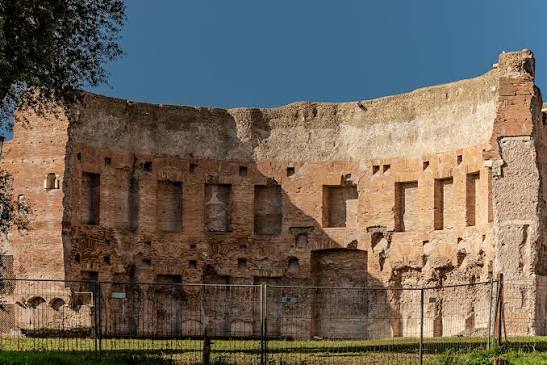
Many international publications have reported on the September 2026 opening in Rome of the new Museum of the Baths of Trajan. Built on the Oppian Hill overlooking the Colosseum, the underground museum displays what are believed to be the largest ancient wall mosaic and the largest wall fresco ever discovered from the Roman era. These are truly amazing archaeological discoveries. But first, let’s look at the back story.
During the 1990s, archaeologists began exploring beneath the Baths of Trajan in Rome for two primary reasons: to search for the remains of Emperor Nero’s legendary Domus Aurea (Golden House) and to understand the complex engineering behind the Trajan Baths’ architecture. They did indeed uncover structural infrastructure, including massive lead pipes believed to deliver water to the baths from aqueducts and stamped with Emperor Trajan’s name.
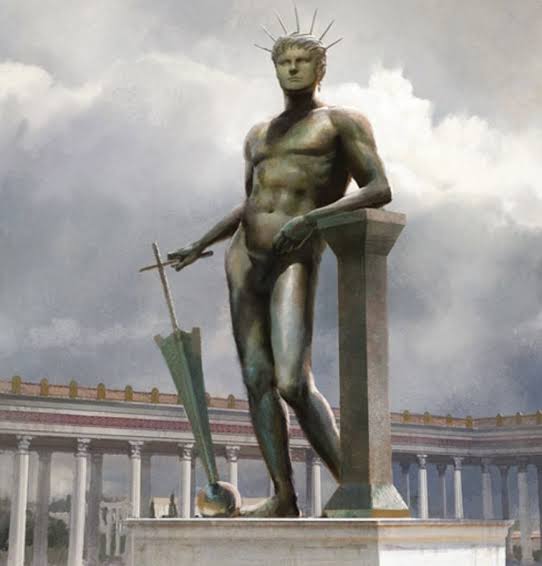
They also uncovered parts of the Domus Aurea, which was a vast complex that included Nero’s ultra-luxurious palace that he created after the Great Fire of 64 CE. He had seized huge portions of the burned city—including massive areas of public land—to build a private pleasure palace for himself. Gold everywhere: The interior and exterior walls were heavily gilded, rooms were encrusted in precious stones, and the entryway featured a 120-foot-tall bronze statue of Nero himself as the sun god, Sol. Sound familiar?
Then (and now), the public was outraged at the self-indulgent, megalomaniac tyrant. Decades after Nero, Emperor Trajan built in 109 CE a massive public bath complex over the Domus Aurea, covering about 15 acres (80,000 square meters), which included bathing and athletic facilities and libraries; it was the first Roman bath to create an outdoor park for people to use. The Domus Aurea complex was filled in with dirt and served as the foundation of the Trajan Baths. The Romans wanted to erase all traces of the hated emperor and give the land back to the people.
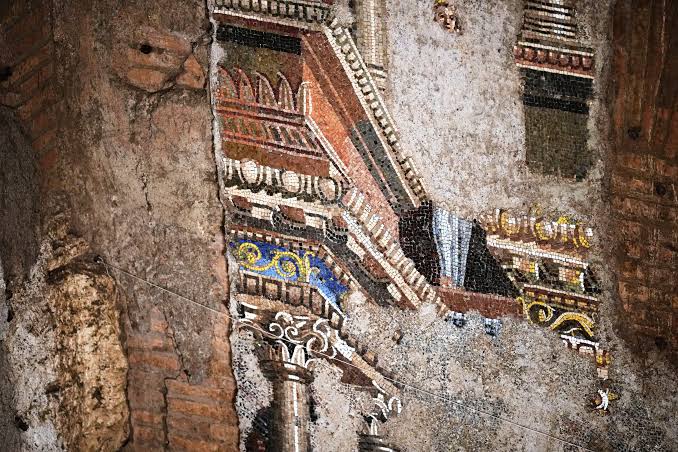
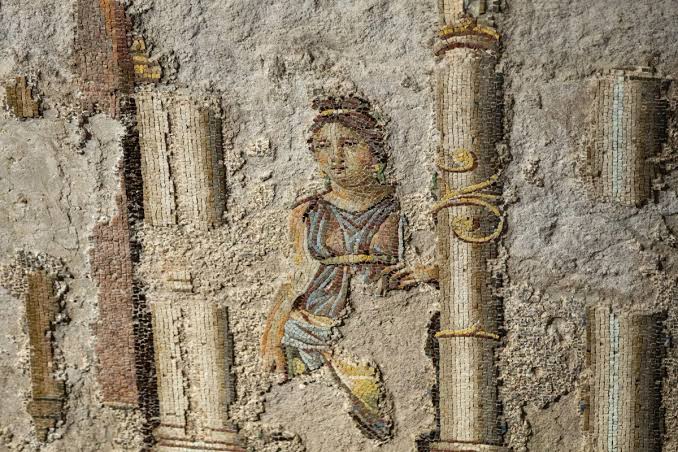
Ironically, by burying the Domus Aurea complex and sealing it in darkness, Trajan’s engineers preserved Nero’s rooms and art, allowing modern-day archaeologists to begin to uncover the past. The Muse and the Philosopher, the wall mosaic in the museum, measures 33’ tall and 52.5’ wide (10 meters by 16 meters) and depicts a theatrical background with columns, walls with inlaid marble, figures and statues of muses, centaurs, a poet and a bearded philosopher. Some tesserae—the cubes of stone, ceramic, and glass used to construct the mosaic—are missing; they may have been used or repurposed in the construction of the baths.
More recent excavations reveal a new section: a view of maritime villas on a Roman port. It is not yet known whether it represents an actual port or an imaginary one.
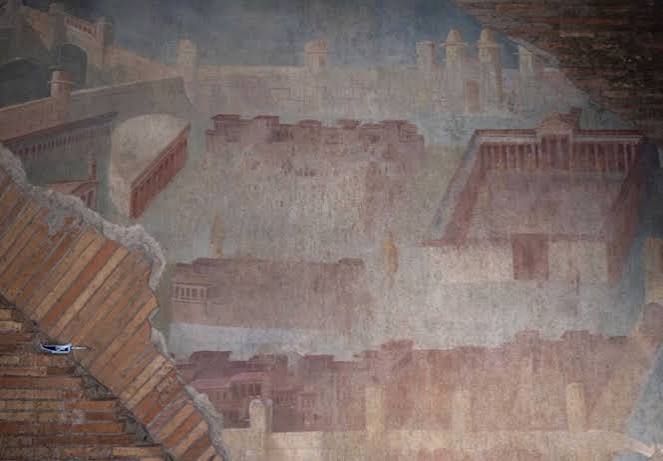
The Painted City is a wall fresco in the same structure. It shows a view of a city encircled by walls and towers. The town is complete with a theatre and a temple topped by a statue of Apollo. Included is a residential neighborhood of “insulae,” which are ancient Roman blocks of flats. The buildings are painted in perspective.
It is not known yet whether the mosaic and the fresco came from Nero’s Domus Aurea or a luxury residence in the complex. Digging continues.


