
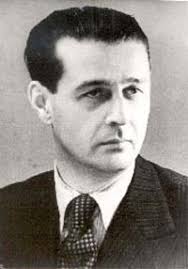
 Giorgio Perlasca was one of Europe’s great unsung heroes. He saved thousands of Jews from the Nazi gas chambers through his bravery, cunning, charm, and persistence. And he risked his own life at every turn in this story.
Perlasca’s early life gives no clue as to his future role. In fact, it suggests that he might have taken quite the opposite path. Born in Como in 1910, as a teen in Padua he became enamored by Gabriele D’Annunzio, whose ideas and beliefs influenced fascism and Benito Mussolini. He volunteered to fight in one of Mussolini’s wars of conquest in 1935 and, then, as a fascist volunteer, to fight for Franco in the Spanish Civil War.
But when he returned to Italy, Perlasca became quite disillusioned with Mussolini. He detested Italy’s alignment with Nazi Germany and abhorred the Italian race laws against the Jews. At the outbreak of World War II, he managed to avoid military service by working as a livestock agent procuring meat and supplies for the Italian army. He travelled widely in Eastern Europe, first in Zagreb and Belgrade, where he saw massacres of Jews, Serbs, and other minorities.
Then in 1942 he was sent to Budapest. As a tall, handsome man, he used his charm and negotiating skills to make good business deals for the Italians. And he enjoyed the theatre and restaurant life of the city, often in the company of his Jewish friends. But things changed in 1943 with the fall of Mussolini. Perlasca was imprisoned as an enemy alien near the Austrian border. Three months later he escaped, returned to Budapest, and immediately went to the Spanish embassy for protection. As a former pro-Franco soldier, he was given Spanish citizenship, a passport, and a new name—Jorge. Outside the embassy he noticed thousands of people milling around. He was told they were Jews pleading for “letters of protection,” which Spain and other neutral governments issued to protect Jews from deportation to the gas chambers. The Spanish embassy couldn’t keep up with the requests, so Perlasca volunteered to help. He made key contacts with Nazi officials—bribing, blackmailing, and charming them into helping him, or at least not interfering with his activities.
Then in 1944 with the Russians approaching Budapest, the Spanish consulate fled to Switzerland leaving behind empty offices, but also the embassy seal. Perlasca brazenly convinced Hungarian authorities that he was the new Spanish ambassador. Then he set to work not only stamping letters of protection with the embassy seal, but also housing the Jews in eight rented apartment blocks where he flew the Spanish flag. The bluff worked. But he had to patrol the houses day and night to make sure that bands of Hungarian Nazis did not break in and murder the protected people.
Daily executions on the banks of the Danube meant that only a quarter of Hungary’s 800,000 Jews survived the war. At the end of 1944, the Ministry of the Interior decided to move all Jews from the Consular apartments to the ghetto and then set fire to it. Perlasca rushed to the Minister to beg him to stop. When humanitarian arguments fell on deaf ears, he switched to threats. He warned that if the Spanish government was not assured that the Jews under its protection would not be harmed, all Hungarians in Spain would be imprisoned and their property confiscated. He even added that the Brazilian and Uruguayan governments would do the same. The Minister’s plans were abandoned.
Perlasca had many other close calls. Once when he was removing twin adolescents from a train bound for Auschwitz, an SS officer pointed a pistol at him. The heroic Swedish diplomat Raoul Wallenberg, who was standing nearby, shouted that he could not treat a Spanish diplomat like that. Then a more senior SS official arrived and asked what was happening. He told the young officer to do nothing more because “sooner or later we’ll get the children anyway.” This officer was the notorious Adolf Eichmann.
When Soviet troops entered Budapest in January 1945, the Jews were finally able to leave the apartments. The Russians forced Perlasca to work as a street cleaner. Soon thereafter, he was able to go to Istanbul and then back to Italy. Despite his negotiating skills, few people back home believed his story, including his wife. So he simply stopped talking about it and faded into obscurity…that is, until a group of Hungarian Jewish women recalled the nightmare of wartime Budapest at a family gathering in Berlin in 1986. “Do you remember that Spanish consul?”


Vad Vashem Museum in Jerusalem
They eventually found him in Padua, and the recognitions began. Perlasca had saved the lives of at least 5,500 Jews, more than four times the number that the heralded Oskar Schindler saved. Perlasca was awarded medals and decorations from Italian, Spanish, Hungarian, American, and Israeli governments for his courage and actions. A bust of him stands proudly in Budapest. But Perlasca downplayed his heroism to the end (he died in 1992) claiming that he had done nothing more than tell a lot of lies.
 Un idioma in inglese, “pie in the sky / torta nel cielo” si riferisce ad una situazione piacevole da immaginare ma che è irraggiungibile o poco pratica. È anche lo slogan per una campagna di marketing di JetBlue, una compagnia aerea con sede a New York. Potrebbe essere un idioma adatto alla campagna.
 La compagnia aerea ha collaborato con un ristorante iconico di New York, Patsy’s Pizzeria, per far volare le pizze dal JFK al LAX. Per tre giorni a maggio nel 2018, il corriere ha offerto a 350 persone al giorno a Los Angeles l’opportunità di ricevere una pizza al formaggio da 16” per $12 o una pizza al salame piccante per $15 dall’istituto di East Harlem. JetBlue ha coperto tasse, costi di consegna e mance.
 Patsy’s servì pizze cotte a carbone da quando gli immigrati italiani Pasquale “Patsy” Lancieri e la moglie Carmela aprirono la pizzeria nel 1933. (Vedete il post, La storia della pizza in America, del primo settembre 2016.) Patsy’s è nella Pizza Hall of Fame. JetBlue ha
 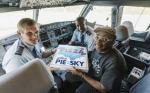 realizzato un video introduttivo con Spike Lee accanto all’attuale proprietario a Patsy’s, Frank Brija, per educare gli spettatori alla corretta maniera di mangiare la pizza di New York: usare le mani al posto degli utensili, piegare la fetta a metà, e condividerla con un amico.
 Dato che Santa Barbara è fuori dall’area di consegna di “Pie in the Sky”, un giornalista locale ha effettuato l’ordine online e si è diretto a sud verso un albergo a Los Angeles per ricevere la sua pizza al formaggio. Il tempo di consegna originale era dalle 19
  alle 22 ore, che è stata successivamente aggiornata tra le 20 e le 21 ore. Circa alle 21:10, è arrivata la pizza, ma una era al salame piccante e faceva freddo e la crosta era molliccia. Mezz’ora più tardi è arrivata un nuovo cartone di pizza, ed è emersa un’autentica e calda pizza al formaggio newyorkese: la salsa di pomodoro era leggera, il formaggio era ben rosolato in alcuni punti, e la crosta fatta a mano era croccante e gommosa, perfetta da piegare.
 Sky” di JetBlue potrebbe essere un buon esempio di “la torta nel cielo”, le persone sui social media stanno offrendo idee di consegna di altri icone favorite di New York, tra cui la cheesecake. In cima alla lista ci sono i bagel, il cui segreto è anche l’acqua.
 L'Olivo Santa Barbara