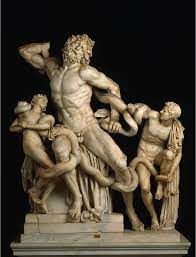
Laocoön and his Sons

One of the most admired works of Hellenistic statuary is The Laocoön Group, an ancient marble sculpture unearthed near Rome in 1506 and on public display at the Vatican Museums.  The figures are nearly life-size, and the group stands 6’7” in height, showing the Trojan priest Laocoön and his sons Antiphantes and Thymbraeus being attacked by sea serpents.  With its struggling and straining bodies and contorted facial expressions, the statue exemplifies human agony and sublime tragedy.

Pliny the Elder, a foremost Roman author on art among other accomplishments, praised the work highly, which he attributed to three Greek sculptors from Rhodes– Agesander, Athenodoros and Polydorus– but he does not give a date or a patron.  It is not known today whether The Laocoön Group is an original work or is a copy of an earlier bronze sculpture.  Various dates have been suggested, but most scholars think it was created between 27 BC and 68 AD.

The story of Laocoön comes from Greek poems on the Trojan Wars, but the events around the attack by the serpents vary considerably.  The story is not mentioned by Homer at all; it had been the subject of a tragedy by Sophocles, which is now lost.  The most famous account is in Virgil’s Aeneid.

In Virgil, Laocoön was Poseidon’s priest who was killed with both his sons after attempting to expose the ruse of the Trojan Horse.  In Sophocles, he was Apollo’s priest who should have been celibate but had married.  The serpents killed the sons but spared Laocoön so that he would continue to suffer.  In other versions, he was killed for having had sex with his wife in the temple of Poseidon, and the snakes were sent by Poseidon.  In the former versions, the snakes were sent either by Poseidon and Athena, or by Apollo; the Trojans interpreted the deaths as proof that the horse was a sacred object.  The interpretations are different:  Either Laocoön was punished for doing wrong, or for being right.

It is interesting to note that the two snakes depicted in the sculpture are both biting and constricting; they are probably intended to be venomous, as told by Virgil.  They produce different effects on the three figures: the youth embraced in the coils is fearful, the father struck by the fangs is in torment, and the son who received the poison is dying.  In one Greek account of the story, the older son on the right is able to escape, and the composition seems to allow for that possibility.

The Laocoön Group had a profound influence on Michelangelo and countless other artists who followed.  Michelangelo was impressed by the massive scale of the work and by its sensuous aesthetic.  Its influence can be seen in his sculptures, the Rebellious Slave and the Dying Slave, which were created for the tomb of Pope Julius II, and on figures in the Sistine Chapel ceiling.  Raphael used the face of Laocoön for his depiction of Homer in his Parnassus fresco in the Vatican’s Raphael Rooms, expressing blindness rather than pain.  Titian and Rubens also drew inspiration from the sculpture.
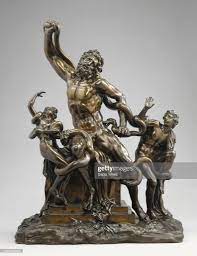
During the Baroque period in Florence in the 1700s, there was an intense interest in small bronze copies of famous antiquities.  Giovanni Battista Foggini (1652 – 1725), an artist renowned for small bronze statuary, created a bronze replica of Laocoön and his Sons, at least one of which is on display at the Getty Museum in Los Angeles.

Among the unknowns about the origin of this statue is its patron.  Art historians think it was probably commissioned for the home of a wealthy Roman, possibly of the Imperial family.  For the Romans, the subject held a special meaning: the divine punishment meted out to Laocoön and his sons forewarned Aeneas of the fall of Troy and, according to the myth, caused him to flee the city.  Since Aeneas was believed to have come to Italy and to have been the ancestor of Romulus and Remus, the death of Laocoön could be seen as the first link in the chain of events that led to the founding of Rome.
Posted in Animali, Arte, English, Firenze, Foto, Italia, Libri, Roma, Storia, Vaticano | Leave a comment

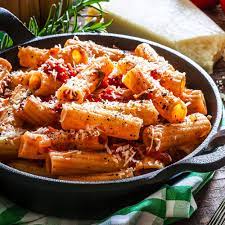
Un classico romano: “rigatoni alla zozzona”

Oltre a classici come carciofi e saltimbocca, i piatti forti della cucina romana sono questi primi: gli spaghetti alla carbonara, i bucatini all’amatriciana, e i tonnarelli cacio e pepe. Non altrettanto conosciuti fuori dall’Italia sono la pasta alla gricia, che è come quella all’amatriciana senza pomodori, e le fettuccine alla papalina cremosa con prosciutto.  Tra i grandi primi troviamo anche i rigatoni alla zozzona, con ingredienti classici – pomodoro, guanciale, tuorli d’uovo, pecorino romano – più salsiccia.

Mescolati insieme, questi ingredienti creano un piatto robusto, per così dire “zozzo”, che in dialetto romano significa “pieno di un sacco di cose buone, gustose e grasse”. Come tutta la cucina tradizionale romana e laziale, la pasta alla zozzona è ricca e sostanziosa. Si fonda su ingredienti naturali prodotti nelle campagne circostanti e sulla credenza popolare che le porzioni debbano essere sufficientemente abbondanti per sfamare le persone che un tempo lavoravano nei campi.

Raramente i rigatoni alla zozzona si trovano nei menù dei ristoranti romani alla moda. È più un piatto tipico delle trattorie di Trastevere o nelle fraschette nei Castelli Romani a sud est di Roma. Le fraschette in origine erano osterie dove si andava a bere vino nuovo; servivano solo vino o al massimo accompagnato da pane e formaggio. A volte i clienti portavano il proprio cibo. Nel tempo, davanti alle fraschette, sono nate bancarelle di generi alimentari. Oggi, le fraschette sono più ristoranti, che servono piatti della tradizione romana come la porchetta, grigliate di maiale locale e piatti di pasta come i rigatoni alla zozzona.

Ecco una ricetta per questa pasta dal New York Times. Alcune varianti richiedono passata o pomodori pelati al posto dei pomodorini; quasi tutti prevedono la pancetta al posto del guanciale, che è a volte difficile da trovare negli Stati Uniti.

Rigatoni alla zozzona

Sale marino

454 g di rigatoni grandi

2 cucchiaini di olio extravergine di oliva

114 g di guanciale (o pancetta), tagliato a fiammiferi da 2 pollici

1 cipolla tritata

454 g di salsicce italiane dolci, senza budello

2 cucchiai di concentrato di pomodoro

340 g di pomodorini

1 bicchiere di vino rosso

4 tuorli d’uovo

4 cucchiai di pecorino romano grattugiato, più altro a piacere

1 cucchiaino di pepe nero appena macinato

1. Portare a bollare una pentola capiente di acqua salata. Quando l’acqua avrà raggiunto il bollore, cuocete la pasta secondo le indicazioni sulla confezione, se si preferisce al dente. Conservare ¼ tazza di acqua della pasta, quindi scolare la pasta.

2. Nel frattempo, preparare il sugo: aggiungere l’olio d’oliva in una padella ampia e profonda e scaldare a fuoco medio-basso. Aggiungere il guanciale in uno strato uniforme e cuocere, mescolando di tanto in tanto, fino a quando il grasso non si sarà sciolto e le strisce iniziano a diventare croccanti, circa 5 minuti. Utilizzando un mestolo forato, togliere il guanciale e metterlo da parte in un piattino. Trasferire l’olio della padella in una piccola ciotola, lasciandone circa 1 cucchiaio nella padella.

3. Aumentare il fuoco a medio-alto e aggiunger la cipolla nella padella nell’olio di cottura, lasciandola ammorbidire, per circa 1 minuto. Aggiungere la salsiccia spezzettata, sale (opzionale) e cuocere il tutto. Cuocere, mescolando di tanto in tanto, finché la salsiccia non sarà dorata, circa 5 minuti.

4. Unire il concentrato di pomodoro, poi i pomodorini. Abbassare il fuoco a medio e sfumare con il vino. Coprite il sugo con un coperchio e far cuocere per 5 minuti.

5. Togliete il coperchio e, aiutandovi con il dorso di un cucchiaio, frantumare i pomodori e incorporarli nella salsa. Lasciare cuocere il sugo, senza coperchio, per altri 5 minuti.

6. In una ciotolina, unire i tuorli d’uovo, ¼ di tazza di formaggio, il pepe e 1 cucchiaio di guanciale sgocciolato.

7. Aggiungere la pasta e il guanciale al sugo bollente e mescolare, poi ricoprire.

8. Mescolare 2 cucchiai di acqua per la pasta nel composto di uova. Spegnere il fuoco e unire il composto di uova alla pasta fino a quando non sarà ricoperta e lucida, aggiungendo se necessario 2 cucchiai di acqua per la pasta. Trasferite la pasta in un piatto da portata e guarnite con altro formaggio, se lo desiderate.

Buon Appetito!

Posted in Cucina italiana, Foto, Italia, Italiano, Roma | Leave a comment

A Roman Classic: Rigatoni alla Zozzona

Besides such classics as artichokes and saltimbocca, the cornerstones of Roman cuisine are these pasta dishes: gli spaghetti alla carbonara, i bucatini all ‘amatriciana, and i tonnarelli cacio e pepe.  Not as well known outside of Italy are pasta alla gricia, which is like amatriciana without tomatoes, and creamy pasta alla papalina with ham.  Also in this group is rigatoni alla zozzona, which combines ingredients from the three principal classic dishes—tomatoes, guanciale, egg yolks, and Pecorino Romano cheese—plus sausage.

Mixed together, these ingredients create a robust dish that is “zozzo,” which literally means “dirty,” in Italian, but in Roman dialect means “full of good, tasty and fatty things”  Like traditional cuisine in Rome and the rest of Lazio, rigatoni alla zozzona is filling and hearty.  It is based on ingredients produced in the surrounding countryside and on the popular belief that serving sizes need to be abundant enough to feed people who once worked in the fields.

It is unlikely that rigatoni alla zozzona will be found on the menus of high-end Roman restaurants.  It is more typical fare in the trattorias of Trastevere or in the fraschette in the Castelli Romani area southeast of Rome.  Fraschette originally were taverns where people went to try new wines; lacking kitchens, they served only wines, and possibly bread and cheese.  Sometimes customers brought their own food.  Over time, stands selling food sprung up in front of the fraschette.  Today, fraschette operate more like restaurants that serve traditional Roman fare like porchetta, a local roast pork, and pasta dishes like rigatoni alla zozzona.

Here is a recipe for this pasta from the New York Times.  Some variations call for passata or peeled tomatoes instead of cherry tomatoes; almost all allow for pancetta in place of guanciale, which is sometimes difficult to find in the United States.

Rigatoni alla Zozzona

  •  Kosher salt
  • 1 pound large rigatoni
  • 2 teaspoons extra-virgin olive oil 
  • 4 ounces guanciale (or pancetta), cut into 2-inch matchsticks
  • 1 small yellow onion, minced
  • 1 pound hot or sweet Italian sausages (about 4 to 5 sausages), casings removed 
  • 2 tablespoons tomato paste
  • 3 cups cherry tomatoes (about 12 ounces)
  • 1 cup red wine
  • 4 egg yolks
  • ¼ cup grated Pecorino Romano, plus more to taste
  • 1 teaspoon freshly cracked black pepper
  1. Bring a large pot of salted water to boil. Once the water comes to a boil, cook the pasta according to package directions until al dente. Reserve ¼ cup of pasta water, then drain pasta. 
  2. Meanwhile, prepare the sauce: Add the olive oil to a deep, large skillet and heat over medium-low. Add the guanciale in an even layer and cook, stirring occasionally, until the fat renders and the strips start to crisp, about 5 minutes. Using a slotted spoon, remove guanciale to a small dish and set aside. Transfer the pan drippings to a small bowl, leaving about 1 tablespoon in the skillet.
  3. Increase heat to medium-high and stir the onion into the pan drippings, allowing it to soften, about 1 minute. Add the sausage and 1 teaspoon salt (optional) and break up the meat into small pieces. Cook, stirring occasionally, until the sausage has browned, about 5 minutes.
  4. Stir in the tomato paste, then the cherry tomatoes. Decrease heat to medium and stir in the wine. Cover the sauce with a lid and cook for 5 minutes. 
  5. Remove the lid and, using the back of a spoon, break up the tomatoes and incorporate them into the sauce. Allow the sauce to cook, uncovered, for 5 more minutes.
  6. In a small bowl, combine the egg yolks, ¼ cup cheese, the pepper and 1 tablespoon of the reserved guanciale drippings.
  7. Add the pasta and guanciale to the simmering sauce and stir to coat. 
  8. Stir 2 tablespoons of the pasta water into the egg mixture. Turn off the heat and stir the egg mixture into the pasta until coated and glossy, adding 2 tablespoons more pasta water if needed. Transfer the pasta to a serving dish and top with additional cheese, if desired.
Posted in Cucina italiana, English, Formaggio, Foto, Italia, Roma | Leave a comment