
 Every year at the end of September, in the streets and pizzas of centro storico of Bronte, the Fair of the Pistachio is celebrated. Bronte is one of the 3 towns on the western slope of Mount Etna in Sicily where the finest pistachios in the world are grown.
The pistachio of Bronte DOP (Europe’s Protected Designation of Origin) has been famous throughout the world since antiquity  for its sweet and delicate flavor, its aromatic scent, and its intense green color. Bronte and its two neighboring towns (Atrano and Biancavilla) produce only about 1% of the world’s pistachios, which has led to illegal selling of pistachios from other countries as originally coming from Bronte. While 80% of Sicily’s production is exported, the rest is used in many Italian products, ranging from sausage to pasta, from cakes to nougats, from cheeses to biscuits. The Brontese pistachio gelato is one of the most appreciated in the world.
The story of the harvest is very much tied to the culture and traditions of the area, which have been handed down father to son, mother to daughter, for centuries. And it is also the story of the land that both survives the volcano and takes advantage of its fertility, and of the ever-unpredictable climate.
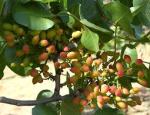 The harvest occurs every two years to preserve the quality of the fruit and to avoid excessive exploitation of the plants that are already under stress from, among other things, the frequent periods of drought in the Sicilian summers. In the alternate years, the trees are pruned cutting “the eyes,” that is, the buds from the branches that grow the shoots. This guarantees a consistent quality production the following year.
Before machines everything was done by hand, and even now, there are few machines used in the harvest. The trees grow close to each other clinging to the igneous rock on land  that machinery can barely penetrate. Scissors and hatchets are used to remove the dry branches that no longer produce fruit; the branches must then be burned immediately to avoid being attacked by a parasite that can threaten the entire cultivation. To facilitate the harvest and to minimize the loss of fruit, black tarps are spread out under the trees. Workers wear gloves to protect themselves from the stain of the resin. For the fruit clusters that grow high in the trees, they use a so-called ferra, a stick that is made from a wild fennel plant. Being soft, it is the only instrument that can be used to strike the branches without ruining them, and at the same time, make the mature pistachios fall to the ground.
After the daily harvest, the nuts are loaded in sacks destined for the smallatura, a simple  machine that every Brontese family has for removing the husk that covers the shell. Then the nuts must be immediately exposed to the sun to promote drying. Every country house in Bronte is equipped in front with a terrace—not for the people to lounge on, but, in fact to dry the pistachios.
Every Brontese family also knows that the danger to their crops comes from the sky. In the past, before weather instruments and when roles were gender-based, the grandmothers stayed home to manage the daily operations (including the collection and drying of the nuts on the terrace). They learned to “read” the sky and the clouds. As soon as they saw bad weather approaching from the west, they called together the women of the family to collect all the pistachios on the terrace before the rains drenched them.
The harvest is a perpetual struggle—against drought, rains, and parasites—but what’s at stake is the income of many families who base their lives on this fruit. Two years ago,  Bronte produced an exceptional crop, but this year hail came in the middle of May, at the worst possible time when the fruit was small and needed to mature. There is another tradition rooted in the Brontese culture that even today is passed down from parents to children. It is the ancient popular belief according to which eating too many pistachios brings on the fever. Even today, the older folks tell this to the children to dissuade them from eating too many during the harvest and therefore to preserve as much of their precious crop as possible.


