Dogs are an invaluable asset in rescue efforts—whether it’s an avalanche in Rigopiano, an earthquake in Amatrice, the hurricane in Houston, or the mudslides of Montecito. Both Italy and the United States have had their share of disasters recently, and
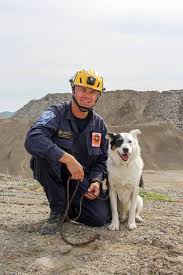
 photos of search and rescue efforts often depict dogs alongside first responders looking for survivors and later, sadly, for cadavers.
The National School of Volpiano outside of Turin trains dog units for Italy. It began 20 years ago to carry on a discipline that began  in 1941 to find victims from the bombing during the war. There are currently 103 operating units in the country, but must grow to 186 according to the reorganization plan of the National Corps. The United States has many training facilities but I will focus on the one in Santa Paula, California, called the National Disaster Search Dog Foundation (SDF). There are similarities and differences between the Italian and American facilities.
First, both agree that any dog can become a rescue dog. While German Shepherds, Labradors, Golden Retrievers, and Border Collies are quite common, any dog including  mixed breeds are eligible because all dogs have the same olfactory capacity. Dogs are trained to find drugs and bombs in airports, and even a beagle sniffed our day-old pizza that we had forgotten in our luggage on a return trip from Italy. (We were investigated by the Department of Agriculture to see if we had also brought in a slab of prosciutto.)
Dogs have 300 million olfactory receptors versus 6 million in humans. The part of the 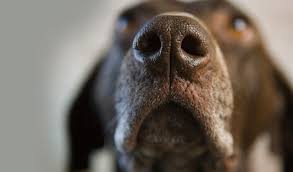 brain devoted to analyzing smells is 40 times greater than ours. Hence, a dog’s sense of smell is between 10,000 and 100,000 times more acute. Let’s say it’s only 10,000 times better. If you make the comparison to vision, then what we can see at a 1/3 mile away, a dog could see more than 3,000 miles away—that’s clear across the United States.
Both training facilities agree that the dogs must possess important physical and psychological characteristics. They must be of medium size to be able to move with ease. They must be sociable, curious, motivated, and above all, have an excellent rapport with their human companions / trainers. Throughout training and searches, they cannot be distracted – by the smell of another animal or by food. They learn to search in all types of terrain—from mountains to woods, and through rubble, mud, and debris—often in extreme conditions.
In Italy, firefighters who choose this field come to the school with their dogs, who must be between 6 and 18 months old. Training lasts 9 months and there are 5 exams along the way. The training is rigorous, the selection is extremely hard. Even at the last stage, a dog could be sent home without its certificate.
SDF is a nonprofit that rescues shelter dogs and trains them for search and rescue work.  The organization then provides them free of charge to handlers at fire departments and other first-response agencies. The firefighters spend hours every day with their dogs, bonding and training. The dog recruits at SDF are often mutts whose focus, energy, and manic obsession with toys make them terrible pets. Trainers harness that focus, using it as a tool to reward search dogs for successful work. The toys are usually very rugged chew toys, made of old fire hoses encased in thick material.
When dogs pick up the scent of a live person, they get as close as they can and then bark nonstop. Their handlers mark the spot, and rescue workers then begin excavation. While Italian dogs are rewarded with a simple “Bravo” or “Brava,” the dogs trained in Santa Paula are rewarded with toys and play, as odd as it sounds. Food is only used as a reward for “cadaver dogs.” For both schools, if a dog does not smell anyone alive in an area, it’s almost certain that there is no one to be found. To be certain, a second dog—also trained specifically to detect only living survivors—checks the same area.
In Italy dog-human units arrive for training from every region of Italy. Then they return  to their respective regional operational units where they work until they converge together at the site of an earthquake or other
  major disaster. In Montecito, California, 39 dogs were assigned to the nightmare and about half had been trained at the Santa Paula training facility, which itself suffered damage from the preceding Thomas Fire.
Dogs can get injured in these dangerous assignments. Soon after the January 9 mudslide, 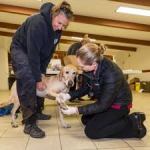 volunteer veterinarians arrived at the Incident Command base camp to help dogs before and after they sniffed through thick mud, toxic debris, and huge boulders at the disaster sites. After their long shifts, dogs first received a bath. Then vets examined them and, when needed, cleaned wounds, performed minor surgeries, and treated them for soreness and strains. Probably afterwards, a hearty meal.
Our heartfelt appreciation to these amazing canines…and their human companions.
 Le notizie sono arrivate da molto lontano—dall’isola di Jeju in Corea del Sud—tardi il 6 dicembre del 2017. La Pizza Napoletana è entrata nella lista del patrimonio immateriale dell’Unesco. Le folle si sono radunate lungo Via dei Tribunali, la storica arteria della pizza di Napoli, per celebrare: “Abbiamo vinto!” “Il mondo riconosce la nostra arte”!
 ma anche il suo valore sociale. Diventare un pizzaiuolo è divenuto un percorso che ha permesso di uscire dalla povertà per decenni e decenni. Un mestiere umile solo in apparenza, fare la pizza è un’arte che si può imparare senza andare all’università o senza spendere denaro. Richiede talento e creatività – non solo per mettere in mostra le capacità del pizzaiuolo, ma anche per unirle alla storia, alle tradizioni e
  all’anima del territorio. Mentre ci sono scuole e accademie per insegnare l’arte, “le conoscenze e le abilità vengono trasmesse principalmente nella bottega, dove i giovani apprendisti osservano i maestri al lavoro, imparando tutte le fasi chiave e gli strumenti del mestiere”.
 pizzaioli, ma anche i più grandi mangiatori di pizza: 15 libbre ( 6.604 grammi) vengono consumate in media da ogni italiano ogni anno; non sorprendentemente, in media 25 libbre (11.340 grammi) vengono consumate per persona ogni anno negli Stati Uniti. Ciò che anche non sorprende è che molti americani siano stati tra i 2 milioni di persone che hanno sostenuto la candidatura dell’Italia al premio Unesco, la campagna Unesco più sostenuta nella storia.
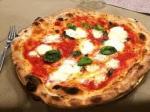
 dicembre 2017, le pizzerie di Napoli hanno aperto presto per iniziare la cottura. I tavoli erano apparecchiati per le strade e la pizza era servita a colazione – per lo più la Margherita, la più napoletana di tutte le pizze, profumata e colorata, semplice e squisita, e degna di un vero patrimonio di umanità.