Rossini is the most famous _____ in Italy today

Can you guess?

No, nothing to do with music or food, at least not directly.  Rossini is an orange tabby cat who became famous in Rovigo, a city in the Veneto, about 80 kilometers southwest of Venice.  As his reputation spread far and wide, Rossini now must handle his celebrity status and press with a Facebook page and an Instagram profile. He has thousands of followers.

Rossini’s story begins in Bosnia.  As a kitten, he was found among the rubble in a house by an animal rights volunteer and brought to Italy to Rovigo.  He was adopted by Valentina, who lives with her family in the town’s center where he quickly became the town idol, “the cat’s meow,” who is courted and cuddled by authorities, business men and women, and shopkeepers.

What is so special about Rossini (not that every cat isn’t special)?  Is it his regal gait?  Is it because he adores the company of human beings?  Or is it his gypsy spirit that leads him to wander the city from morning to night—from bars to restaurants, to concerts, to town hall meetings, to private homes.? Wherever he goes, he receives the “red carpet” treatment—delicious treats, bowls of water, and welcoming scratches behind the ears.

Photos posted on Instagram document his activities from moment to moment.  Here is Rossini sprawled in the first row to hear a jazz concert.  There he is in the window of the central bookstore resting on the books of Wilbur Smith. And here he is in the arms of the mayor at the town hall council meetings.  (What is not posted is the picture of Rossini making pee-pee in the salon of the Town Hall.)

Rossini at Town Hall

It is rumored that his calendar is crammed fuller than that of the mayor.  Fans write to him from all over Italy: “Ciao Rossini, ti seguo da Roma, sei un amore.”  Hi Rossini, I follow you from Rome, you are a love, writes a Facebook fan.  Io sono di Taranto, ma vorrei venire a Rovigo solo per incontrarti” I am from Taranto (in Puglia), but I would like to come to Rovigo just to meet you, posts another admirer.

Rossini in the Piazza

Everybody loves Rossini…except perhaps the fire fighters of Rovigo, who have lost count of the times they have been called to save Rossini from some inaccessible place —the roof of a palazzo, the top of a church, and even inside a prison.  How he got there nobody knows.  The calls from the citizens to the fire department are at least weekly: “Run, Rossini is blocked in.”  “Hurry, Rossini is in danger.”

Despite a lovely home, Rossini loves big spaces.  The street is his world.  After each scrape, he returns home, purrs for Valentina, and then sets out again for new adventures.
 

Posted in Abitudini, Animali, English, Foto, Italia, Veneto | 3 Comments

Il Vino Italiano

Joel Garbarino è il blogger ospite di questa settimana. È un ingegnere, un amico, e un collega studente d’ italiano a Santa Barbara. I suoi parenti italiani sono liguri e poiché non parlano inglese, ha imparato a parlare italiano. È nel processo, ovviamente, ha imparato a conoscere il cibo e il vino italiano. È appassionato di vino italiano, ha frequentato dei corsi da un sommelier in Italia, e ha viaggiato nella maggior parte delle grandi regioni vinicole in Italia. Ha dato la seguente presentazione  alla Italian Cultural Heritage Foundation di Santa Barbara nell’aprile 2018.  Il suo vino preferito è il Brunello.

Una storia breve del vino italiano

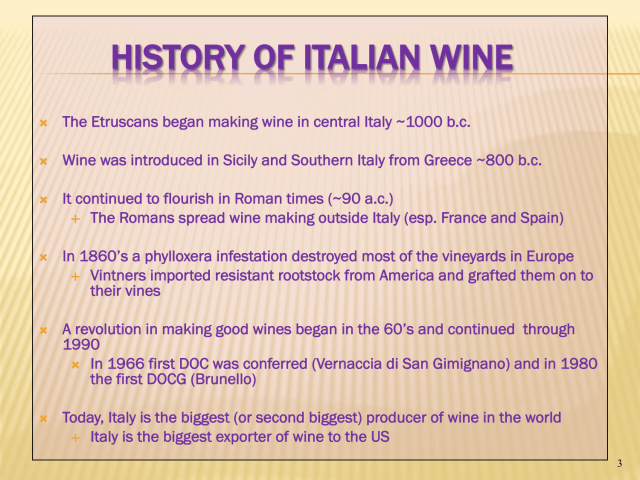
  • Gli Etruschi iniziarono a produrre vino nell’Italia centrale intorno al 1000 a.C.
  • I greci introdussero il vino in Sicilia e nell’Italia meridionale intorno all’800 a.C.
  • La produzione di vino continuò a prosperare in epoca romana, intorno al 90 d.C.
  • I romani diffusero la produzione di vino fuori dall’Italia, in particolare in Francia e in Spagna
  • Nel 1860 una infestazione di fillossera distrusse la maggior parte dei vigneti in Europa ·
  • I viticoltori importarono il portainnesto resistente dall’America e li innestarono sulle loro viti ·
  • Una rivoluzione nella produzione di vini buoni iniziò negli anni ’60 e proseguì fino al 1990 ·
  • Nel 1966 fu conferita la prima DOC (Vernaccia di San Gimignano) e nel 1980 la prima DOCG (Brunello) ·
  • Oggi l’Italia è il più grande (o il secondo più grande) produttore di vino al mondo ·
  • L’Italia è il più grande esportatore di vino negli Stati Uniti  

Il clima e geografia dell’Italia

 L’Italia ha un clima mite

L’Italia ha coste lunghe

L’Italia ha regioni vinicole vicino alla costa

L’Italia ha montagne, vulcani e colline –diversi     terreni per la coltivazione dell’uva da vino

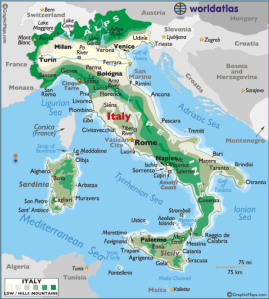
Quindi…l’uva da vino viene coltivata in tutte e 20 regioni d’Italia


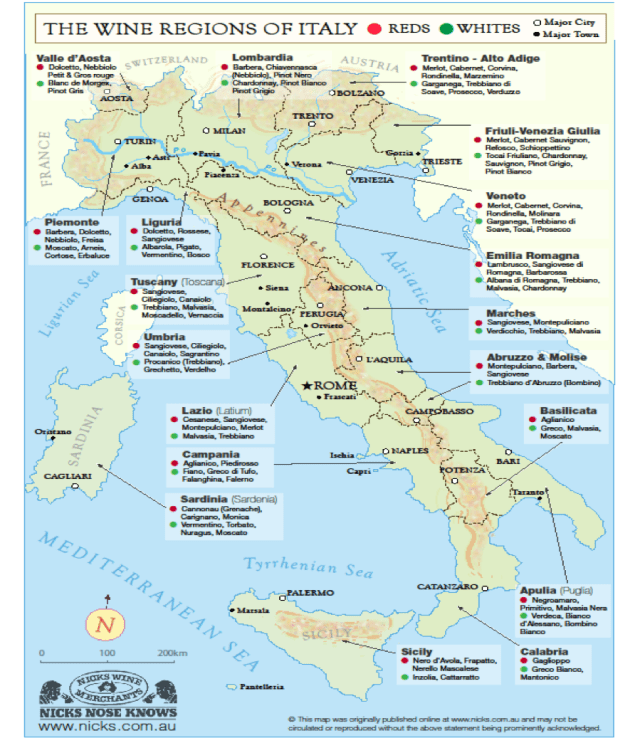
Le regioni vinicole d’Italia

Classificazioni dei vini italiani 

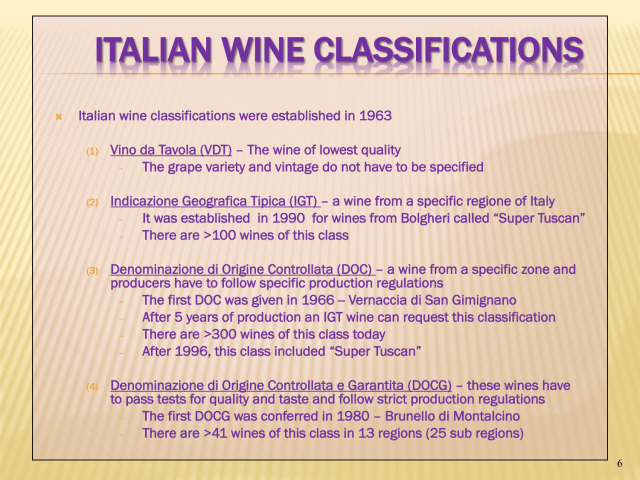
Le classificazioni del vino italiano furono stabilite nel 1963

 Vino da Tavola (VDT) – il vino di bassa qualità; il vitigno e la vendemmia non devono essere specificati

Indicazione Geografica Tipica (IGT) – un vino proveniente da una regione specifica d’Italia. L’IGT nasce nel 1990 per i vini di Bolgheri chiamati “Super Tuscan”. Ci sono più di 100 vini in questa classe

Denominazione di Origine Controllata (DOC) – un vino proveniente da una zona specifica e i suoi produttori devono seguire specifiche norme di produzione

  • La prima DOC fu conferita nel 1966 alla Vernaccia di San Gimignano
  • Dopo 5 anni di produzione, un vino IGT può richiedere questa classificazione
  • Oggi ci sono più di 300 vini in questa classe
  • Dopo il 1996, questa classe includeva “Super Tuscan”

Denominazione di Origine Controllata e Garantita (DOCG) – questi vini devono superare test di qualità e gusto e seguire rigide regole di produzione

  • La prima DOCG è stata conferita nel 1980 – Brunello di Montalcinoo
  • Ci sono più di 41 vini di questa classe in 13 regioni (25 sottoregioni)

I 41 Vini DOCG

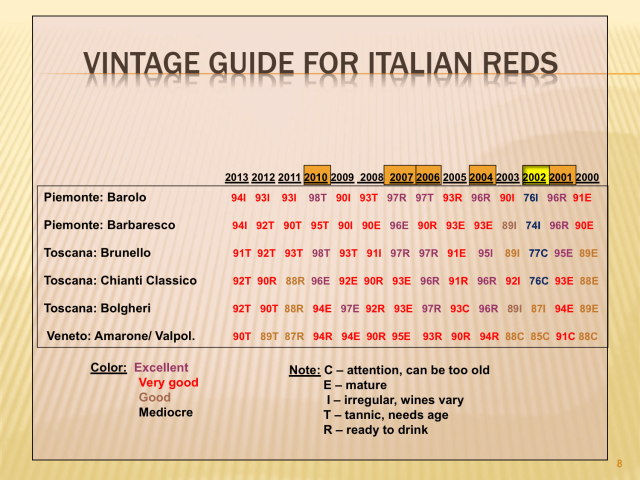
Guida vintage per rossi italiani

Note:  Violetta=Eccellente, Rosso=Molto buono, Oro=Buono, Blu=Mediocre;

C=Attenzione, potrebbe troppo vecchio      E=Maturo    I=Irregolare, i vini variano

T=Tannico, ha bisogno di età      R=Pronto da bere

Regioni vinicole del Piemonte

Regioni vinicole del Veneto

Regioni vinicole del Toscano

I Vini dell’Italia Meridionale

Sommario

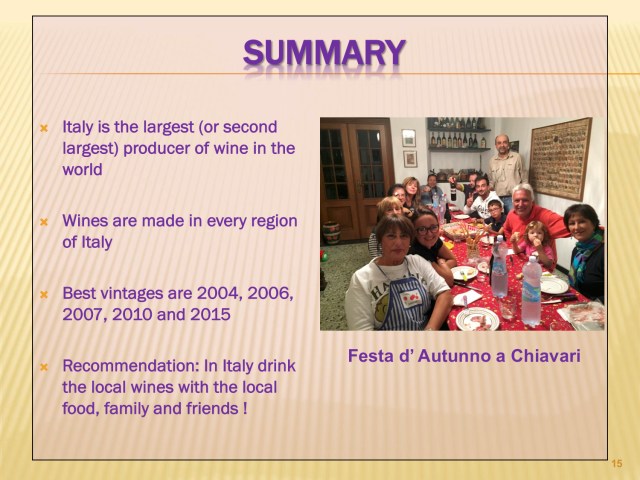
  • L’Italia è il più grande (o il secondo più grande) produttore di vino al mondo
  • I vini sono fatti in ogni regione d’Italia
  • Le migliori annate sono 2004, 2006, 2007, 2010, e 2015
  • Raccomandazione: in Italia bevi i vini locali con il cibo locale, la famiglia e gli amici!


Posted in California, Cucina italiana, English, Foto, Italia, Liguria, Santa Barbara, Uncategorized, Vino | Leave a comment

Italian Wine

Joel Garbarino is this week’s guest blogger.  He is an engineer, a friend, and a fellow Italian student from Santa Barbara.  His Italian relatives are from Liguria and because they do not speak English, he learned to speak Italian.  And, in the process, of course, he learned about Italian food and wine.  He is passionate about Italian wine, has taken courses from a sommelier in Italy, and has traveled to most of the great wine regions in Bel Paese.  The following is a powerpoint presentation he made to the Italian Cultural Heritage Foundation of Santa Barbara in April 2018.  His favorite wine is Brunello.

Notes:  The phylloxera were similar to aphids.  American vines had evolved to have natural defenses.  See later slide for definitions of DOC and DOCG.

Climate and Geography of Italy


Notes:  Italy has the perfect climate and geography for making wine:  plenty of sun, and many hills near the sea (similar to California)

Notes:  Every region makes both red and white wines.  In Piedmont, Barolo and Barbaresco are made from the nebbiolo grape.  In Tuscany, Brunello, Chianti, and Nobile wines are made from the Sangiovese grape.

Note:  You can find the classification on the neck of the bottle

Notes:  There are more than 41 DOCG wines from 13 regions: 27 reds, 13 whites, and 1 rose. The most well-know regions are Piedmont, Tuscany, and the Veneto

Notes: Ratings go from 0 to 100; 96-100 are excellent wines. Good years are 2001, 2004, 2006, 2007, and 2010.  2002 was a poor year.  2014 was a mediocre year because of too much rain.  2015 was an excellent year, perhaps the best in 20 years.

Notes: Near the city of Alba, one finds the famous areas of Barolo and Barbaresco, which are made from the Nebbiolo grape.  Nebbia means fog in Italian. The region can be foggy, reminding one of Napa and Sonoma.  One of my favorite white wines is Gavi.  The most famous producer of Barbaresco is Gaja, a family winery founded in 1869.  In the ’60s and ’70s, they introduced new ideas for vinification:  thinning grapes to increase quality, using grapes from a single vineyard; and using French barrels for the first year of fermentation.  In 1996 Gaja declassified his Barolo and Barbaresco from DOCG by adding 5% Barbera because he wasn’t satisfied with the quality.

Notes: The vineyards of Valpolicella are just north of Verona.  There are three styles of red wines made there with a blend of Corvina, Rondinella and Molinara grapes:  Valpolicella classico (DOC), Recioto or Amarone (DOCG), and Valpolicella Ripasso (DOC).  The most famous producer of Amarone is Quintarelli.  The Veneto (Conegliano) also produces the famous Prosecco.

Notes: Sangiovese grows only in Italy and California.  Sangiovese clones easily, so Chianti is sangiovetto, Brunello is sangiovese grosso, and Nobile is sangiovese prugnolo gentile.  Brunello is named after a stream near Montalcino.  In 1865 at an agricultural fair a red wine called Brunello won 1st prize.  In 1888 Feruccio Biondi-Santi, who fought under Garibaldi, released the 1st modern Brunello.  In the 1960s there were 11 producers; by 1980 when Brunello received the 1st DOCG designation, there were 53.  Today there are more than 100.  Super Tuscan: The Marchese Mario Scisa della Rochetta married the daughter of the family who owned the land around Bolgheri.  In 1945 he decided to make wine and imported rootstock from hi family, the Rothschilds, in France.  In 1968 he introduced Sassicaia to the market.  In 1978 he entered his wine in the famous international wine competition Decatur in London and won 1st prize over the more well-known French wines.

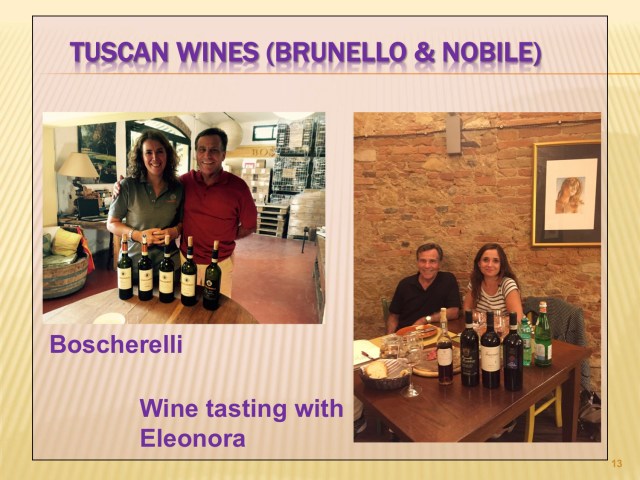
Notes: I was fortunate to study Italian and Italian wines with a lovely language teacher and sommelier, Eleonora Vieri.  The 3 best Nobile producers are Boscherelli, Monte Mecurio, and Poliziano.  Each makes a cru level Nobile that rivals a good Brunello:  Boscherelli’s is called “Nocio,” Monte Mercurio’s “Damo,” and Poliziano’s “Asinone.”  Asino in Italian is donkey or ass, so “Asinone” is a big ass wine!

Wines of Southern Italy

Notes: Puglia has Salice Salentino and Primativo (similar to the zinfandel grape); Basilicata has Aglianico del Vulture, Campania has Greco di Tufo and Taurasi (a big wine called the Barolo of the Mezzogiorno) and Sicily has Nero D’Avola, Marsala, and Moscato.  A Campania family, Mastroberardino, has been making wines since 1878.  During the war, many vineyards in the south were destroyed, and the family helped the government replant and preserve many of the antique varieties (eg, Aglianico, Fiano, Greco, and Piedirosso).  One of the sons is known as the “grape archeologist.”  In 1966 the family started a project called “Viale dei misteri” to recreate the wine of Pompeii using the same grapes and production techniques.  Today the family makes more than 50% of the wine in Campania and 90% of the Taurasi.

Posted in California, Cucina italiana, English, Foto, Italia, Italoamericani, Santa Barbara, Sicilia, Storia, Toscana, Umbria, Uncategorized, Veneto, Vino | 2 Comments