
 “Will no one rid me of this turbulent (or, meddlesome) priest?” This is one of the most famous quotations that has come down to us through oral tradition. Today it is often adapted in modern political life and strife. Although apocryphal, it is originally attributed to King Henry II in his conflict with the Archbishop of Canterbury that ultimately led to the prelate’s murder.
Here is the story and the timeline. In 1162, King Henry II nominated Thomas Becket as the Archbishop of Canterbury assuming he would be compliant in the king’s ongoing 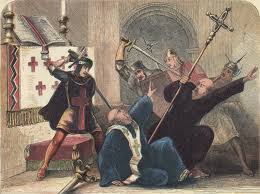 battles with the Catholic Church. But Becket found his calling on the ecclesiastical side and aligned himself against the king’s interests, which included trying to establish jurisdiction of secular courts over the clergy. The conflict escalated, and Becket excommunicated clergy who opposed him. In frustration, the king uttered the apocryphal words that led four of his knights to stab the archbishop in Canterbury Cathedral in 1170.
The crime shook the Catholic Europe of the time. Pope Alexander III proclaimed Becket a saint in 1173, and the cathedral in Canterbury, with its shrine to the martyr, became a 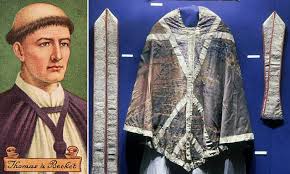 destination for pilgrimages. At the end of the 14thcentury, King Henry VII donated the archbishop’s bloodstained tunic to the Vatican with the aim of ingratiating himself with the pontiff so that he would canonize Henry VI. But then Henry VIII in 1532 proclaimed the schism from Rome. The shrine of Becket in Canterbury was destroyed and the bones of the saint dispersed. But the tunic remained in Rome in the Basilica of Santa Maria Maggiore.
 Today the Church of England is asking Rome to borrow the bloody tunic in preparation for the 850thanniversary of the killing of the archbishop. A series of celebrations is scheduled for 2020, including a large inter-confessional mass between Anglicans and Catholics and an exhibition of objects and relics linked to Becket. A British newspaper has reported that the Basilica is in favor of loaning the relic to England, but the final approval must come from the Vatican’s Minister of Culture.
 The story of King Henry II and Thomas Becket has been a source of extensive artistic and literary inspiration beginning in 1392 with Geoffrey Chaucer’s The Canterbury Tales, a collection of 24 stories about the pilgrims who made their way from Southwark to
  the shrine of St. Thomas Becket in Canterbury Cathedral. In 1884, England’s poet laureate, Alfred, Lord Tennyson wrote his play, Becket,about the famous relationship. Jean Anouilh’s play Becket was written in 1959. More modern adaptations include the 1964 film starring Peter O’Toole and Richard Burton and Ken Follett’s novel The Pillars of the Earth.
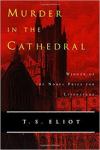 Many interpretations include the supposed rhetorical plea of King Henry II. One that did not was T.S. Eliot’s verse drama Murder in the Cathedral, first performed in 1935. Dealing with an individual’s opposition to authority, the play was written at the time of rising fascism in Central Europe. Eliot drew heavily on the writing of Edward Grim, a clerk and contemporary biographer who was an eyewitness to the event in 1170. According to Grim writing in Latin, the king’s words were “what miserable drones and traitors have I nourished and brought up in my household, who let their lord be treated with such shameful contempt by a low-born cleric?” While this quotation doesn’t have the spin of the one handed down through oral tradition, what does remain as food for thought today is how the thoughtless words of the powerful can arm the hand of fanatics.
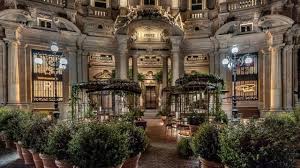
 L’Italia ha bisogno di Starbucks? Sopravvivrà? Il giorno di apertura c’erano persone in attesa almeno da un’ora in una coda che serpeggiava attorno all’edificio. Questa era una novità, un evento che molti italiani attenti alla moda hanno accolto, insieme alle venti tazze – uno status symbol per i giovani che le esibivano mentre passeggiano per la città. Accoglieranno anche bevande americane come il latte speziato alla zucca con salsa di noci di acero?
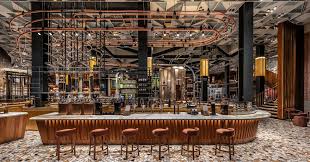 anche il cibo, un’atmosfera rilassata, un luogo di incontro sociale, e il conforto dell’abitudine. Secondo il direttore di Starbucks, la torrefazione offre “un’esperienza” che non compete con i caffè milanesi, che hanno le loro tradizioni e storie. Invece, offrirà servizi tipici di quelli negli Stati Uniti, tra cui la connessione Wi-Fi gratuita e “la possibilità di venire, sedersi, comprare niente, e fare riunioni di lavoro”. I clienti possono anche venire a bersi rapidamente un espresso al bar, il solito approccio italiano.
 L'Olivo Santa Barbara