“We’re all in the same boat”

The starting cannon fired.  The smoke cleared.  Nothing happened.
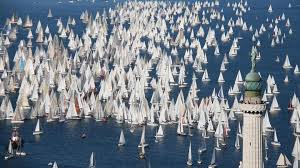
From a distance they resembled a long mountain range of snow-capped peaks.  Up close they were more than 2,600 becalmed sailboats.  Eventually some of the professional crews sailing state-of-the-art ships captured enough puffs of air to move forward.

This was the Barcolana regatta, which takes place every year in the Gulf of Trieste on the second Sunday of October.  By most accounts, it is the largest regatta in the world.  Olympic sailing crews line up side-by-side with boating enthusiasts from all over the world and with many local experts and newbies.
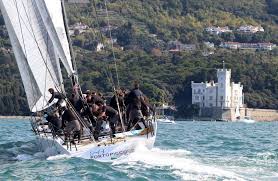
Since the Barcolana was founded in 1969 (with only 51 entrants), sailboats have gathered annually in the gulf near the Miramare Castle, which was built by Archduke Ferdinand Maximilian.  Tradition holds that he was forced to dock here in 1855 by strong gusts of the Bora wind.

Normally, the Bora—named for Boreas, the Greek god of the north wind—howls down from the Julian alps to the Adriatic ocean.  It can blow so fiercely that some sidewalks in Trieste are lined with handrails.  Some years the Bora has broken masts of ships in the regatta.  Other years it has been nonexistent, and some boats couldn’t complete the 15-mile course toward Slovenia and back to the finish line near Trieste’s Unity of Italy piazza.

In Trieste both Italian and Slovene are spoken, along with triestinà, the city’s colorful dialect.  Linguistic multiculturalism extends to its coffee culture.  In the home of Illy, an espresso is a nero, a macchiato is a capo, and a cappuccino is a caffelatte.  But it wasn’t coffee on the minds of the crew this October day as they loaded their ships’ holds with friulano, prosecco and sauvignon.  Knowing the forecast, the question for most wasn’t whether they would celebrate a win, but whether they might win this year’s first trophy for last place.  To pass the time, they drank white wine, sang old Trieste folk songs and swam off the stern of the boat.  One friend on shore even texted, “since there is no wind, at least try and catch some sea bass for tonight.”

From experts to beginners, the sailors were all in the same predicament—to try to win or to try to lose.  The spirit of the race was captured in last year’s official regatta poster—“We’re all in the same boat.”  The theme then and now resonates amid a national crackdown on migrants.  The message of inclusiveness infuriated the anti-migrant League party.


Posted in Abitudini, English, Foto, il Caffé, Immigrazione, Italia, Lo Sport, Politica, Storia, Trieste, Vino | 1 Comment

In prima linea nell’educazione ai cambiamenti climatici

La parola dell’anno 2019 è “emergenza climatica”, secondo l’Oxford English Dictionary. Il termine definisce “una situazione in cui sono necessarie azioni urgenti per ridurre o arrestare i cambiamenti climatici ed evitare danni ambientali potenzialmente irreversibili che ne conseguono”. E l’Italia sta facendo molto a tal riguardo.

Secondo un recente articolo del New York Times, l’Italia è il primo paese al mondo a fare lezioni sul cambiamento climatico nelle scuole. A partire dal 2020 tutti gli studenti seguiranno 33 ore di lezioni sui cambiamenti climatici. Saranno integrate ad altre materie, come la geografia e la fisica, che non saranno più studiate in modo tradizionale. Che senso ha imparare i nomi e le posizioni dei luoghi o studiare la geografia dei laghi e dei fiumi se molti di loro si sono prosciugati o sono scomparsi? Qual è lo scopo di apprendere i nomi e le posizioni dei mari senza comprendere l’impatto dell’inquinamento e lo scioglimento dei ghiacciai sull’ambiente? Milioni di studenti inizieranno a capire cosa significa riscaldamento globale, non solo nella propria vita, ma anche per il resto del mondo.

Il curriculo varierà per età. Per i bambini dai 6 agli 11 anni, afferma il ministro dell’istruzione italiano che “stiamo pensando di utilizzare il modello delle fiabe” in cui storie di culture diverse possono focalizzare l’attenzione sul loro personale legame con l’ambiente. Ci si aspetta che gli studenti delle scuole medie apprendano informazioni più tecniche e quelle scuole superiori esplorino l’Agenda 2030 delle Nazioni Unite per lo Sviluppo Sostenibile.

La scienza ci dice che i prossimi 10 anni sono cruciali. Insegnare ai bambini e agli adolescenti i cambiamenti climatici, si spera, avrà anche il notevole effetto importante di trasmettere tali informazioni ai genitori e, in ultima analisi, di esercitare pressioni sui politici. Troppi politici in Italia e negli Stati Uniti non credono nei cambiamenti climatici o credono che non sia una preoccupazione imminente anche se l’aumento delle temperature è in atto da decenni.

In Italia, il movimento anti-stato Cinque Stelle ha rivendicato preoccupazioni ambientali al centro della propria identità. Ha sostenuto le tasse sullo zucchero e sulla plastica. Ma Matteo Salvini, leader del partito della Lega, ha una visione scettica del cambiamento climatico, sembra ignorare le basi scientifiche e ridicolizza la difesa dell’ambiente. La minaccia a questa nuova iniziativa educativa per insegnare ai bambini i cambiamenti climatici ha portato a un cambiamento nel governo. Non molto tempo fa, un governo di sinistra ha tentato di introdurre programmi educativi per ridurre un certo tipo di disinformazione sul tema in questione, ma i programmi sono stati interrotti non appena il governo è caduto.

Negli Stati Uniti, un recente sondaggio della National Public Radio (NPR) ha scoperto che la maggior parte degli insegnanti non fa lezione sul cambiamento climatico. Tuttavia, l’80% dei genitori lo vorrebbe. Inoltre, il 67% dei repubblicani e il 90% dei democratici (indipendentemente dal fatto che abbiano figli) concordano sul fatto che la materia dovrebbe essere insegnata nelle scuole. Questo è un momento critico, in quanto il presidente Trump sta tirando fuori gli Stati Uniti dall’Accordo di Parigi del 2016, che si occupa delle emissioni di gas serra, tra le altre cose.

Insegnare ai bambini i cambiamenti climatici li aiuterà a comprendere la gravità di ciò che sta accadendo, dalla deforestazione allo scioglimento dei ghiacciai, dagli incendi alle inondazioni. Si spera che diventino futuri sostenitori e leader nel modo in cui verranno gestite risorse preziose, come l’acqua. Come afferma il ministro dell’istruzione italiano, “ogni paese deve fare la propria parte per fermare ‘i Trump del mondo’”.

Lo stesso ha aggiunto inoltre: “Il cittadino del XXI secolo deve essere un cittadino sostenibile”.


Posted in Abitudini, educazione, Italia, Italiano, Politica | Leave a comment

At the forefront of climate change education

The 2019 word of the year is “climate emergency,” according to the Oxford English Dictionary. The term is defined as “a situation in which urgent action is required to reduce or halt climate change and avoid potentially irreversible environmental damage resulting from it.”  And Italy is doing something about it.

According to a recent article in the New York Times, Italy is the first country in the world to teach climate change in schools.  Starting in 2020 all students will take 33 hours of climate change lessons.  They will be integrated into many subjects, such as geography and physics, which will no longer be studied in the traditional way.  What is the point of learning place names and locations or studying the geography of lakes and rivers if many of them have dried up or disappeared?  What is the point of learning the names and locations of the seas without understanding the impact of pollution and the melting of glaciers?  Millions of students will begin to understand what global warming means, not only in their own lives, but also throughout the world.

The curriculum will vary by age range.  For children 6 to 11, Italy’s education minister says, “we are thinking of using the fairy-tale model” in which stories from different cultures would emphasize a connection to the environment.  Middle schoolers would be expected to learn more technical information, and high school students would explore the United Nations’ 2030 Agenda for Sustainable Development.

Science tells us that the next 10 years are crucial.  Teaching children and teenagers about climate change, one hopes, would also have the important effect of passing the information to parents and, ultimately, to putting pressure on the politicians.  Too many politicians in Italy and the United States either don’t believe in climate change or believe it is not an imminent concern even though the rise in temperatures has been underway for decades.

In Italy, the anti-establishment Five Star Movement has claimed environmental concerns at the heart of its identity.  It has supported taxes on sugar and plastic.  But Matteo Salvini, leader of the League party, has a skeptical view of climate change, seems ignorant of the scientific basis, and ridicules environmental advocacy.  The threat to this new educational initiative to teach children about climate change is a change in government.  Not so long ago, a left-leaning government attempted to introduce educational programs to spot disinformation, but they were discontinued when the government lost power.

In the United States, a recent National Public Radio (NPR) poll discovered that most teachers do not teach climate change.  Yet, 80% of parents wish they did.  In addition, 67% of Republicans and 90% of Democrats (regardless of whether they have children) agree that the subject should be taught in schools.  This is a critical time, as President Trump is pulling the United States out of the landmark 2016 Paris Agreement dealing with greenhouse-gas emissions, among many other things.

Teaching children about climate change will help them understand the gravity of what is happening, from deforestation to melting glaciers, from fires to floods.  One hopes that they will become advocates and leaders in the way that precious resources, like water, are managed.  As Italy’s education minister says, “every country needs to do its part to stop the ‘Trumps of the world.’”

He added, “The 21st century citizen must be a sustainable citizen.”

Posted in Abitudini, Cambiamenti climatici, educazione, English, Italia, Politica | Leave a comment