
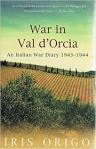
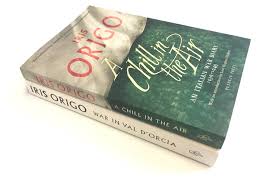
 It is said that the best diaries of the second world war were written by women. They sensed that they were living through a crucial time in history, and they felt the duty to record it. In fact, War in the Val d’Orcia
 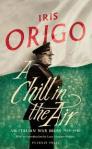 by Iris Origo, first published in 1947, was hailed as the one of the great diaries of the twentieth century. It describes the chaos and suffering of the Italian people caught between the Allies and the Fascists and the Germans in 1943 and 1944. Only recently Origo’s other diary was published (2017): A Chill in the Air: An Italian War Diary, 1939-1940, which is set earlier than her established and well-known work.
Origo’s story begins in 1902. She was born in London to a British aristocrat mother and to a wealthy American father. When Iris was only 7, her father died; he stipulated in his will that he wanted her to live in Italy, a country he loved. She grew up in the Villa Medici, in Fiesole, above Florence. At 18, she fell in love with and married Antonio Origo, an Italian nobleman who was ten years her senior.
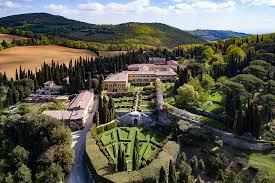 In 1923, they bought and managed La Foce, a dilapidated Tuscan estate of about 7,000 acres (c. 2832 hectares), which lies close to the towns of Montepulciano, Chiusi and Chianciano Terme in the Val d’Orcia, midway between Florence and Rome. The Origos restored the 15th century villa and planted beautiful gardens. They employed 25 families and built a school to teach 50 local children. They also built 35 dwellings in the 20s and 30s for tenant farmers.
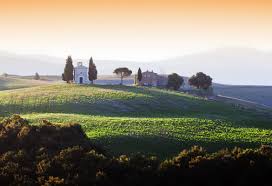 War in the Val d’Orcia is a daily account of what happened when this peaceful farming valley became a battleground during the war. The account begins with the arrival of the first refugee children sent by parents in response to the Allied bombing of Italian cities, particularly Genoa and Turin. At great personal risk, the Origos also gave food and shelter to partisans, Jews, deserters, refugees, prisoners-of-war, and other anti-nazis and anti-fascists. As the battle between the Germans and the Allies heated up and the fighting drew near, the inhabitants of La Foce abandoned everything; the couple shepherded about 60 adults, children and the elderly through artillery fire to safety in Montepulciano. The villa survived but not its contents.
Nearly 80 years later, Iris Origo’s first diary came to light. A Chill in the Air: An Italian War Diary, 1939-1940 records the months before Italy’s descent into the Second World War, and the Fascist government’s growing infatuation with Nazi Germany as Hitler’s armies marched triumphantly across Europe. Already a writer and biographer in the spring of 1939, Origo was deeply troubled by the conflict between England and Italy and decided “to steady herself” by setting down “as simply and truthfully as I can” the world’s events as she observed and analyzed them.
She followed Mussolini’s speeches, read the Italian press, listened to the BBC and other foreign radio broadcasts, and talked with friends and associates in Italy and beyond in an attempt to sort through conflicting information. It became clear to her that Mussolini was mounting a program of propaganda and intimidation. She noted that in Florence every shop window was covered with notices that read, “Il Duce ha sempre ragione,” or “The Duce is always right.” She records that the propaganda was taking the form of an economic problem where the democratic countries, the “haves,” were permanently blocking the way of the “have nots” to gain economic expansion. She notes that the Fascists saw the impending war as a struggle between the rich and poor—as a revolutionary movement. She follows and reports on Italy’s invasion of Albania and Germany’s invasion of Poland.
For years the Italian people hoped and trusted that Mussolini would keep Italy out of war. But by June 1940 Mussolini had become the jackal to Hitler’s lion, declaring war on Britain and France just as the Germans were poised to enter Paris. By the fall of 1940 after the birth of her daughter, Origo began to work in the Prisoner’s Branch of the Italian Red Cross and no longer had time to continue her diary. A few years later she began her journal that would become War in Val d’Orcia, hiding it under the floorboards every night to prevent it from falling into enemy hands.
 Taken together, both diaries show what a perceptive and intelligent writer Iris Origo was, and the deep affection she had for her adopted country. The diaries also are a thrilling story of a formidable woman’s transformation from observer to actor at a turning point in the history of Europe and the United States. “Chill” is not only a preface to her later diary but it is also a cautionary tale to our own perilous times.
 Calcio, sì, ma basket? Raramente si associa questo sport all’Italia. Era in Italia, tuttavia, che Kobe Bryant appreso i primi rudimenti di basket, si esercitava incessantemente e sognava di diventare un giocatore della NBA. Nel 1984, il padre di Kobe, Joe ‘Jellybean’ Bryant, si ritirò dalla NBA per giocare in Italia e si trasferì con la famiglia a Rieti, nel Lazio. Così, a partire dai 6 anni, Kobe saltava dal balcone di casa dei suoi genitori, attraversava una strada trafficata e correva nel cortile della chiesa per lanciare la palla nel
 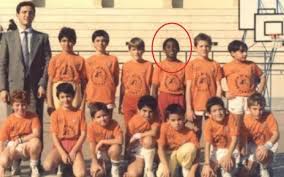 canestro. La famiglia si trasferì più volte: a Reggio Calabria, poi a Pistoia (in Toscana) e infine a Reggio Emilia. Durante i suoi anni formativi, fino all’età di 13 anni, Kobe imparò fluentemente l’italiano, praticava il basket e aveva molti amici. Ricordi, soprattutto quelli di Reggio Emilia, che si porterà dietro per tutta la vita.
 Kobe ha rilasciato numerose interviste ai media italiani in un italiano impeccabile. In un’intervista del 2011 su Radio Deejay, ha dichiarato: “Sono cresciuto qui in Italia, è un paese che sarà sempre vicino al mio cuore. Sempre. Qui mi sento in pace”. Luca Vecchi, sindaco di Reggio Emilia, ha recentemente scritto su Facebook, “Kobe Bryant è cresciuto qui ed è stato, per tutti noi, un ‘Reggiano’”. Davide Giudici, un amico di vecchia data ed ex compagno di squadra di Kobe, ha scritto: “Quando si è trasferito a Reggio Emilia e ha iniziato a giocare nella mia squadra, è stato subito chiaro che proveniva da un altro pianeta, un palmo sopra di noi. Quando ci diceva spesso che un giorno sarebbe diventato un giocatore professionista della NBA, lo prendevamo in giro. Ma lavorava per questo. Alla fine della nostra formazione, noi siamo semplicemente andati a fare altre cose. Kobe, invece, è tornato a casa e ha continuato ad allenarsi con il canestro che suo padre aveva preparato per lui nel suo giardino”.
 L'Olivo Santa Barbara