The Statue of Zeus Enthroned

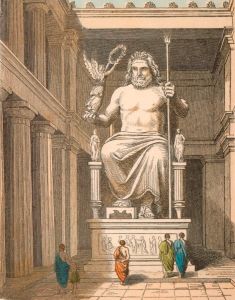
In about 430 B.C., the Greek sculptor Phidias created a forty-foot tall, gold and ivory statue of Zeus for the temple of Zeus at Olympia, one of the most important religious sanctuaries in the Greek world.  This statue later came to be considered one of the Seven Wonders of the ancient world.

The sculptor of 29-inch marble statuette “Zeus Enthroned” from the first century B.C. is unknown but must have been strongly influenced by the famous colossal image.  Zeus, the king of the gods, sits on an ornamental, high-backed throne with his feet on a footstool.  His draping cloak exposes his powerful chest.  His raised right hand probably held a scepter and his left hand a thunderbolt.

The statue’s travels are many, but not entirely clear.  Initially, it may have served as a cult statue in a private shrine of a wealthy Greek or Roman home.  At some point, it spent a long time submerged in the sea as the marine incrustations indicate.  Then the path grows even colder.  What we do know is that the J. Paul Getty Museum in Los Angeles bought the statue in 1992 from an American couple but there is no documentation to indicate that it was legally exported.

Now, because of a recently discovered fragment of the statue on the island of Capri near Naples, the statue is voluntarily being returned to Italy.  This is the latest example in a long series of artworks that the Getty has returned to Italy because of questionable provenance.  In January 2015, the Getty returned the “Head of Hades” to Sicily (see post, “The Underworld,” of April 21, 2016).

The question of who owns the world’s art is timeless.  As is the question of whether one country, which has cared for and protected art that may have been stolen from another country, should be forced to return it.   The modern restitution question first arose in the 1970s as archaeologists, journalists, and public officials realized that looting was not a thing of the past.  The growing market in the West was fueling destruction of archaeological sites.  There was collusion along the entire chain of actors in smuggled antiquities—from tomb robbers to restorers, upscale dealers, auction houses, and wealthy collectors.  There also was a lack of clear international law to regulate all of this.

For years Italy has waged a campaign against museums, dealers, and collectors for return of artifacts it claims were illegally excavated and smuggled from the country.  This culminated in a criminal trial in Italy beginning in 2005 of Marion True, the antiquities curator of the Getty Museum.  The trial was agonizingly slow.  In the end, the statute of limitations expired, and perhaps we will never know if Marion True was a scapegoat or a scofflaw.  But the demands for returned art were daunting for the Getty, which at that time returned 40 masterworks, including a large statue of Aphrodite.

I can’t help but ask, “Who really ‘owns’ Zeus Enthroned”?  After all, it is a Greek statue.  Italy owns it now.  (See post of October 1, 2015 entitled, “The Controversy over who owns the Art of the World.”)

Posted in Arte, California, Campania, English, Foto, Italia, Storia | 2 Comments

New Haven e la pizza di Pepe

In “La Storia della pizza in America” (l’1 settembre 2016) ho menzionato la Pizzeria Napoletana di Frank Pepe a New Haven, Connecticut.  In questa città è presente una “Little Italy” completa di striscioni e bandiere tricolori e un sacco di ristoranti italiani, tra cui il famoso Pepe’s sulla strada Wooster.
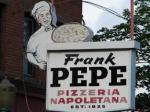
New Haven è ricca della storia degli immigrati italiani, e il luogo di nascita di mio marito Guglielmo e molti dei suoi parenti.  Come i Vollero, Frank Pepe è originario della costiera amalfitana.  Il paese di nascita di Frank è Maiori in provincia di Salerno.  Arrivò in New Haven nel 1920, aprì una panetteria e di lavoro consegnava le merci nel quartiere con un carrello.  Un giorno appiattì un po’ di pasta di pane e ci mise alcuni avanzi sopra, e la cosse.  La Pizza di Pepe così nacque.

Nel 1925, Frank Pepe aprì la sua pizzeria e usava solo un fuoco di carbone per dare alle sue “torte di pomodoro” la loro crosta celebre.  È considerato il creatore delle pizze in stile “New Haven”, che sono leggendarie per il loro aspetto deforme, la crosta sottile e i bordi carbonizzati.  Una delle specialità di Pepe è la pizza alle vongole in bianco.

Dopo Frank Pepe morì nel 1969, le sue figlie, Elizabeth e Serafina, hanno continuato l’attività familiare.  Elizabeth è appena morta nel 2017 all’età di 94 anni.  Oggi i nipoti gestiscono la pizzeria, che si è espansa in 6 altre località in Connecticut, una a Yonkers, NY, e una a Chestnut Hill, MA.

Si torna al quartiere di New Haven.  Come Chris Dinkeloo, che è il marito di Audrey Santatico (uno dei secondi cugini di Guglielmo) ha detto: “Quello che non ho capito quando mi sono sposato in una famiglia italiana è che sono stato improvvisamente imparentato alla maggior parte delle persone di New Haven”.

Per dimostrare il suo punto, siamo imparentati a Frank Pepe.  Seguite questo attentamente.  La figlia di Frank Pepe, Elizabeth, sposò Ralph Rosselli il cui fratello sposò Josephine Amaturo, la sorella di Phyllis, che è la moglie di Tom Giglietti.  Tom è il nipote di Rosa Vollero, che era la sorella di Andrew Vollero, il padre di Guglielmo.

In conclusione, Chris osserva: “La grande cose delle famiglie italiane in questa zona è che non solo conoscono la loro eredità per almeno 3 generazioni, ma anche conoscono chi sono i loro terzi e quarti cugini.  Il lignaggio sembra essere il tema principale della conversazione alla cena di famiglia la domenica ogni settimana”.


Posted in Campania, Cucina italiana, Foto, Italia, Italiano, Italoamericani, Storia | Leave a comment

New Haven and Pepe’s Pizza

In “The Story of Pizza in America” (September 1, 2016), I mentioned the Frank Pepe Pizzeria Napoletana in New Haven, Connecticut.  This city has a Little Italy complete with tricolor banners and lots of Italian restaurants,        including the famous Pepe’s on Wooster Street.

New Haven is rich in Italian immigrant history, and is the home of my husband, Bill, and his many relatives.  Like the Volleros, Frank Pepe came from the Amalfi coast.  Frank’s home town was Maiori in the province of Salerno.  He came to New Haven in 1920, opened a bakery, and delivered goods to the neighborhood by cart.  One day he flattened some bread dough, put some leftovers on top of it, and baked it.  Pepe’s pizza was born.

In 1925 Frank Pepe opened his pizzeria and used only a coal fire to give his “tomato pies” their famous crust. He is credited with New-Haven style pizzas, which are legendary for their misshapen appearance, thin crust, and charred edges.  One of Pepe’s specialties is white clam pizza.

After Frank Pepe died in 1969, his daughters Elizabeth and Serafina continued the family business.  Elizabeth just died in 2017 at the age of 94.  Today the grandchildren run the pizzeria, which has expanded to 6 other locations in Connecticut, one in Yonkers, NY, and one in Chestnut Hill, MA.

Back to the neighborhood in New Haven.  As Chris Dinkeloo, who is the husband of Audrey Santatico (one of Bill’s second cousins in the New Haven area) said: “What I didn’t realize when I married into an Italian family here is that I was suddenly related to most of the people in New Haven.”

To prove his point, we are related to Frank Pepe.  Follow this closely.  Frank Pepe’s daughter Elizabeth married Ralph Rosselli whose brother married Josephine Amaturo, who is the sister of Phyllis, the wife of Tom Giglietti.  Tom is the grandson of Rosa Vollero, the sister of Andrew Vollero, who is Bill’s father.

In conclusion, Chris observes: “The great thing about the Italian families in this area is that not only do they know their heritage back 3 generations, they also know who their 3rd and 4th cousins are.  Lineage seems to be the main topic of conversation at the family dinner table every Sunday.”


Posted in Campania, Cucina italiana, English, Foto, Italia, Italoamericani, Storia | 1 Comment