Highlights of our trip to Orvieto

To begin, Bill and I would like to thank our friends, Susan Forkush and Adrian Misarti, for an unforgettable visit to Orvieto.  Susan, who also lives in Santa Barbara, lives in the historic center of Orvieto.  Adrian, who was a university colleague of Bill’s many years ago, lives in the countryside outside of Orvieto.  Through Susan we met many fun people, including Roy, Victoria, David, and Laurie.  And through Adrian, we met his partner, the charming and interesting Alessandra who originally came from Naples, and Adrian’s daughter, Nicole, who grew up in Milan, speaks Italian, and is a scientist in Alaska who visits her dad every year.

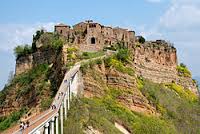
A very special time for us was when the parents of Jacopo Giacopuzzi, an excellent pianist who lives in Santa Barbara, visited us.  Patrizia and Claudio live in Verona, a city 315 kilometers (195 miles) north of Orvieto.  We had dinner together and then took a walk through Orvieto to see the Good Friday candlelight procession.  The next day we went to Civita di Bagnoregio, a small and beautiful Medieval town where visitors must climb a long, steep hill to get there.  But it is worth it.  Then…a welcome picnic at Lake Bolsena!
Here are some things that we really loved or learned on this trip:

  • La colomba (the dove), a pastry typical at Easter, and also “la torta sbrisolona” from Mantua, which the Giacopuzzi brought for our festivities
  • The signs in front of the stores that proudly list local products:  la porchetta (similar to a pork loin), il cinghiale (wild boar meat), and other meats; pastas like umbrichelli and also strozzapreti and tagliatelle; the the famous wine of the area–Orvieto Classico
  • Other signs that read “For Rent” or “For Sale”– a sign of the hard economic times in Italy but also perhaps a sign of social change where children no longer want to live in parents’ houses in small towns but prefer larger cities
  • The seasonal vegetables–artichokes, fava beans, and asparagus–at the market in Piazza del Popolo
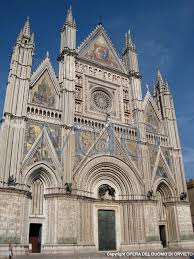
  • The iconic Duomo of Orvieto with its beautiful mosaic facade, the Signorelli frescoes inside, and the bells that ring every day at 8:45 and noon
  • Orvieto is also known for its underground wells.  Food could be stored underground in the past and allowed many popes over the centuries to survive in this city.  Moreover, the “caves” form a sort of honeycomb that perhaps cushions Orvieto from earthquakes.
  • Every morning, a cornetto (croissant) and a coffee (espresso) at a different bar
  • Corso Cavour, “main street” in Orvieto, that runs through the city to the funicular (I wonder if Corso Cavour is one of the most common street names in Italy)
  • The funicular that descends to Orvieto Scalo; it seems that many Medieval towns on hills  have “a scalo” below where there usually is a train station
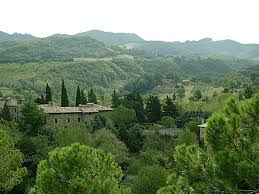
  • Umbria is known as the green heart of Italy–the gorgeous rolling hills with so many shades of green from the new growth on the grape leaves in the vineyards to the dark green of the cypress trees
  • Day trips to charming nearby towns like Rocca Ripesena, Castel Viscardo, Allerona, and Castiglione in Teverina
  • Finally, I didn’t know that the Tiber existed beyond Rome.  In fact, it’s the third longest river in Italy that originates in the Apennines in Emilia-Romagna and flows 406 kilometers from Umbria to Lazio
Posted in Cucina italiana, English, Foto, Italia, Orvieto, Santa Barbara, Storia, Umbria, Verona | 2 Comments

Così spopola Monòpoli in Italia: il vecchio e il nuove

Il gioco da tavolo Monòpoli, un celebre passatempo, è venduto in Italia dal 1935 (vedete il post dell’aprile del 2015, “Monòpoli, 80 anni tra imprevisti e probabilità).  Nel 2011, per onorare i 150 anni dell’unità d’Italia, è stata pubblicata un’edizione per l’anniversario in base alle votazioni online per le città che sarebbero state rappresentate.  I risultati sono stati sorprendenti.  Le città più grandi, come Roma, Bologna, Venezia, e Firenze non sono rientrate nella lista.  La maggior parte delle città che sono state rappresentate sono capitali di provincie, non le città più grandi.

Forse ciò che è più sorprendente è la popolarità del gioco da tavola nell’era del digitale e del dominio dei videogiochi.  Infatti, il gioco in scatola sta vivendo una seconda giovinezza.  Come l’edizione anniversario, le nuove edizioni mettono in luce le città locali.  Ad aprire la strada era stata nel 2005 un’artista livornese con “Livornopoli,” una versione di monopoli ambientata nella cittadina toscana dove ci si muove, per esempio, tra piazza delle Carrozze e via del Littorale.

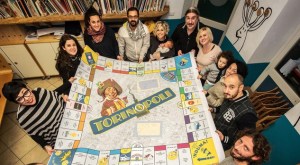
Poi una sera a cena un gruppo di amici torinesi, quasi per scherzo, ha pensato che sarebbe una buona idea creare un’edizione ambientata a Torino.  Hanno seguito la loro intuizione ed in pochissimo tempo l’idea è diventata una realtà.  Torinopoli è un omaggio a tutto ciò quello che riguarda la città: i suoi personaggi classici, i suoi proverbi in dialetto, le sue consuetudini e tradizioni, e, naturalmente, le sue strade, monumenti, e quartieri.

Ma ancora più interessante è il modo in cui i giovani hanno finanziato la produzione del gioco.  Come prima cosa, hanno usato una piattaforma di crowdfunding, chiamata “Produzione dal basso” per raccogliere fondi.  Poi, hanno convinto diverse imprese locali a sponsorizzare il progetto in cambio del proprio nome su una casella del gioco.

Il successo è stato travolgente.  Lanciato a fine 2016, sono state prodotte 3 mila scatole per la prima edizione. Torinopoli si è esaurito in pochissimi giorni.  Il gioco è diventato il regalo più desiderato per il Natale 2016.  Inoltre, i giovani hanno raccolto 20 mila euro su “Produzioni dal basso”, rispetto ad una richiesta iniziale di 5 mila.  Adesso, il gruppo di amici sta organizzando una nuova campagna per produrre la seconda edizione, che finora ha raccolto 40 mila euro in poco più di un mese.  Pure Livornopoli è stato un successo, e per cui l’ideatrice ha deciso di ristampare il suo gioco, ma questa volta sfruttando il potere del finanziamento collettivo attraverso la rete.

Motivati dall’orgoglio e dall’amore per la propria città, altri creativi in tutta Italia stanno seguendo questi esempi.  In arrivo presto sono Romanopoli e Pesaropoli, mentre Palermopoli e Bolognopoli sono all’orizzonte.  Forse in futuro arriveranno anche Veneziopoli, Firenzopoli, e Milanopoli.  Ma soprattutto, spero di vedere una versione di Monopoli, una città bellissima lunga la costa in provincia di Bari.

Posted in Firenze, Foto, Italia, Italiano, La Gente, Storia | Leave a comment

Why Monopoly is becoming a hit in Italy

 The board game, Monopoly, quite popular in the United States decades ago, has been sold in Italy since 1935 (see the post from April 2015).  In 2011, to honor 150 years of Italian unification, an anniversary edition was published based on online voting for the cities that would be represented.  The results were surprising.  The largest cities, like Rome, Bologna, Venice, and Florence didn’t make the cut.  Most of the cities chosen were capitals of provinces.

Perhaps what is even more surprising is the popularity of a board game in a digital era that is dominated by video games.  In fact, the famous game in a box is having a resurgence.  Like the anniversary edition, new editions highlight local cities.  Leading the way in 2005 was an artist from Livorno with a new game, “Livornopoli,” that is set in the Tuscan town where one moves, for example, from the Piazza delle Carrozze to the via del Littorale.

Then one evening a group of friends from Turin, almost as a joke, thought it would be fun to have an edition set in their city.  They followed their intuition and in no time their idea became a reality.  Torinopoli is a tribute to everything about their city:  the classic characters, their proverbs in dialect, their habits and traditions, and, naturally, their streets, monuments, and neighborhoods.

But even more interesting is the way that these young folks financed the production of the game.  First, they used a crowdfuning platform, called “Produzione dal basso” to raise funds.  Then, they convinced various local businesses to sponsor the project in exchange for a place on the game board.

The success was overwhelming.  Launched at the end of 2016, there were 3,000 boxes in the first edition.  Torinopoli sold out in a few days.  The game had become the most coveted gift for Christmas that year.  Moreover, the entrepreneurs had collected 20,000 euros from the crowdfunding site compared to an initial request for 5,000!  Now, the group of friends is organizing a new campaign for the second edition, which has already collected 40,000 euros in a little more than a month.  Livornopoli also was a success, and the creator has decided to reprint the game but this time engaging the power of collective financing through the web.

Motivated by pride and love of their cities, other ingenious people throughout Italy are following this example.  Coming soon are Romanopoli and Pesaropoli, while Palermopoli and Bolognopoli are on the horizon.  Perhaps in the future we will also have Veneziopoli, Firenzopoli, and Milanopoli.  But above all, we hope to see a version from the citizens of Monopoli, a gorgeous city along the coast in the province of Bari.

Posted in Abitudini, English, Firenze, Foto, Italia, La Gente, Puglia, Roma, Sicilia, Storia, Toscana, Venezia | 1 Comment