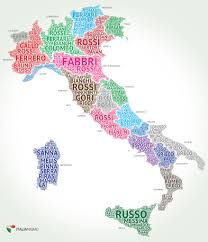
A Brief History of Italian Surnames

Today there are more than 300,000 traditional surnames in Italy not counting new ones introduced through immigration.  A precise calculation is impossible because over time some become extinct and others are formed—often from transcription errors in the registry offices.  The number of surnames is actually quite large compared to other regions of Europe.  Some may be variants of the same original surname.  The linguistic fragmentation of Italy with its many dialects and the relatively late development of a national language may explain this phenomenon.

What are the most common surnames in Italy today?  According to one classification, the top 10 are Rossi, Ferrari, Russo, Bianchi, Romano, Gallo, Costa, Fontana, Conti, and Esposito.  Go to www.mappadeicognomi.it for the top 1000.

Many people think that surnames today came from Latin names when, in fact, they evolved more directly from the Middle Ages.  Even if your name is Cesaroni today, you probably cannot claim Caesar as your ancestor.  In Roman times (100 bc – 400 dc) there was a system of three names like Caio Giulio Cesare (Caesar) e Marco Tullio Cicerone (Cicero).  Here is where is gets confusing.   The three names were called praenomen, nomen e cognomen, and the meanings are somewhat different from what you might expect.  The praenomen is comparable to the personal name of today.  The nomen is similar to today’s surname, and the cognomen is the similar to the contemporary definition of nickname—hence, Caesar and Cicero.

In the first centuries of the Middle Ages (500 – 1000 dc), the custom became to have only one name.  In feudal times, the surname was not used because peasants were servants of the land in the hands of their lords.  To distinguish among them, the name of the father was used at most.

Then things changed after the year 1,000 because of greater mobility.  There were movements among populations, of goods, of population centers, of trades.  At this point, having only one name became a serious problem.  So, a second name became assigned to citizens, that which today we call cognomi (surnames).  They were chosen in different ways:

  • from the name of the father or possibly an ancestor (for example, di Francesco, di Stefano, di Matteo);
  • from the place of origin (for example, Ferraresi, Romano);
  • from the trade or profession (for example, barbieri [barbers], cacciatori [hunters];
  • from physical characteristics (for example, biondi (blond), gobbi (hunchbacked), bassi (short), mancini (left handed).

Then in 1564 with the Council of Trent, the Catholic church established that in every parish all the baptisms and deaths be put in a registry, which was already being done but only sporadically. From 1866 on, registrations, including marital status, were located in every municipality.

Let’s look at the derivation of some of the most common names.  Rossi and Russo:  The origin of these surnames (and variants) is linked to the color of hair and complexion.  The spread of red hair in the Celtic pre-Roman populations was quite remarkable, as well as among the Latin people.  In ancient popular beliefs, red hair symbolized a capricious and impulsive character, but also creativity and ingenuity.  While these surnames are found throughout Italy, Rossi has greater concentration in the center-north, Russo has a major concentration in Campania (especially in the Naples area), and Russi is specific to Puglia.  Rizzo comes from a dialect nickname for riccio, which means curly to indicate a physical characteristic, like curly hair, or character, a rough and angular person.  While the name is widespread throughout Italy, there are concentrations in Sicily and Puglia.  A variant, Rizzoli, is typical of Emilia Romagna, while Rizzolo is present mainly in Veneto, Piedmont, and Sicily.

Ferrari (from ferro, iron) comes from nicknames linked to a blacksmith’s trade or a worker involved in the extraction or fusion of iron.  The surname is widespread throughout the peninsula but particularly in the north.  Variants include Ferrarini, Ferrario, and Ferrieri.

Esposito comes from the word that means “exposed.”  This surname was given to orphans abandoned in front of churches or monasteries until 1814.   It is widespread thoughout Italy and in Campania in particular, whereas Espositi is mainly Roman.

For other surnames, visit www.cognomix.it.


Posted in Abitudini, Campania, English, Italia, La Gente, Piemonte, Puglia, Sicilia, Storia, Veneto | 1 Comment

Le Notizie False in Italia: Parte II

Ci sono due iniziative in Italia che promuovono la diffamazione di notizie false insegnando l’alfabetizzazione digitale agli studenti delle scuole superiori.  Il primo progetto, guidato da Laura Boldrini, la presidente della Camera del Parlamento, mira ad educare una generazione di studenti a riconoscere le notizie false e le teorie cospirative che circolano sul web.  La storia è stata riportata nel New York Times.  Le lezioni fanno parte di un esperimento straordinario del governo italiano, in collaborazione con le principali aziende social tra cui Facebook, e viene distribuito in 8.000 licei in tutta Italia.

“Le fake news instillano gocce di veleno nella nostra quotidiana dose di web,” ha spiegato Boldrini.  “È semplicemente una cosa giusta dare ai ragazzi la possibilità di difendersi dalle bugie”.   Oltre ad affrontare molti progetti, gli studenti imparano come i loro “likes” siano monetizzati e usati a scopi politici.  Stanno imparando una nuova serie di Dieci Comandamenti, tra cui “non si devono condividere notizie non verificate”, “si chiedono fonti e prove”, e “si ricordano che l’internet e i social network possono essere manipolati”.

Questa iniziativa non potrebbe arrivare in un momento migliore…poco prima delle cruciali elezioni italiane.  Tra sospetti globali di intromissione russa nelle elezioni negli Stati Uniti, in Germania e in Francia, così come nella Brexit e nel movimento indipendentista catalano, notizie false e propaganda potrebbero danneggiare l’Italia, uno degli ultimi governi di centro-sinistra rimasti in Europa.

E sembra che l’Italia sia un terreno fertile per l’inganno digitale.  Frustrati dai problemi economici, dall’alta disoccupazione e dalla crisi dei migranti, molti italiani aderiscono a tutti i tipi di teorie cospirative.  Si chiama “dietrologia”, la convinzione che ci sia sempre qualcosa dietro la superficie.  Secondo Alessandro Campi, un professore di scienze politiche all’Università di Perugia, la passione italiana per vedere gli intrighi dietro ogni angolo è profonda.  “Tutto ciò fa parte del patrimonio culturale italiano” da una lunga storia di dominio straniero, di intrighi di papi e cardinali, di governo corrotto.  Continua, “Direi che il Movimento Cinque Stelle [un gruppo di destra guidato da Beppe Grillo] crede più di ogni altro partito politico nelle teorie cospirative”.  Un esempio è il rifiuto da parte del partito delle vaccinazioni infantili, nonostante il consenso scientifico.  Grillo li chiama truffatori da parte di compagnie farmaceutiche con l’intenzione di “indebolire il sistema immunitario dei bambini”.

Boldrini sostiene che l’internet non può venire nascosto ai margini della società e che il governo deve insegnare alla prossima generazione di elettori italiani come difendersi dalle menzogne e dalle teorie del complotto progettate per agire sulle loro paure.

L’altra grande iniziative in Italia si chiama “Quotidiano in classe”, sponsorizzata dall’Osservatorio permanente giovani-editori (Opge), un’organizzazione la cui missione è sviluppare il pensiero critico nei giovani per renderli cittadini migliori di domani.  Fornisce alle scuole 3 giornali di qualità ogni settimana.  Insegnando come giornali diversi presentano gli stessi fatti in modi diversi, il progetto spera di sviluppare il pensiero critico e la capacità di distinguere le fonti affidabili da quelle che non lo sono.  Questo progetto è affidato all’International Advisory Council di Opge, un think tank che include i direttori dei più prestigiosi giornali americani: Il New York Times, il Wall Street Journal, ed il Los Angeles Times.

Recentemente, Tim Cook, il capo della Apple, si è incontrato a Firenze con studenti di questa iniziativa: “Le conseguenze delle fake news sono peggiori di quello che si possa immaginare perché vengono usate per polarizzare sempre di più la società”.  Ha elogiato il progetto di media literacy dell’Opge e ha sottolineato l’importanza di confrontare differenti prospettive anche con quelle con cui non siamo d’accordo.

Il direttore di Opge si è incontrato con altri direttori della Silicon Valley.  Dagli incontri è emerso che la stessa persona davanti allo schermo di un personal computer, o maneggiando uno smartphone e un tablet, assume nei confronti di argomenti che legge una posizione più radicalizzata rispetto a quella che avrebbe, invece, discutendo davanti a una persona in carne e ossa.  Hanno anche discusso come false notizie possono diventare uno strumento di una strategia che mira a dividere: L’opposto di ciò che la Rete ha fatto sinora—unire le persone distanti.


Posted in Abitudini, Italia, Politica | Leave a comment

Fake News in Italy: Part II

There are two initiatives in Italy to combat fake news by teaching digital literacy to high school students.  The first project is spearheaded by Laura Boldrini, the president of the Italian lower house of Parliament, to educate a generation of students to recognize fake news and conspiracy theories that circulate on the web.  The story was reported in the New York Times.  The lessons are a part of an extraordinary experiment by the Italian government, in cooperation with leading digital companies including Facebook, and is being rolled out in 8,000 high schools across the country.

“Fake news drips poison into our daily web diet and we end up infected without even realizing it,” said Ms. Boldrini.  “It’s only right to give these kids the possibility to defend themselves from lies.”  Besides tackling projects and work sheets, the students learn how their “likes” on Facebook are monetized and politicized.  They are learning a new set of the Ten Commandments, including “thou shalt not share unverified news,” “thou shall ask for sources and evidence,” and “thou shall remember that the internet and social networks can be manipulated.”

This initiative couldn’t come at a better time…just ahead of crucial Italian elections.  Amid global suspicions of Russian meddling in elections in the United States, Germany, and France, as well as in Brexit and in the Catalan independence movement, fake news and propaganda could damage Italy, one of the last major center-left governments remaining in Europe.

And it seems that Italy is fertile ground for digital deceit.  Frustrated by economic problems, high unemployment, and the migrant crisis, many Italians subscribe to all kinds of conspiracy theories.  It is called “dietrologia,” the belief that there is always something “dietro” (behind) the surface.  According to Alessandro Campi, a professor of political science at Perugia University, the Italian passion for seeing intrigue around every corner runs deep.  “All of this is part of the Italian cultural heritage” from a long history of foreign domination, to scheming popes and cardinals, to corrupt government.  He continues, “I’d say that the Five Star Movement [a right-wind group led by Beppe Grillo] believes more than any other political party in conspiracy theories.”  One example is the party’s rejection of childhood vaccinations despite scientific consensus.  Grillo calls them scans by pharmaceutical companies with the intention of “weakening children’s immune system.”

Ms. Boldrini claims that the internet cannot be forfeited to the fringes, and that the government must teach the next generation of Italian voters how to defend themselves against falsehoods and conspiracy theories designed to play on their fears.

The other major initiative in Italy is called “The Daily in Class,” which is sponsored by l’Observatorio permanente giovani-editori (Opge), an organization whose mission is to develop critical thinking in youth to make them better citizens of tomorrow.  It supplies schools with 3 quality newspapers each week.  By teaching how different newspapers present the same facts in a different way, the project hopes to develop critical thinking and the ability to distinguish reliable sources from those that are not.  This project is entrusted to the International Advisory Council of Opge, a think tank that includes the directors of the most prestigious American newspapers:  The New York Times, the Wall Street Journal, and the Los Angeles Times.

Recently, Tim Cook, the head of Apple, met in Florence with students from this initiative: “The consequences of fake news are worse than one can imagine, because they are used to polarize society more and more.”  In praising the media literacy project of Opge, Cook emphasized the importance of considering different perspectives including those with which you don’t agree.

The director of Opge met with other directors from Silicon Valley.  An interesting concept emerged:  A person in front of a screen of a personal computer, or handling a smartphone or a tablet, takes on a more radical position toward subject matter that he or she reads compared to a someone who, instead, discusses the subject matter with a flesh-and-blood person.  They also discussed how fake news has become an instrument in a strategy that aims to divide:  Just the opposite of what the Internet has done so far—unite distant peoples.


Posted in Abitudini, English, Italia, Politica | Leave a comment