Eleonora Vieri, Parte I–A First-Hand Account of the Pandemia in Italy

Eleonora Vieri is my teacher and editor.  She corrects nearly every post that I write for this blog.  I met her several years ago and came to learn that she teaches the Italian language to foreigners.  But what makes her so special for me is that she teaches not just the language, but also Italian culture–from history to art to Italian traditions like its coffee culture.  She is excellent at teaching Italian conversation, as well as grammar—whatever students prefer. She is kind, patient, and encouraging.  During these times of social distancing, it’s a great opportunity to do what you’ve always promised yourself:  Learn or practice Italian.  If you are interested, check out her web site:  www.italianviaskype.net.

 I interviewed Eleonora and will present her responses in three parts.   Because of its timeliness, I am presenting in Part I her thoughts and observations about the pandemic in Italy and her first-hand account of her hometown of Castiglione del Lago, which is in the Umbrian region near Tuscany.  Part II will focus on her childhood, education and how she became a teacher.  And Part III will discuss her philosophy and approach to teaching foreigners via Skype.  You will get to know a very warm and endearing person and teacher.

“At first, no one in Italy could have imagined that an epidemic would result in such a large pandemic.  The gravity of the situation became clear, glaring and disturbing when, in the first days of March while I was substitute teaching at an elementary school, a ministerial decree suddenly arrived to announce that lessons at the school would be stopped until a date to be determined.  The following day, we teachers went to school to prepare all the necessary materials for our young students.  But then the parents came the following day to collect the students from school.  There was some panic.  People were learning to keep distant from one another, to wash their hands frequently, and the teachers began to quickly organize a new way of teaching.

“At about the same time, I was to resume my work in a school of Italian for foreigners, located in Montepulciano.  But reservations were suddenly canceled due to a precipitous drop in tourism.  So there was no work there.  Fortunately, I have been teaching foreign students Skype lessons for years, and I can continue to do so to support myself.  But I now have a lot more time on my hands, which, in some ways is a relief.  The amount of activities I did during the days left me tired in the evening, with little time for myself.  Maybe the pandemic is whispering to us to change something in our lives, to find a new calling or sense of life.

“I, like my friends and others, go to the historic center of Castiglione del Lago every day.  But in those early March days, there was not a soul there.  It was deserted.  I went to a friend’s clothing store; for days they had not seen one customer.  They felt desperate.  I greeted Marcella, an elderly lady who was a longtime merchant in town, but I don’t kiss her.  We keep our distance, which makes us both sad.  We like to kiss and embrace people.

“We all also like to take walks on the lake.  Then came the ministerial order banning outdoor activity.  Like me, many friends, merchants, and those who have farms and restaurants — at home and out of work.

“But then there are those who must work, like my sister and cousin who work in a hospital.  For many days at the Policlinic of Perugia where they work, there were not enough professional masks. Then the ward for patients with infectious diseases was full.  There were doctors and nurses themselves in quarantine.  And then in nearby Pantalla, the hospital there was dedicated exclusively for Covid-19 patients.

“There were sad images throughout Italy.  Bergamo and the souls that had to be buried by the army.  People lost in Castiglione del Lago.  The images of health workers tired and exhausted. But also images of those who voluntarily provide help, including the Red Cross and many charities.  Municipalities that organize and support the weakest citizens, not only by providing food and basic necessities, but also with a telephone service to assist the elderly, who are often alone.

“Today, April 14, is the first day of reopening in Italy.  A breath of air, a little bit of hope.  According to the latest ministerial decree, some factories, bookstores and stationery stores can reopen today, along with clothing stores for babies and children.  Of course, everything will be modulated according to the different regions of the country.

“I have confidence that in life things never happen casually and without a reason.  In Italian there is an expression that “not all evil comes to harm.”  Our ancient proverbs always guard human truths.  And I also trust the Italian institutions.  The government and the health care system have shown much competence (even the World Health Organization reiterated it) despite immense difficulties, both in health care and the economy.  We have a prime minister we are proud of:  he is competent, steadfast, courageous and passionate … how a real leader should be.”
 

Posted in Abitudini, educazione, English, Foto, Italia, La Gente, La Lingua, Toscana, Umbria | 3 Comments

Santa Rosalia: Una storia dentro una storia

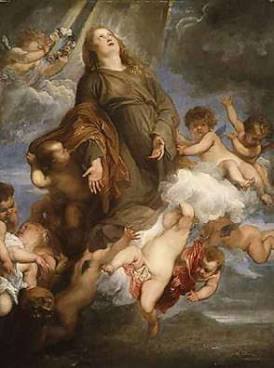
Di recente, il critico d’arte Jason Farago ha scritto una storia sul New York Times intitolato “Il santo che ha fermato un’epidemia è bloccato al Met”. Racconta della sua visita solitaria al Metropolitan Museum of Art di New York per contemplare il dipinto di Anthony Van Dyck, “Santa Rosalie che intercede per la peste di Palermo”. Questo dipinto risalente a 400 anni fa doveva essere il fulcro della mostra “Making the Met: 1870-2020”, la celebrazione per il 150 ° compleanno del museo. Era prevista l’apertura a fine marzo prima del blocco della città.

La prima storia inizia nel 1599. Anthony Van Dyck nacque ad Anversa (nell’attuale Belgio) e iniziò a dipingere in tenera età.  Diventò un ritrattista di corte, rivoluzionando il genere. Sebbene abbia dipinto soggetti mitologici e biblici, oggi è meglio conosciuto per i suoi ritratti dell’aristocrazia europea.  Si recò a Londra per lavorare alla corte di re Giacomo I, poi nel 1621 partì per l’Italia dove vi rimase per 6 anni. Lì studiò i maestri italiani, mentre affinava la sua arte.  Si rifece allo stile di Veronese e Tiziano, così come a quello di Rubens. Principalmente con sede a Genova, dipinse l’aristocrazia genovese in uno stile a figura intera, dove figure estremamente alte e aggraziate guardano in basso lo spettatore da una grande superiorità.

Nella primavera del 1624, il venticinquenne van Dyck salpò per la Sicilia, dove era stato invitato a dipingere il viceré spagnolo dell’isola. Completò il ritratto e poi colpò il disastro: a maggio Palermo riferì dei primi casi di una pestilenza che avrebbe presto ucciso più di 10.000 persone, il 10% della popolazione della città. Il viceré, che Van Dyck aveva dipinto, dichiarò lo stato di emergenza e solo cinque settimane dopo morì.  In quarantena, Van Dyck osservò con orrore la chiusura del porto, delle porte della città e l’ospedale strabordò.

Ora la seconda storia. Rosalia nacque nel 1130 a Palermo da una nobile famiglia normanna che sosteneva di discendere da Carlo Magno. Fu devotamente religiosa e si ritirò per vivere come eremita in una grotta sul Monte Pellegrino in Sicilia, dove morì nel 1166. Secoli dopo, durante la pestilenza del 1624, la religiosa apparve prima a una donna malata e poi a un cacciatore, a cui indicava dove i propri resti dovevano trovarsi. Gli chiese di portare le proprie ossa a Palermo e di portarle in processione in tutta la città. L’epidemia si attenuò e i riconoscenti cittadini iniziarono a venerarla come La Santuzza, la Piccola Santa perché aveva salvato la città.

In risposta a ciò e come segno di riconoscenza, van Dyck iniziò a dipingere Rosalia. Dovette inventare un’iconografia per lei e decise di dipingerla come una giovane donna con i capelli lunghi, ricci, biondi o rossi, con le guance arrossate e gli occhi spalancati per l’estasi. Sotto di lei nel dipinto, “Santa Rosalie che intercede per la peste di Palermo”, si trova il porto di Palermo e sullo sfondo si trova il Monte Pellegrino, la collina dove sono state trovate le sue reliquie. Un putto porta una corona di rose rosa e bianche, come riferimento al suo nome; un altro putto tiene in mano il suo cranio. Sorvolando la città, Rosalia sembra promettere che l’epidemia alla fine si risolverà e che la bellezza trionferà.

Questo dipinto è uno dei 5 dipinti superstiti di Rosalia che van Dyck creò nella sua permanenza a Palermo. Sicuramente, avrebbe potuto fare affidamento ai suoi legami reali per sfuggire alla peste e tornare a casa, ma trovò nella pestilenza un argomento più urgente dei ritratti cortesi che alla fine avrebbero dato lustro alla proprio arte. Questo dipinto fu una delle prime acquisizioni del Met, subito dopo un anno dalla fondazione del museo nel 1870. Avrà un’importanza ancora maggiore dopo che l’attuale epidemia si sarà risolta e le persone potranno ancora una volta apprezzare l’arte insieme.

Santa Rosalia è la patrona di Palermo, e il Festino di Santa Rosalia, che si svolge ogni anno a luglio, è uno dei più grandi festival in Italia. È un misto di sacro e profano, di concerti rock e preghiera. Speriamo che i Palermitani possano festeggiare con gioia anche quest’anno.

Posted in Abitudini, Arte, Foto, Genova, Italia, Italiano, Medicina, New York, Sicilia, Storia | Leave a comment

Saint Rosalia:  A Story within a Story

Recently, art critic Jason Farago wrote a story in The New York Times entitled “The Saint Who Stopped an Epidemic Is on Lockdown at the Met.”  In it he tells of his lonely visit to the Metropolitan Museum of Art in New York City to contemplate the Anthony Van Dyck painting, “Saint Rosalie Interceding for the Plague-stricken of Palermo.”  This 400-year old painting was to be a centerpiece in the exhibition “Making the Met: 1870-2020,” the museum’s 150th birthday celebration.  It was scheduled to open in late March before the city’s lockdown.

The first story begins in 1599.  Anthony Van Dyck was born in Antwerp (modern-day Belgium) and began painting at an early age.  He became a court portraitist, revolutionizing the genre.  Although he did paint mythological and biblical subjects, he is best known today for his portraits of European aristocracy.  He traveled to London to work for King James I, and then in 1621 he left for Italy where he remained for 6 years.  There he studied the Italian masters while honing his career.  He drew on the styles of Veronese and Titian, as well as Rubens.  Mostly based in Genoa, he painted the Genoese aristocracy in full-length style, where extremely tall, graceful figures look down on the viewer with great hauteur.

In the spring of 1624, the 25-year-old van Dyck set sail for Sicily, where he had been invited to paint the island’s Spanish viceroy.  He completed the portrait, and then disaster struck:  In May, Palermo reported the first cases of a plague that would soon kill more than 10,000 people, 10% of the city’s population.  The viceroy, whom van Dyck had painted, declared a state of emergency; he died five weeks later.  A quarantined Van Dyck watched in horror as the port closed, the city gates slammed shut, and the hospital overflowed.

Now the second story.  Rosalia had been born in 1130 in Palermo to a Norman noble family that claimed descent from Charlemagne.  She was devoutly religious and retired to live as a hermit in a cave on Mount Pellegrino in Sicily, where she died in 1166.  During the plague in 1624, she appeared first to a sick woman and then to a hunter, to whom she indicated where her remains were to be found.  She asked him to bring her bones to Palermo and have them carried in procession throughout the city.  The epidemic abated, and the grateful citizens worshipped her as La Santuzza, the Little Saint, for saving the city.

In response, a grateful van Dyck began to paint Rosalia.  He had to invent an iconography for her and decided to paint her as a young woman with long, curly, blond or red hair, cheeks blushing, eyes wide with ecstasy.  Beneath her in the painting, “Saint Rosalie Interceding for the Plague-stricken of Palermo,” lies the harbor of Palermo, and in the background is Monte Pellegrino, the hill where her relics were found.  One putto bears a wreath of pink and white roses, as a reference to her name; another putto holds her skull.  Floating over the city, Rosalie seems to promise that the epidemic will lift eventually, and that beauty will triumph.

This painting is one of 5 surviving paintings of Rosalia that van Dyck created in his days in Palermo.  Surely, he could have relied on his royal connections to escape the plague and return home.  But he found amid the pestilence a subject more urgent than the courtly portraits that would eventually frame his legacy. This painting was one of the Met’s very first acquisitions, bought a year after the museum’s founding in 1870.  It will have even more elevated importance after the current epidemic lifts, and people can once again appreciate art together.

Saint Rosalia is the patron saint of Palermo, and the Festino di Santa Rosalia, which takes place every July, is one of the largest festivals in Italy.  It’s a mix of sacred and secular, rock concerts and prayer.  Let’s hope the Palermitanos can celebrate with joy this year.

Posted in Abitudini, Arte, English, Foto, Genova, Italia, Medicina, New York, Sicilia, Storia | 3 Comments