Ancient Fast Food

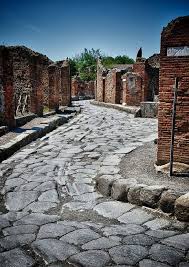
Since excavations of Pompeii began in 1748, many aspects of the ancient civilization buried in ash and rock have emerged.  The excavations and discoveries accelerated since 2012 with the Great Pompeii Project that continue to provide archaeologists and historians with clues about how residents lived, dressed and ate. 

Along the streets of Pompeii were found shops and workshops offering everything imaginable from arts and crafts to hardware and tools.  There were wine stores, bakeries, grocers, fruit stores and bakeries, as well as banks, barber shops, brothels, and public baths.  The discharge of Vesuvius covered, concealed and preserved the mills, ovens and loaves.  Archaeologists found traces of oil in the jugs of olive oil shops and amphoras stacked in the wine stores.  They even found evidence of rosemary, garlic, olive oil, cheese and anchovies in the fossilized flatbreads of bakeries.
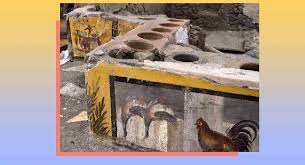
In total, archaeologists have identified about 160 properties that they believe were bars and restaurants.  In October 2020, an extraordinary thermopolium emerged from the excavations.  This is a shop that is similar to what we would call a diner or snack bar today.  It served “street food” popular in A.D. 79 from a counter with submerged pots of ready-made food.  While about 80 thermopolii have been found at Pompeii (and many more will be found), this one is notable for its state of preservation, for the exceptional nature of the painted counter and for the fresh clues it provides about the ancient population’s culinary tastes.

The high quality of the painted panels on the front of a Z-shaped counter include a central image of a Nereid, the mythological sea nymph, riding a sea horse, along with frescoes of a dog on a leash, a rooster and ducks upside down and ready to be eaten.  According to archaeologists, the images represent, in part, a kind of menu available to customers.  There was also a painted image of a thermopolium, complete with amphorae and jars.

At lunch the people of Pompeii ate in the street and in a hurry as neither tables nor chairs were available in a thermopolium.  They mostly ate focaccia, flat bread, olives and jugs of wine.  Archaeologists are examining the contents of the dolia, the terracotta containers, in the countertops and are also finding a menu based on mammals, birds, fish and snails.  While the contents of some dolia remain to be analyzed, they found in one dolium a pork and fish combination, a sort of paella but without rice, which the ancient Romans did not eat.  In another they found a concoction involving snails, fish and sheep, perhaps a soup or stew. 

Pompeii remains a powerful symbol of the power of nature and the transience of life.  But the force of Vesuvius has also preserved for future generations the fascinating lifestyle of ancient Romans.  The excavation of this thermopolium is expected to finish in March 2021 and to be available to visitors by Easter, the coronavirus permitting.

(See also the 3-part series of posts on Pompeii:  Pompeii and a Legacy of Disasters, 1/24/2019; The Great Pompeii Project, 1/31/2019; Extraordinary Discoveries in Pompeii in 2018, 2/7/2019.)
Posted in Abitudini, Arte, Campania, English, Foto, Italia, La Gente, Napoli, Pompei, Storia | 1 Comment

Gino Bartali: Un’icona dello sport e dell’umiltà

Correva l’anno 1937.  Gino Bartali (1914 – 2000) vinse il Giro d’Italia per la seconda volta consecutiva.   Era a quel tempo il più grande idolo sportivo italiano ed europeo. Erano gli anni in cui Benito Mussolini governava l’Italia con violenza e intimidazione, già da ben 15 anni e presto avrebbe portato il paese in guerra. Nel 1938 Bartali vinse il Tour de France. Mussolini cercò di usare questa vittoria sulla scena mondiale per dimostrare la superiorità della razza ariana e quindi dell’Italia, una “razza pura o superiore,” come quella tedesca.

Bartali rifiutò la tessera del partito fascista. Non fu la prima e nemmeno l’ultima volta che sfidò il facismo. Infatti durante la guerra rischiava la vita quasi ogni giorno per proteggere ebrei e partigiani in tutta Italia. La storia di Bartali è la cornice del documentario del 2014, “My Italian Secret: Forgotten Heroes”, diretto da Oren Jacoby e narrato da Isabella Rossellini.

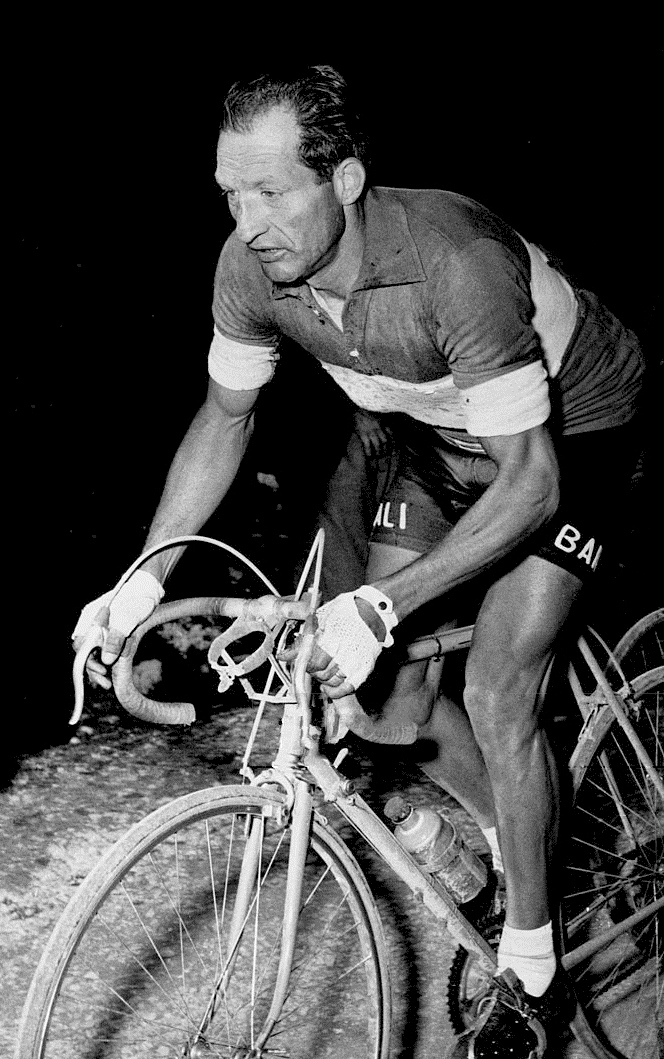
La sua fama come ciclista gli consenti di raggiungere in bicicletta non solo le campagne della sua nativa Toscana, ma anche città come Genova, Roma, Assisi, ecc. Indossava il completo da ciclista con il proprio nome stampato sul retro della maglia. Percorreva circa 40.000 chilometri all’anno durante la guerra. “Mi sto allenando”, diceva, e fascisti e nazisti non osavano fermare l’idolo dello sport. Non sapevano che portava documenti segreti nel telaio della sua bicicletta. Naturalmente non voleva e non poteva svelare quali fossero questi documenti, perché nel caso sarebbe stato arrestato e torturato. Né i nazisti sapevano che aveva nascosto una famiglia ebrea nel seminterrato di casa sua. Se l’avessero scoperto, sarebbe stato immediatamente fucilato.

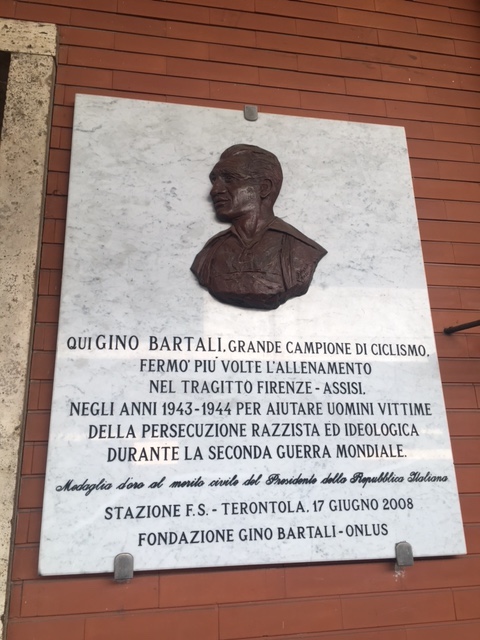
Foto di Eleonora Vieri


Passava spesso anche per Terentola, un piccolo paese della Toscana vicino a Castiglione del Lago in Umbria. La stazione ferroviaria di Terentola era uno snodo importante per i convogli tra il nord e il sud Italia. Ebrei e partigiani tentarono più volte e segretamente di salire sui treni diretti a sud per chiedere asilo. Quindi la stazione era fortemente sorvegliata. Ma quando si presentava Bartoli, la folla si raccoglieva attorno al grande campione del ciclismo. Era il momento giusto per i rifugiati di cambiare treno e dirigersi verso la libertà, perché le guardie sarebbero accorse verso la folla creata da Bartali per disperderla, lasciando così i treni incustoditi.

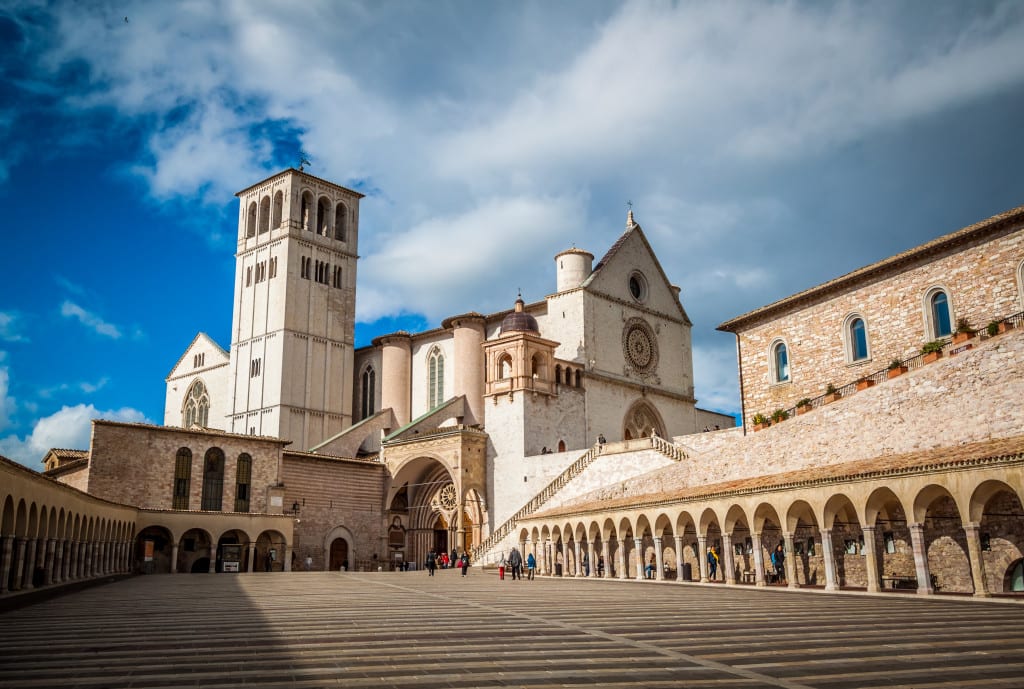
Assisi era il centro dell’attività segreta. Molti ebrei erano nascosti lì nei monasteri e se venivano messi in pericolo dalle truppe in visita, venivano portati nelle grotte romane sotterranee dove potevano fuggire nelle campagne. Tra Firenze e Assisi, Bartali trasportava fotografie e false carte d’identità che avrebbero permesso a molti ebrei di non essere scoperti, e quindi avrebbero evitato una morte certa.


Fu sempre ad Assisi, molti anni dopo, che Bartali iniziò a raccontare al figlio trentenne Andrea, delle sue imprese in tempo di guerra. A Bartali piace andare ad Assisi per ammirare gli affreschi di Giotto e per rivivere i suoi ricordi. Uomo profondamente religioso, Bartali non ha mai parlato delle sue nobili azioni. Disse ad Andrea: “È un mondo in cui devi fare del bene, ma non parlarne”. Fece giurare ad Andrea di non dirlo a nessuno. Quando suo figlio gli chiese: “Perché mi dici questo se non posso dirlo a nessuno?”, suo padre disse: “Un giorno troverai il momento giusto per parlarne”.

Anche dopo che Bartali vinse il suo secondo Tour de France nel 1948, 10 anni dopo la sua prima vittoria in Francia, fece silenzio riguardo ai suoi contributi in tempo di guerra. Credeva che gli eroi fossero quelli che morirono, che venivano feriti o che avevano trascorso un tempo infinito in prigione e nei campi di concentramento. Credeva che se avesse parlato del proprio lavoro, avrebbe tratto vantaggio dalle disgrazie altrui. Credeva che nel mondo ci fossero troppe ingiustizie spinte da un cieco fanatismo. Nella sua intervista nel documentario, Andrea dice: “Ha fatto quello che ha fatto a causa del suo personaggio”.

L’ultima dimora di Bartali rivela ulteriormente la sua umiltà. La tomba riporta semplicemente il suo nome e le date di nascita e morte. Non si fa menzione alcuna alle sue vittorie ciclistiche, al suo eroismo in tempo di guerra, alle tante medaglie che vinse. Come disse lui stesso, “le medaglie devono essere indossate sulla tua anima”

Posted in Arte, Comunità ebrea, Film, Firenze, Foto, Italia, Italiano, Lo Sport, Politica, Storia, Toscana, Umbria | 2 Comments

Gino Bartali: An Icon of Sports and Humility

The year was 1937.  Gino Bartali (1914 – 2000) won the Giro d’Italia for the second straight year.  He was Italy’s and Europe’s biggest sports idol.  By this time, Benito Mussolini had ruled Italy with violence and intimidation for 15 years and he would soon lead the country into war.  In 1938, Bartali won the Tour de France.  Mussolini tried to use this triumph on the world stage to prove Italy’s Aryan superiority — that is, that the Italians, like the Germans, belonged to the “master race.”

Bartali rejected the Fascist party patronage.  It was not the last time he defied the party.  In fact, throughout the war he risked his life almost every day to protect Jews and partisans throughout Italy.  Bartali’s story is the framework of the 2014 documentary, “My Italian Secret: Forgotten Heroes,” directed by Oren Jacoby and narrated by Isabella Rossellini. 

Gino Bartali’s fame as a cyclist enabled him to ride his bicycle not only throughout the countryside of his native Tuscany but also to Genoa, Rome, Assisi, and beyond.  He wore his bicycle uniform with his name emblazoned on the back of his shirt.  He logged about 40,000 kilometers a year during the war.  “I’m training,” he would say, and the Fascists and Nazis didn’t dare stop the sports idol.  Little did they know that he carried secret documents in the frame of his bicycle.  He didn’t want to know what these documents were in case he was stopped and tortured.  Nor did the Nazis discover that he hid a Jewish family in the basement of his home.  Had they discovered either, he would have been immediately shot.

Courtesy of Eleonora Vieri

He also liked to ride to Terentola, a crucial Tuscan town near Castiglione del Lago in Umbria.  The train station there was a transportation crossroad between the North and the South.  Jews and partisans tried to climb unseen onto the trains heading South for asylum.  Hence the station was heavily guarded.  But when Bartoli showed up, crowds gathered around the great cycling champion.  The distracted guards would leave the trains to disperse the crowds, and the refugees would switch trains and head for liberty.

It was Assisi that was the center of underground activity.  Many Jews were hidden there in the monastery and if they were endangered by visiting troops, they were taken to the underground Roman caves where they could escape to the countryside.  Between Florence and Assisi, Bartali was transporting photographs and false identity cards that enabled many Jews to avoid detection and certain death and to flee.

It was also at Assisi that many years later Bartali began to tell his 30-year old son, Andrea, of his wartime activities.  Bartali like to go to Assisi to see the Giotto frescoes and to relive his memories.  A deeply religious man, Bartali never spoke of his deeds.   He told Andrea, “It’s a world in which you must do good but not talk about it.”  He made Andrea swear not to tell anyone.  When his son asked, “Why are you telling me this if I can’t tell anyone?”, his father replied, “Someday you will find the right moment to talk about it.”

Even after Bartali won his second Tour de France in 1948, 10 years after his first victory there, he was silent about his contributions in the war.  He believed that the heroes were those who died, were injured, or who spent endless time in prisons and camps.  He believed that if you talked about your work, you would be taking advantage of others’ misfortunes.  He believed that there is too much injustice in this world spurred on by blind fanaticism.  In his interview in the documentary, Andrea says, “He did what he did because of his character.” 

Bartali’s final resting place further reveals his humility.  The grave simply says his name and the dates of his birth and death.  There is no mention of his cycling championships, no mention of his wartime heroism, no mention of the many medals that he won.  As he himself said, “medals are to be worn on your soul.”

Posted in Comunità ebrea, English, Film, Firenze, Foto, Italia, Lo Sport, Storia, Toscana, Umbria | Leave a comment