Stromboli: The Lighthouse of the Mediterranean

In the second part of the film, Caro Diario called “Isole,” director and actor Nanni Moretti and his friend are searching for a peaceful place to work on their research.  They visit 5 of the 8 islands in the Aeolian archipelago north of Sicily, including Lipari, Salina, Panarea and Alicudi.  Each island has a unique personality. On Stromboli the two friends find that the environment is hostile, which they attribute to the menacing presence of the volcano.

Of the 3 active volcanoes in Italy (the others are Vesuvius and Aetna), Mount Stromboli is the most active.  In fact, it has been in almost continuous eruption for the past 2,000 to 5,000 years. Known worldwide as the Strombolian eruption, an explosion from the summit craters results in energetic bursts up to a few hundred meters in height, containing ash, incandescent lava fragments and stone blocks.  The eruptions rarely result in lava flows and are not massive, but rather, continuous, fountain-like fiery emissions.  Visible from the surrounding sea, this phenomenon gave rise to the island’s nickname “Lighthouse of the Mediterranean.”  The name “Stromboli” comes from the Greek word for “round” because of the volcano’s round, conical appearance from a distance.

The island’s area is only about 5 square miles (12 square km) and its population today is less than 500.  There are two small villages in the northeast, San Barolo and San Vincenzo.  A smaller village, Ginostra, lies in the southwest.  There are no high schools on the island so students must leave for mainland Sicily to continue their education.  According to the 2019 award-winning documentary, Island of Fire,” many of these students leave the island for good, but others are eventually drawn back to the volcano and the beauty of their ancestral home.
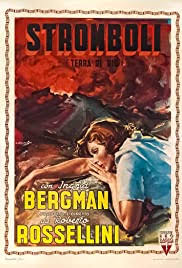
In the early 1900s, Stromboli had far more inhabitants.  About 4,000 people lived on the island until the destructive eruption and tsunami of 1930, which caused many to flee to safer places.  Then in 1950, Roberto Rossellini filmed his movie Stromboli Land of God on location.  The film received much critical acclaim but also negative press in the United States because of the affair between Rossellini and the film’s protagonist, Ingrid Bergman.  The film may also have set in motion the island’s tourist industry.  Today, people in search of tranquility and natural beauty explore the island’s black sand beaches, grottos and caves.  Many visitors hike up 3 miles to witness first-hand the beauty and mystery of the volcano.

Rossellini’s film was also the inspiration for a type of turnover invented by Italian-Americans in Philadelphia around 1950.   A Stromboli is made with bread or pizza dough and filled with various Italian cheeses (typically mozzarella) and Italian meat, such as salami, capicola and bresaola, or vegetables.  Similar to a calzone, a stromboli is rolled or folded into a cylinder, while a calzone is folded into a crescent shape.

Next time you visit the island also known as the Aeolians’ black pearl, pack lots of water and a stromboli and hike up to the summit of Mount Stromboli.

Posted in English, Film, Foto, Italia, Italoamericani, Sicilia, Storia, Vacanze, Viaggio | Leave a comment

Caffè Sospeso (in italiano)

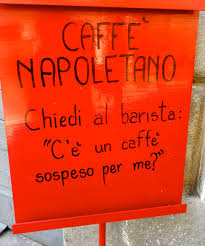
“Searching for Italy” è una serie televisiva in 6 episodi, in viaggio alla scoperta dei segreti e delle delizie della cucina regionale italiana insieme a Stanley Tucci, un attore italo-americano. Nell’episodio di Napoli, Tucci descrive un’usanza risalente a più di 100 anni fa, nata nei caffè della classe operaia di Napoli. Il caffè sospeso: è una tazzina di caffè pagata in anticipo da un anonimo, come atto di carità. Questa tradizione ebbe inizio con un uomo, non sappiamo chi, che ordinò un caffè sospeso, pagando cioè il costo di due caffè, ma bevendone solo uno, perché il secondo era destinato al “fortunato” cliente successivo.  Il secondo caffè in omaggio era riservato a qualcun meno fortunato. 

È un gesto piccolo, ma benevolo, che può avere un grande potere.  A Napoli si racconta la storia di una donna in procinto di fare un colloquio di lavoro: era in fila per il caffè, quando una donna le passò avanti nella fila. Seccata da questo maleducato gesto, si dovette ricredere una volta arrivata al bancone: la sgarbata signora aveva pagato anche il suo caffè.  Allora rinfrancata da questo gesto, affrontò il colloquio di lavoro con un rinnovato senso di speranza, dopo 10 mesi di inoccupazione.

L’usanza sembra si sia diffusa. In Spagna è conosciuto come Café Pendientes e in Francia si chiama Café en Attente. Negli Stati Uniti si usa l’espressione meno incantevole, “paying it forward”. In una città del Massachusetts, una donna di nome Eileen è andata a pagare il caffè in un negozio di ciambelle locale e le è stato detto che il suo caffè era stato già pagato dal cliente precedente. Eileen era così sbalordita, che è tornato al negozio la mattina seguente e ha pagato due caffè, bevendone solo uno. Il suo gesto ha provocato una reazione a catena: i successivi 55 clienti hanno deciso di fare la stessa cosa. Il proprietario del negozio ha detto: “È stato contagioso, la generosità era incredibile e mette tutti di buon umore”.

Così, ecco che anche piccoli atti di gentilezza possono avere un impatto enorme su coloro che li ricevono. Tutti hanno vissuto momenti difficili e un caffè sospeso rende onore alla solidarietà e all’umanità di tutti noi. Inoltre le persone traggono beneficio nel sapere di aver aiutato qualcuno, anche quando lo fanno in modo anonimo. La gentilezza può creare una catena di buona gesti… come un caffè sospeso dopo l’altro.

Posted in Abitudini, Cucina italiana, Foto, il Caffé, Italia, Italiano, Italoamericani, Napoli, Storia | Leave a comment

Caffé Sospeso (English)

“Searching for Italy” is a 6-part television series that follows Stanley Tucci, an Italian-American actor, as he travels across Italy to discover the secrets and delights of the country’s regional cuisine.  In the Naples episode, Tucci describes a custom dating back more than 100 years with roots in the working-class cafés of Naples.  A caffé sospeso, a suspended or pending coffee, is a cup paid for in advance as an anonymous act of charity.  It started when someone who was having a lucky day ordered a sospeso, paying the cost of two coffees and drinking only one.  Either the next client would receive the free cup, or, more likely, it would be reserved for someone a little down on his luck who inquired if a sospeso were available.

It is a small, but benevolent, gesture that can have great power.  There is a story in Naples that a woman about to embark on a job interview was standing on line for her coffee when another woman cut in line ahead of her.  She was annoyed but when she got up to the counter she was told that the other woman had paid for her coffee.  It took the sting out of her annoyance and buoyed her spirits.  She had been out of work for 10 months and faced the interview with a renewed sense of hope.

The custom seems to be spreading.  In Spain it is known as Café Pendientes and in France it is called Café en Attente.  In the United States it goes by the less enchanting expression, “paying it forward.”  In a town in Massachusetts, a woman named Eileen went to settle her coffee bill at a local donut shop.  She was told that her coffee had been paid for by the previous customer.  Eileen was so amazed that she returned to the shop the next morning and paid for two coffees, drinking only one.  Her action prompted quite a chain reaction:  The next 55 customers decided to do the same thing.  The store owner said, “It was infectious, the generosity was unbelievable and it put everyone in such a good mood.”

Even small acts of kindness can have a massive impact on those who receive them.  Everyone has had hard times or lonely times and a caffé sospeso honors the solidarity and humanity in all of us.  It also demonstrates that people take pleasure knowing that they have helped someone, even when they do it anonymously.  Kindness can create a chain of goodwill…one caffé sospeso at a time.

Posted in Abitudini, Cucina italiana, English, Foto, il Caffé, Italia, Napoli, Storia | 2 Comments