The Orchestra of the Sea: Giving Voice to the Voiceless

The Mediterranean Sea is sometimes called the largest cemetery in Europe.  According to the United Nations, 28,000 migrants have died or gone missing in the dangerous crossing of the sea since 2013.  It holds the history of countless migrants desperately using smugglers and un-sea-worthy boats to flee war, persecution, and hunger in search of a better life.  For those who survive and those who perish, their dilapidated boats wash up on the shores of Lampedusa and other southern Italian islands. Now prisoners in Italy are transforming these boats into works of art and symbols of hope.
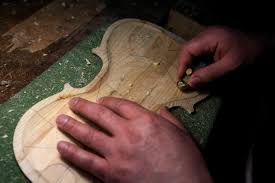
The story begins in 2012 when the Milan-Opera prison, the largest in Italy, began a rehabilitation project in which prisoners could carve, chisel, and assemble wooden objects in a carpentry laboratory.  All through the pandemic, prisoners created crucifixes, rosaries, and nativity scenes for distribution to churches and schools using wood from discarded boats in Lampedusa.  As part of this initiative, a violin was built with some of this wood, using a technique dating back to the 1500s.  The first one was called Violino del Mare (Violin of the Sea).  It produced a sound that amazed musicians and performers with its clarity.

In these prisons, an instrument takes 400 hours to create, from disassembling the boats to the finished product.  While a violin made in the famed workshops of Cremona, an hour’s drive from Milan, is made of fir and maple, the migrant boats are made from a softer African fir painted in the sun-drenched hues of blue, orange, green, and red.  The veneer of paint influences the timbre of the musical instrument.

La Casa dello Spirito e delle Arti is the Foundation that sponsors “Metamorphosis,” the rehabilitation project that established the  Violin Making and Carpentry Laboratories in four Italian prisons.  With the success of the Violin of the Sea, the Foundation asked the Minister of the Interior for 60 more boats from Lampedusa.  During 2022, a second violin, a viola, and a cello were made in the various prisons; during 2023 another 6 violins were created; and in 2024, 8 more stringed instruments will be created. 

Thus was born the Orchestra of the Sea.  It made its debut at the famed Teatro alla Scala in Milan on February 13, 2024.  (See https://www.youtube.com/watch?v=l8bumoRt5Ac.) As they played works by Bach and Vivaldi, the musicians were acutely aware that their instruments also gave voice to the tales of hope and desperation of migrants. In the royal box at the concert hall were the mayor of Milan, along with 2 prisoner-luthiers on leave from the Opera Prison.  As one of the artisans said, “This morning I woke up in an ugly, dark place.  Now I am here.  I feel like Cinderella.”  The concert was live-broadcast / simulcast at the prison as well.
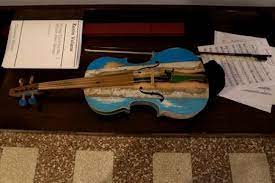
For the prisoners in the Metamorphosis program, creating the instruments provides both physical and psychological therapy.  One prisoner revealed that the four to five hours of work a day in the laboratory gave him a sense of tranquility, a time to reflect on the mistakes he’s made, as well as an opportunity to develop skills for a future.  “I’m gaining self-esteem,” he revealed.  The prisoners also reflect on the lives of the migrants: they sometimes find remnants of their lives–like a diaper bag and a little sneaker in the boats—and wonder whether these daring and desperate travelers survived. 

This is a story of many transformation:  from discarded wood to beautiful musical instruments worthy of the La Scala stage; from prisoners without hope to artisans and luthiers with a future; from voiceless migrants to soaring music that draws the spotlight on their lives.  The Orchestra of the Sea will continue performing throughout Italy and southern Europe, finally going to the northern European capitals where policy is created.
Posted in Abitudini, Arte, English, Foto, Immigrazione, Italia, La Gente, la politica, Milano, Musica, Politica, Storia | 2 Comments

La Stanza Segreta

Le Cappelle Medicee a Firenze sono strutture annesse alla Basilica di San Lorenzo di Brunelleschi, considerata la chiesa “ufficiale” della famiglia Medici. Diversi membri della famiglia sono sepolti nella Sagrestia Vecchia. Il cardinale Giulio de Medici, il futuro papa Clemente VII, volle erigere un vero e proprio mausoleo di famiglia e assunse Michelangelo per progettare la Sagrestia Nuova nel 1520. Da qui si svilupparono due storie misteriose.

Nel 1530, Michelangelo scomparve per tre mesi mentre stava lavorando alle cappelle.  Per quasi 500 anni il luogo in cui si nascose Michelangelo è rimasto un mistero, ma è emersa una teoria riguardo a ciò.  Intorno al 1527 i fiorentini si erano stanchi dei Medici, una delle famiglie più ricche e potenti d’Europa.  Sperando in un governo più democratico, i ribelli organizzarono una rivolta popolare per cacciare la famiglia regnante da Firenze. Michelangelo si unì ai ribelli, che lavoravano per aiutare a fortificare le mura della città contro i Medici.

Perché Michelangelo si sarebbe unito ai ribelli?  In realtà doveva il suo sostentamento al Papa e alla famiglia Medici, che gli commissionò varie opere, incluso il proprio progetto a cui stava lavorando.  Dopo 10 mesi di lotta, il Papa e la sua famiglia vinsero, e i ribelli vennero rapidamente puniti.  Anche Michelangelo sarebbe stato punito se non avesse trovato un nascondiglio.  Nel novembre del 1530, tuttavia, il Papa informò Michelangelo che poteva tornare al lavoro—impunito—per completare la Cappella.  Solo allora uscì dal suo nascondiglio.

Saltiamo 445 anni al 1975.  Il direttore del Museo delle Cappelle Medicee in quel momento stava cercando per un modo che permettesse ai turisti di uscire dal museo.  Lui e i suoi colleghi scoprirono una botola nascosta sotto un armadio vicino alla Sagrestia Nuova, una camera progettata per ospitare le tombe ornate dei sovrani medicei.  Sotto la botola, gradini di pietra conducevano a una stanza, che all’inizio pensarono fosse utilizzata solo come magazzino per il carbone.  Si chiedevano se ci fosse qualcosa di interessante sotto le pareti di gesso.  Gli esperti trascorsero settimane rimuovendo meticolosamente l’intonaco con i bisturi.

Ciò che emerse furono dozzine di disegni a carboncino e gesso, si pensò così che fossero di Michelangelo, opere prodotte nel periodo di fuga durante la rivolta. Alcuni schizzi sono simili ai suoi capolavori più famosi, tra cui la statua di Davide, i dipinti nella Cappella Sistina e una statua che adorna una tomba medicea nella Sagrestia di sopra.  Apparentemente riempiva la sua solitudine con riflessioni su vecchi lavori, oltre a disegni di che avrebbe voluto una volta sopravvissuto a quei drammatici mesi.

Oltre alle domande logistiche su come sopravvisse in questo spazio di 7 x 2 metri, emergono dubbi sulla provenienza di questi disegni.  Come qualsiasi opera d’arte non firmata, è impossibile confermare con certezza l’origine dei disegni.  Alcuni critici d’arte ritengono che alcuni dei graffiti siano troppo amatoriali per essere di Michelangelo.  Altri sono convinti che in questa stanza segreta ci sia la principale scoperta artistica del ventesimo secolo.  Presumibilmente Michelangelo ricordò il suo trascorso lì: “Mi sono nascosto in una piccola cella, sepolto come i defunti Medici di sopra, sebbene mi stessi nascondendo di uno vivo.  Per dimenticare le mie paure, ho riempito le pareti di disegni”.

Dalla scoperta di questi disegni nel 1976, la stanza è stata aperta principalmente agli studiosi.  Tuttavia, nel 2013, i computer touch screen hanno reso i tesori visibili a un pubblico più ampio. 

Ora, a quasi 50 anni dalla scoperta, la stanza è stata aperta al pubblico. A causa delle dimensioni della stanza e per tutelare i disegni, le visite saranno riservate a gruppi di quattro persone e limitate a 15 minuti.

Posted in Arte, Firenze, Foto, Italia, Italiano, Storia, Toscana, Vaticano | Tagged , | 1 Comment

The Secret Room

The Medici Chapels are structures adjoining Brunelleschi’s Basilica of San Lorenzo in Florence, which was considered the “official” church of the Medici family.  Several family members are buried in the Old Sacristy.  Cardinal Giulio de Medici, the future Pope Clement VII, wanted to erect a proper family mausoleum and hired Michelangelo to design the New Sacristy in 1520.  Two mysterious stories have evolved from here.

In 1530, Michelangelo disappeared for three months while working on the Chapels.  His whereabouts remained a secret for almost 500 years, but one theory has emerged.  By 1527 Florentines had grown weary of the Medici, one of the wealthiest and most powerful families in Europe.  Hoping for a more democratic government, rebels organized a popular revolt and drove the ruling family out of Florence.  Michelangelo joined the rebels working to help fortify the city walls against the Medici forces.

Why would Michelangelo join the rebels?  He owed his very livelihood to the Medici family, who commissioned his art including the very project he was working on.  After 10 months of struggle, the Medici family won, and the rebels were swiftly punished.  Michelangelo would have been punished too had he not found a hiding place.  By 1530, the Pope let it be known that Michelangelo could return to work—unpunished—to complete the Chapel.  Only then did he emerge from his hiding place.

Fast forward to 1975.  The director of the Medici Chapels Museum was searching for a new way for tourists to exit the museum.  He and his colleagues discovered a trapdoor hidden beneath a wardrobe near the New Sacristy.  Below the trap door, stone steps led to a room that appeared at first to simply store coal.  They wondered if something interesting might be underneath the plaster walls.  Experts spent weeks meticulously removing the plaster with scalpels.

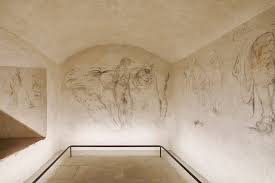
In a secret room located in Florence’s church of San Lorenzo the walls are covered in drawings believed to be the work of Michelangelo and his disciples

What emerged were dozens of charcoal and chalk drawings believed to be the work of Michelangelo in the room where he may have hidden during the revolt.  Some sketches are similar to his most famous works, including the statue of David, paintings in the Sistine Chapel, and a statue adorning a Medici tomb in the Sacristy above.  He apparently filled his solitude with reflections on old works, as well as sketches of those he wanted to do once he survived those dramatic months.

Apart from questions about how he survived in this space, there are doubts about the provenance of these drawings.  As with any unsigned artwork, it is impossible to confirm the origins with absolute certainty.  Some art critics believe that the doodles are too amateurish to be Michelangelo’s.  Others are convinced that in this 7- by 2-meter secret room is the major artistic find of the 20th century.  Supposedly Michelangelo recalled his time there: “I hid in a tiny cell, entombed like the dead Medici above, though hiding from a live one.  To forget my fears, I filled the walls with drawings.”

Since the discovery of the drawings in 1976, the secret room has been open mostly for scholars.  In 2013, touch screen computers made the treasures visible to a wider audience.  Now nearly 50 years after the discovery, the room has been open to the public.  Due to the size of the room and to protect the drawings, visits will be kept to groups of four and limited to 15 minutes.

Posted in Architecture, Arte, English, Firenze, Foto, Italia, la politica, Politica, Storia, Toscana, Vaticano | 2 Comments