The Coppola Cap

For sale in the market stalls of Palermo today and worn throughout Sicily and even in Calabria and elsewhere is the Coppola hat, a type of flat hat that is an iconic symbol of Sicily.  The history is uncertain, as is the origin of the name.  One popular theory is that it originated in England where a law in 1571 required males older than 6 years (except for nobles and the upper class) to wear woolen hats on Sundays and holidays.  The purpose was to protect the domestic production of wool, which was the basis of the country’s economy at the time.

How did the coppola hat reach Sicily?  According to this theory, there was a migration in the late 19th century of English families in search of bargains and investments.  Very much in vogue in England and Ireland, the flat cap took the Italian name of “coppola,” which came from the English word “cup.”  However, others believe that the name “coppola” is more likely to be a Sicilian, Calabrian or Apulian adaptation of the Latin word “caput” for head.  The Sicilian word “còppula” also means head.  

Another theory on the history says that the Sicilian cap is a variation of the English gamekeeper’s cap introduced in Sicily around 1800 when Ferdinando I, King of Naples and Sicily, left Naples for Palermo in the face of Napoleon’s invasion of southern Italy.  British troops were stationed in Sicily to protect the island from a possible French invasion and to protect Sicilian sulphur, which was critical to Britain’s military strength and to its industrial revolution.  

An avid hunter, Ferdinando was often accompanied on these outings by British military and diplomats.  The Sicilian aristocracy began to imitate the British modes of dress, like the tweed hunting caps.  Before long, Sicilian peasants were imitating the style.  The hat provided protection from the sun and allowed workers to wear an inexpensive item that they considered a luxury.  Before long, landowners began to refer to submissive workers as “una buona coppola.” As the mafia gained control of the countryside, mafiosi used the same term for citizens unlikely to interfere in the organization’s criminal activities.  Then it became associated with the “picciotti,” who were young men in the lowest ranks of the mafia hierarchy.

Even since its earliest days, the flat cap has evolved in usage and meaning.  In the beginning in England, it denoted different socio-economic levels:  Black was worn by the working class, brown was for farmers and field works, and blue was used by sailors.  It became a driving hat and a newsboy hat.  And later in the twentieth century, it was linked to rich people’s sports like hunting and golf, and even to musical genres such as jazz.

By the 1990s, Italian and other designers begin to take inspiration from the past, but instead of making dull-colored tweed cuppola caps, they designed brightly colored ones in many different fabrics, including cotton and linen and even in denim made from recycled jeans.  In Sicily, a “Mafia awareness” movement supported the creation of attractive caps, which were intended to debunk the traditional stereotype of the rustic Sicilian Mafioso.  While the older generation of Sicilians still wear the traditional caps, the brightly colored coppola is probably the wave of the future.

Posted in Abitudini, Calabria, Differenze culturali, English, Foto, Italia, La Gente, La Moda, Mafia, Puglia, Sicilia, Storia | Leave a comment

Ancora sulla Vittoria Alata della Brescia

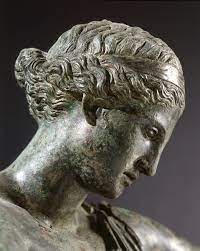
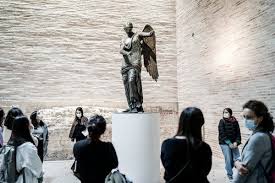
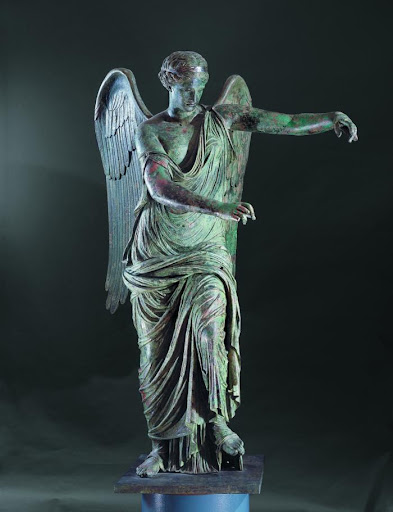
Una delle sculture più celebri al mondo è la Vittoria Alata di Samotracia (chiamata anche Nike di Samotracia), una scultura in marmo di età ellenistica del II secolo a.C. oggi in mostra su un piedistallo in cima a una scala al Louvre. C’è un’altra Vittoria Alata, del I secolo d.C., che ha anche raccolto lodi e attenzioni in tutto il mondo… un bronzo romano che oggi si trova in un parco archeologico nella città di Brescia in Lombardia. Come spesso accade con le statue romane, esse nascevano come copie o ispirazione di originali statue greche.

, Il tempio principale di Brixia (come era chiamata Brescia nel I secolo d.C.), dedicato a Giove, Giunone e Minerva, Fu scoperto durante gli scavi del Capitolium. Gli scavi iniziarono nel 1822 e nel luglio 1826 fu fatta una scoperta sorprendente: un grande ammasso di oggetti in bronzo fu trovato nascosto tra due pareti del tempio, tra cui statue equestri, il braccio di un uomo e la Vittoria e le sue braccia e ali. Erano molto probabilmente le decorazioni in bronzo del tempio; la Vittoria Alata probabilmente sormontava il frontone, forse per commemorare i successi dell’imperatore romano Vespasiano, che regnò dal 69 al 79 d.C. Insieme ai ritratti in bronzo dorato di altri imperatori romani, il deposito segreto fu intenzionalmente nascosto, probabilmente alla fine del IV secolo, quando il cristianesimo divenne religione ufficiale dell’impero e i simboli pagani distrutti o fusi, nel caso di manufatti in bronzo. Pertanto, la Vittoria Alata nascosta è una delle poche statue di bronzo romane sopravvissute in gran parte intatte.

Data l’importanza della scoperta, il primo museo civico di Brescia aperto nel 1830 sorge nelle ricostruite rovine del tempio. La mostra più importante è stata la Vittoria Alata, ora con le braccia e le ali ricongiunte. Brescia divenne presto una calamita per i visitatori italiani e stranieri. L’imperatore Napoleone III vide la Vittoria Alata nel 1859 e rimase così colpito dall’eleganza della statua che ne chiese una copia, che ora è esposta al Louvre. Un’altra versione ha anche abbellito la villa costruita per il magnate William Randolph Hearst a San Simeon, in California. Poeti e autori, tra cui Giosuè Carducci, Michele D’Annunzio e Henry James, resero omaggio alla sua bellezza. 

La Vittoria Alata è alta quasi 2 metri rispetto a Samotracia, che è 2,44 metri o 2,75 metri con le ali. Il bronzo di Brescia fu fuso con la tecnica della cera persa, in cui il metallo fuso viene colato in uno stampo ricavato da un modello in cera fusa. Almeno 30 parti furono fuse separatamente e successivamente saldate insieme probabilmente da esperti bronzisti del nord Italia. Le rifiniture furono accuratamente eseguite con strumenti appuntiti e attraverso la tecnica della damascena, una tecnica di intarsio, l’argento fu intrecciato nei suoi capelli. Decorazioni in argento e rame adornavano il suo diadema. Attraverso il restauro, sono state recuperate ulteriori tracce di doratura sulle braccia e sulle mani. Componenti mancanti sono un elmo, probabilmente presente sotto il piede sinistro, e uno scudo, che avrebbe portato il nome del vincitore, alzato verso lo sguardo degli spettatori.

Ora, 2000 anni dopo, la dea Vittoria, la personificazione della Vittoria, è arrivata a rappresentare la resilienza e la vitalità duratura di Brescia, dopo che la città è stata fortemente colpitac dal coronavirus durante i primi giorni della pandemia del 2020.

Posted in Arte, Foto, Italia, Italiano, Lombardia, Storia | Leave a comment

More on the “Winged Victory” of Brescia

One of the most celebrated sculptures in the world is the Winged Victory of Samothrace (also called the Nike of Samothrace), a marble Hellenistic sculpture created in the 2nd century BC and today prominently displayed on a pedestal at the top of a staircase in the Louvre.  There is another Winged Victory, created in the 1st century CE, that has also garnered worldwide praise and attention…a Roman bronze that today stands in an archaeological park in the city of Brescia in Lombardy.  As is often the case with Roman statuary, there were Greek originals that initiated or inspired fashionable Roman copies or adaptations.

It was found during excavations of the Capitolium, the main temple of Brixia (as Brescia was called in the 1st century AD), which was dedicated to Jupiter, Juno, and Minerva.  Excavations began in 1822, and in July 1826, a startling discovery was made: a large hoard of bronze objects was found hidden between two walls of the temple, including equestrian statues, the arm of a man, and Victory and her arms and wings.  They were most likely the bronze decorations of the temple; the Winged Victory probably topped the pediment possibly commemorating the achievements of Roman Emperor Vespasian who reigned from 69 to 79 AD.  Together with gilded bronze portraits of other Roman emperors, the cache was intentionally hidden, probably at the end of the 4th century, when Christianity was adopted as the official religion of the empire and pagan symbols were destroyed or, in the case of bronze artifacts, melted down.  Thus, the hidden Winged Victory is one of the few Roman bronze statues to have survived largely intact.

Given the importance of the discovery, Brescia’s first civic museum was opened in 1830 in the rebuilt ruins of the temple.  The most important exhibit was the Winged Victory, now with her arms and wings reattached.  Brescia soon became a magnet for Italian and foreign visitors.  Emperor Napoleon III saw the Winged Victory in 1859 and was so impressed by the elegance of the statue that he asked for a copy to be made, which is now on display at the Louvre.  Another version even graced the monstrous built for tycoon William Randolph Hearst in San Simeon, California.  Poets and authors, including Giosuè Carducci, Michele D’Annunzio, and Henry James, paid homage to her beauty.

The Winged Victory stands almost 2 meters tall (less than 7 feet) compared to Samothrace, which is 2.44 meters (8 feet) or 2.75 meters (9 feet) with the wings.  Brescia’s bronze was cast using the lost-wax technique, in which molten metal is poured into a mold made from a wax model that has been melted away.  At least 30 parts were cast separately and later soldered together probably by expert bronze workers in north Italy.  The finishing touches were carefully done with pointed tools and, through the technique of damascening (a method of inlaying), silver was woven into her hair. Silver and copper decorations adorned her diadem.  Through restoration, additional traces of gilding were recovered on the arms and hands.  Missing components are a helmet, probably present under the left foot, and a shield, which would have borne the name of the victor, held up to the gaze of spectators.

Now, 2,000 years later, the goddess Victoria, the personification of Victory, has come to represent Brescia’s resilience and enduring vitality after the city was devastated by coronavirus during the early days of the pandemic of 2020.

Posted in Arte, English, Foto, Italia, Lombardia, Storia | 2 Comments