The Mona Lisa of Montecitorio

There are relatively few known surviving paintings by Leonardo da Vinci.  Only about 8 major works are universally attributed to him; there are some that are attributed to his workshop, assistants, and his brushstrokes. There are many incomplete works, and many whose attributions are quite complicated like the Salvator Mundi, which has made headlines in the last few years, first for its historic sale at auction, and then for the revelation that the buyer was Saudi Prince Mohammed bin Salman (see the post of December 9, 2021: “Salvator Mundi: The ongoing saga”).

Now a new story unfolds in Rome: It is the case of the Mona Lisa of Montecitorio.  There are many copies of the masterpiece that today hangs in the Louvre, and this one had been known to exist in the collection of the Palazzo Montecitorio, the seat of the Italian Chamber of Deputies.  It measures 70 cm x 50 cm (less than 28” by 20”), which is smaller than its sister in the Louvre.  But when it was painted and by whom remains controversial as there are no documents to reconstruct the origins of the painting. 

The painting was first mentioned in the Torlonia inventory in 1814 as “a copy of Leonardo da Vinci’s ‘Mona Lisa.’” Called the Torlonia Gioconda, it was owned by a noble Roman family (see the post of July1, 2021: The Torlonia Marbles).  At some point, the painting was attributed to Bernardo Luini, who worked with Leonardo; in fact, some scholars believe that Luini created the Salvator Mundi.  In 1892, the painting became part of the collection of the National Gallery of Ancient Art at Palazzo Barberini.  The work was granted to the Chamber of Deputies in 1927 where it hung for many years in an office above a radiator.  Today it is in the Aldo Moro room on the first floor of the Palazzo Montecitorio.

Today’s controversy started in 2019 when the restored Torlonia Gioconda was featured in an exhibition, Leonardo in Rome: Influences and Legacy at the Accademia dei Lincei to celebrate the 500th anniversary of Leonardo’s death.  The exhibition’s curators claim that the Roman copy could have been created in da Vinci’s studio and that the glazes, the chiaroscuro effect and the refined painting technique suggest a possible intervention by the master himself. 

Cinzia Pasquali, the painting’s restorer, is one of the most famous art restorers in the world.  She has worked for 25 years at the Louvre and conducted the “restoration of the century” in Leonardo’s painting, The Virgin with Child and St. Anne. According to her, the painting dates from the first half of the 16th century and is not by Leonardo but it could have been created in his studio.

Art historians, art critics, and even parliamentarians had their strong opinions about the painting, from “modest” to “the decorative value of furniture” to “it takes my breath away how ugly this painting is.  Not a drop of Leonardo.”  A more measured expression came from a former superintendent of Rome: “it does not seem to have the imprint of an excellent hand like that of Leonardo.”

A member of the Italian Chamber of Deputies announced that a comprehensive study will be carried out on the painting.

Posted in Arte, English, Foto, Italia, Roma, Storia | 1 Comment

Fenicotteri rosa

I fenicotteri rosa sono recentemente apparsi sulle pagine dei notiziari sia italiani, che americani. In Italia, gli uccelli migratori tornano a frotte dall’Africa durante i mesi primaverili ed estivi, diretti in località sparse lungo tutta la penisola. Negli Stati Uniti, un fenicottero fuggito da uno zoo del Kansas nel 2005 è stato avvistato a marzo 2022 in Texas, uno stato generalmente non frequentato da questa specie di uccello.

Il nome inglese “flamingo” deriva dalla parola portoghese o spagnola flamengo, che rimanda al “colore della fiamma”. Il nome latino Phoenicopterus deriva dal greco e significa cremisi o piume rosse. I fenicotteri si nutrono di artemia salina e alghe azzurre, oltre a insetti, molluschi e crostacei; la loro colorazione, che va dal rosa brillante al rosa pallido, deriva dalla quantità di beta-carotene nel loro apporto alimentare.

Una caratteristica distintiva di questo trampoliere è la suo stare in piedi su una sola zampa, tenendo l’altra nascosta sotto il corpo. Il motivo di questo comportamento non è del tutto chiaro. Una teoria è che ciò consenta agli uccelli di conservare il calore corporeo; tuttavia, è un comportamento che si osserva negli uccelli che stanno in acqua sia fredda che calda, sia fuori dall’acqua. Un’altra teoria afferma che ciò riduca il dispendio energetico.

Esistono sei specie di fenicotteri: quattro nelle Americhe e due in Africa e in Europa. I più grandi sono alti fino ad 1,4 metri e possono pesare fino a 3,5 kg.  L’apertura alare varia da 94 cm a 150 cm. Poiché i fenicotteri sono volatori molto abili, quelli in cattività richiedono il taglio annuale delle ali (una procedura indolore simile a un taglio di capelli negli esseri umani) per prevenire la fuga.

È stato proprio questo mancato trattamento che ha permesso al Flamingo n. 492 e n. 347 (numeri di identificazione posti sulle fascette attorno alle zampe) di fuggire dallo zoo del Kansas in una ventosa giornata del 2005. Il n. 347 è volato a nord e non è stato più visto. Il numero 492, successivamente soprannominato Pink Floyd, si diresse a sud il giorno dell’Indipendenza e trovò un ambiente favorevole  in Texas, per le zone umide con acque poco profonde e salate, per le temperature adeguate e per le buone fonti di cibo. Nonostante i molteplici avvistamenti del n. 492, in particolare in primavera, non è chiaro se il Texas sia una dimora permanente o parte di una zona migratoria.

Ciò che è chiaro in Italia è che migliaia di questi maestosi uccelli che migrando dall’Africa si dirigono in diverse regioni dall’habitat favorevole: dalla Puglia al Delta del Po, dalla Sicilia alla Sardegna. I fenicotteri sono uccelli molto socievoli e formano forti legami di coppia; sono state segnalate anche coppie dello stesso sesso. Vivono in colonie che possono essere migliaia. Si ritiene che le colonie servano a tre scopi: evitare i predatori, massimizzare l’assunzione di cibo e utilizzare in modo più efficace gli scarsi siti di nidificazione. Ecco le zone italiane, dove si possono avvistare le maggiori colonie di fenicotteri:

• In Puglia, nelle Saline della Riserva Naturale Margherita di Savoia nei pressi di Trinitapoli, sul Mare Adriatico, colonia considerata la più grande d’Europa;

• In Calabria, nell’Oasi Naturale del Pantano di Saline Joniche;

• In Sardegna, a cominciare dagli stagni di Molentargius e Santa Gillia a Cagliari, nei pressi di San Teodoro, vicina alla celebre spiaggia La Cinta;

• In Emilia Romagna, nel Parco del Delta del Po, anche nelle Valli di Comacchio e nelle Saline di Cervia;

• In Sicilia, nella Riserva Naturale delle Saline di Priolo Gargallo vicino a Siracusa.

La mia amica ed editrice Eleonora Vieri, che vive a Castiglione del Lago in Umbria, mi ha detto che i fenicotteri rosa arrivano al Lago Trasimeno ogni anno per alcuni giorni. Se rimangono più a lungo, a volte diventano grigi perché non trovano i gamberetti rosa che donano loro quelle eleganti nuance. Sono comunque bellissimi da vedere.

In natura, i fenicotteri possono vivere fino a 50 anni. Pink Floyd, che si stima abbiano 25 anni, si sono sicuramente guadagnati le ali e la libertà.

Posted in Animali, Calabria, Foto, Immigrazione, Italia, Italiano, Puglia, Sardegna, Sicilia, Umbria | Leave a comment

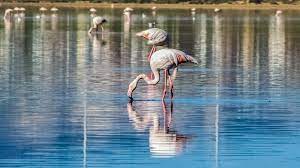
Pink Flamingos

Pink Flamingos have been in the news recently in both Italy and the United States.  In Italy, the migratory birds are returning in droves from Africa for the spring and summer months in favorable Italian habitats throughout the peninsula.  In the United States, a flamingo that had escaped from a Kansas zoo in 2005 has been sighted as recently as March 2022 in Texas, a state that almost never sees this species of bird.

The English name “flamingo” comes from the Portuguese or Spanish word flamengo for “flame-colored.”  The Latin name of the genus, Phoenicopterus, comes from the Greek for crimson- or red-feathered.  Flamingos feed on brine shrimp and blue-green algae, as well as insects, mollusks and crustaceans; their coloring, which ranges from brilliant pink to pale pink, derives from the amount of beta-carotene in their food supply.

A distinctive characteristic of this wading bird is its stance on one leg with the other tucked beneath the body.  The reason for this behavior is not entirely understood.  One theory is that it enables the birds to conserve body heat; however, it is observed in birds standing in both cold and warm water and no water at all.  Another theory claims that it reduces energy expenditure.

There are six species of flamingos—four in the Americas and two in Africa and Europe.  The largest are up to 4.7 feet (1.4 meters) in height and can weigh up to 7.7 pounds (3.5 kg).  The wingspan varies from 37 inches (94 cm) to 59 inches (150 cm).  As flamingos are very capable flyers, those in captivity require annual wing clipping (a painless procedure similar to a haircut in humans) to prevent escape. 

It was precisely this missed spa treatment that enabled Flamingo No. 492 and No. 347 (identification numbers on the leg bands) to escape from the Kansas zoo on that windy day in 2005.  No. 347 flew north and was never seen again.  No. 492, subsequently nicknamed Pink Floyd, headed south on Independence Day and found a compatible environment in Texas with its shallow, salty wetlands, suitable temperatures and ample food sources.   Despite multiple sightings of No. 492 particularly in the spring, it is unclear whether Texas is a permanent home or part of a migratory pattern.

What is clear in Italy is that thousands of these majestic birds are migrating from Africa to favorable habitats from Puglia to the Po Delta, from Sicily to Sardinia.  Flamingos are very social birds and form strong pair bonds; same-sex pairs have also been reported.  They live in colonies that can number in the thousands.  The colonies are believed to serve three purposes:  avoiding predators, maximizing food intake, and using scarce nesting sites more efficiently.  Here are the major colonies in Italy where they can be seen:

  • In Puglia, overlooking the Adriatic, in the salt pans of the Margherita di Savoia Nature Reserve near Trinitapoli, considered the largest in Europe;
  • In Calabria, in the Natural Oasis of the Pantano di Saline Joniche;
  • In Sardinia, beginning with the ponds of Molentargius and Santa Gillia in Cagliari, also near Teodoro, near the famous La Cinta beach;
  • In Emilia Romagna, in the Po Delta Park, also in the Comacchio Valleys and in the Saline di Cervia; and
  • In Sicily, in the Saline di Priolo Gargallo Nature Reserve near Siracusa.

My friend and editor, Eleonora Vieri, who lives in Castiglione del Lago (Umbria), tells me that flamingos come to her Lake Trasimeno each year for a few days. If they stay longer, they turn gray because the shrimp in the lake are grayish. She says they are beautiful.

In the wild, flamingos can live up to 50 years.  Pink Floyd, who is estimated to be 25 years old, has certainly earned his wings and his freedom.

Posted in Animali, English, Foto, Immigrazione, Italia, Puglia, Sardegna, Sicilia, Umbria | Leave a comment