The Piccirilli Brothers

Since probably well before the Renaissance, Italian sculptors were renowned throughout the world for their artistry and skill.  Even in America until the late 1880s, plaster models were shipped to Italy to have them translated into marble by carvers there.  The process could take more than a year.

Two trends changed this dynamic.  First was the wave of Italian immigration that brought talented artists to the United States.  Towns and cities like Santa Barbara were built by stone masons originally from the Veneto.  Their artistry can be seen on the walls and edifices throughout the city.  The hand of Ettore Cadorin can be seen in the statuary of the Santa Barbara Court House.  Under the direction of Gutzon Borglum, Mount Rushmore was created primarily by Luigi del Bianco, the chief carver who refined the facial expressions of the presidents.  As Borglum himself said, del Bianco “is worth any three men I could find in America…. He is the only intelligent, efficient stone carver on the work who understands the language of the sculptor.”  However, his role went unrecognized, perhaps in part because of anti-Italian sentiment, until this century.

The second trend in the 1880s was a growing demand for beautiful public sculpture.  The City Beautiful movement was taking hold in metropolitan areas throughout the country, and nowhere more prominently than in New York City.  And it was to New York City in 1887 that Giuseppe Piccirilli emigrated with his wife, six sons, and a daughter.  Giuseppe was a successful sculptor and stone carver from Massa Carrara in Tuscany, the very place where Michelangelo had found the stone for “Davide.”  His sons—Ferruccio, Attilio, Furio, Getulio, Masaniello and Orazio—were all beginning to show interest and talent as well.

They opened their first studio in Manhattan but moved later to the “country” in the Bronx.  Soon they met Daniel Chester French, who was emerging as a leading American sculptor.  He was so impressed with the artistry of the Piccirilli family that over the next 35 years all but two of his stone sculptures were carved by the brothers.  Included in this immense volume of work was Abraham Lincoln, the colossal central figure of the Lincoln Memorial in Washington, DC,  built between 1914 and 1922.  French sent them a 7-foot plaster model; the Piccirillis used 28 blocks of Georgia marble weighing 150 tons to carve the 19-foot statue.  French tried and failed twice to persuade officials in charge of the Lincoln Memorial to add the Piccirilli name to the monument.

The Piccirilli brothers not only executed the visions of other sculptors, but they also sculpted their own original works.  Their artistry—and their dual professional identities as sculptors and carvers—is evident in works throughout America, but nowhere as prominently as in New York City, which the brothers helped establish as a center for art production.  They carved the famous lion sculptures outside the New York Public Library, as well as the figures in the pediment of the New York Stock Exchange.  They sculpted hundreds of works in Riverside Church.  They designed and produced “Youth Leading Industry,” a bas-relief installed at Rockefeller Center with the innovative use of Pyrex glass blocks.  And the list goes on…. *

The Bronx studio consisted of two immense brick buildings that housed mountains of marble and granite, as well as antique busts and plaster reproductions of Greek and Roman art.  To Daniel Chester French, the studio probably resembled an ancient Florence bottega like the places where the old Renaissance masters created their masterpieces.  French believed that the brothers were better stone carvers than he was.  His esteem for them was so high that he acquired some of their original works for the Metropolitan Museum of Art while he was serving on the museum’s board of trustees.

Yet, the Piccirillis have largely been forgotten, lost in the shadow of figures like Mr. French.  Now, a filmmaker, Eduardo Montes-Bradley, wants to shine a spotlight on the family legacy.  His documentary, “The Italian Factor,” portrays the brothers as prodigiously talented artists indispensable to public art in New York and throughout the country.  The filmmaker also notes that, despite the brothers’ success, an original sculpture by Attilio called “The Outcast” reflects its creator’s alienation at a time of rampant anti-Italian sentiment in the country.  The marble statue depicts a seated, beleaguered nude with his knees drawn to his chest one hand gripping his shoulder and the other shielding his head as if from a blow.  But when the Piccirilli mother died in Italy in 1921, they had her body transported to New York.  It was perhaps at her burial in the Bronx that they felt fully at home in America.

*Other notable works include the allegorical figure of America at the U.S. Custom House at Bowling Green; the statues and part of the pediment of the Brooklyn Museum; the Fireman’s Memorial at Riverside Drive; the Maine Monument, which commemorates the sinking of the battleship Maine in 1898, at the entrance to Central Park near Columbus Circle; and Seal and Fragilina, two among their original worksin the Metropolitan Museum of Art.

Posted in Architecture, Arte, California, English, Film, Foto, Immigrazione, Italia, Italoamericani, New York, Santa Barbara, Storia, Toscana, Veneto | 2 Comments

L’Orchestra del Mare

Il Mar Mediterraneo è talvolta chiamato il più grande cimitero d’Europa.  Seconda le Nazioni Unite, 28.000 migranti sono morti o sono scomparsi nel pericoloso attraversamento del mare dal 2013.  Custodisce la storia di innumerevoli migranti che utilizzano disperatamente trafficanti e imbarcazioni non idonee al mare per sfuggire alla guerra, alla persecuzione e alla fame, in cerca di una vita migliore.  Per coloro che sopravvivono e coloro che periscono, le loro imbarcazioni disastrate vengono portate  sulle coste di Lampedusa e di altre isole del sud Italia.  Ora, i prigionieri in Italia stanno trasformando queste imbarcazioni in opere d’arte e in simboli di speranza.

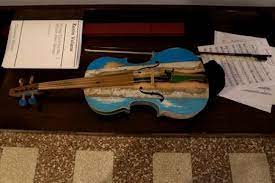
La storia ha inizio nel 2012 quando il carcere di Milano-Opera, il più grande d’Italia, ha avviato un progetto di riabilitazione in cui i detenuti potevano intagliare, scalpellare e assemblare oggetti in legno in un laboratorio di falegnameria.  Durante il periodo della pandemia, i prigionieri hanno creato crocifissi, rosari e presepi da distribuire alle chiese e alle scuole, utilizzando il legno proveniente dalle imbarcazioni abbandonate a Lampedusa.  Come parte di questa iniziativa, è stato costruito un violino con parte di questo legno, utilizzando una tecnica che risale al 1500.  Il primo è stato chiamato Il Violino del Mare.   Ha prodotto un suono che ha stupito musicisti e artisti con la sua chiarezza.

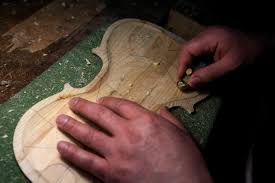
In queste carceri, la creazione di uno strumento richiede 400 ore, dalla smontatura delle imbarcazioni al prodotto finito.  Mentre un violino realizzato nei famosi laboratori di Cremona, un ora di distanza da Milano, è fatto di abete e acero, le imbarcazioni dei migranti sono fatte di un abete africano più morbido dipinto nei colori assolati di blu, arancione, verde e rosso.  La vernice influenza il timbro dello strumento musicale.

La Fondazione Casa dello Spirito de delle Arti sponsorizza “Metamorfosi”, il progetto riabilitativo che ha istituito il Laboratorio di Liuteria e Falegnameria in quattro carceri italiani.  Con il successo del Violino del Mare, la Fondazione ha chiesto al Ministero dell’Interno altre 60 imbarcazioni da Lampedusa.  Durante il 2022, sono stati realizzati un secondo violino, una viola e un violoncello; nel 2023 altri 6 violini sono stati creati; e nel 2024, verranno creati altri 8 strumenti a corda.

Nasce così l’Orchestra del Mare.  Ha debuttato sul palcoscenico del famoso Teatro alla Scala di Milano il 13 febbraio 2024.  (Vedete https://www.youtube.com/watch?v=l8bumoRt5Ac&t=3s) Mentre suonavano opere di Bach e Vivaldi, i musicisti erano profondamente consapevoli che i loro strumenti davano voce anche alle storie di speranza e disperazione dei migranti.  Nel palco reale della sala da concerto c’erano il sindaco di Milano, insieme a due detenuti-liutai in permesso dal carcere di Opera. Come ha detto uno degli artigiani: “Stamattina mi sono svegliato in un posto brutto e buio.  Ora sono qui. Mi sento come Cenerentola”.  Il concerto è stato trasmesso in diretta anche al carcere.

Per i prigionieri nel programma Metamorfosi, creare gli strumenti fornisce terapia sia fisica che psicologica.  Un detenuto ha rivelato che le quattro o cinque ore di lavoro al giorno nel laboratorio gli danno un senso di tranquillità, un momento per riflettere sugli errori commessi, nonché l’opportunità per sviluppare competenze per un futuro.  “Sto guadagnando autostima”, ha rivelato.  I prigionieri riflettono anche sulla vita dei migranti: a volte trovano resti della loro vita—come una borsa per pannolini o una piccola scarpa da bambino nelle imbarcazioni—e si chiedono se questi viaggiatori audaci e disperati siano sopravvissuti.

Questa è una storia di molte trasformazioni: dal legno scartato a bellissimi strumenti musicali degni del palcoscenico della Scala; da prigionieri senza speranza ad artigiani e liutai con un futuro; da migranti senza voce a musica che si leva in alto mettendo in luce le loro vite. L’Orchestra del Mare continuerà ad esibirsi in tutta Italia e nel Sud Europa, per poi recarsi nelle capitali dell’Europa settentrionale dove si creano le politiche.

Posted in Abitudini, Arte, Foto, Immigrazione, Italia, Italiano, La Gente, la politica, Milano, Musica, Politica, Sicilia, Storia | 1 Comment

The Orchestra of the Sea: Giving Voice to the Voiceless

The Mediterranean Sea is sometimes called the largest cemetery in Europe.  According to the United Nations, 28,000 migrants have died or gone missing in the dangerous crossing of the sea since 2013.  It holds the history of countless migrants desperately using smugglers and un-sea-worthy boats to flee war, persecution, and hunger in search of a better life.  For those who survive and those who perish, their dilapidated boats wash up on the shores of Lampedusa and other southern Italian islands. Now prisoners in Italy are transforming these boats into works of art and symbols of hope.

The story begins in 2012 when the Milan-Opera prison, the largest in Italy, began a rehabilitation project in which prisoners could carve, chisel, and assemble wooden objects in a carpentry laboratory.  All through the pandemic, prisoners created crucifixes, rosaries, and nativity scenes for distribution to churches and schools using wood from discarded boats in Lampedusa.  As part of this initiative, a violin was built with some of this wood, using a technique dating back to the 1500s.  The first one was called Violino del Mare (Violin of the Sea).  It produced a sound that amazed musicians and performers with its clarity.

In these prisons, an instrument takes 400 hours to create, from disassembling the boats to the finished product.  While a violin made in the famed workshops of Cremona, an hour’s drive from Milan, is made of fir and maple, the migrant boats are made from a softer African fir painted in the sun-drenched hues of blue, orange, green, and red.  The veneer of paint influences the timbre of the musical instrument.

La Casa dello Spirito e delle Arti is the Foundation that sponsors “Metamorphosis,” the rehabilitation project that established the  Violin Making and Carpentry Laboratories in four Italian prisons.  With the success of the Violin of the Sea, the Foundation asked the Minister of the Interior for 60 more boats from Lampedusa.  During 2022, a second violin, a viola, and a cello were made in the various prisons; during 2023 another 6 violins were created; and in 2024, 8 more stringed instruments will be created. 

Thus was born the Orchestra of the Sea.  It made its debut at the famed Teatro alla Scala in Milan on February 13, 2024.  (See https://www.youtube.com/watch?v=l8bumoRt5Ac.) As they played works by Bach and Vivaldi, the musicians were acutely aware that their instruments also gave voice to the tales of hope and desperation of migrants. In the royal box at the concert hall were the mayor of Milan, along with 2 prisoner-luthiers on leave from the Opera Prison.  As one of the artisans said, “This morning I woke up in an ugly, dark place.  Now I am here.  I feel like Cinderella.”  The concert was live-broadcast / simulcast at the prison as well.

For the prisoners in the Metamorphosis program, creating the instruments provides both physical and psychological therapy.  One prisoner revealed that the four to five hours of work a day in the laboratory gave him a sense of tranquility, a time to reflect on the mistakes he’s made, as well as an opportunity to develop skills for a future.  “I’m gaining self-esteem,” he revealed.  The prisoners also reflect on the lives of the migrants: they sometimes find remnants of their lives–like a diaper bag and a little sneaker in the boats—and wonder whether these daring and desperate travelers survived. 

This is a story of many transformation:  from discarded wood to beautiful musical instruments worthy of the La Scala stage; from prisoners without hope to artisans and luthiers with a future; from voiceless migrants to soaring music that draws the spotlight on their lives.  The Orchestra of the Sea will continue performing throughout Italy and southern Europe, finally going to the northern European capitals where policy is created.

Posted in Abitudini, Arte, English, Foto, Immigrazione, Italia, La Gente, la politica, Milano, Musica, Politica, Storia | 2 Comments