
 How many foods can you name that have holes in them? “Holey” food is more common than you probably think. In some cases, the holes have a culinary purpose; in others, they are symbolic. As with many Italian foods, the history of the food and/or its name are quite interesting. Let’s start with pasta (see post, “A Tour of Italy through Pasta” from November 19, 2015).
There are many tubular pastas, the most common being penne. The tubular form allows sauce to enter the pasta and cover a larger surface. Originating from the Campania region of Italy, penne is cut at an angle that resembles the tip of a quill or pen. Ziti are larger than penne; the name probably comes from a variant for maccheroni di zita,literally, bride’s macaroni. Larger still is rigatoni, which comes in varying lengths and diameters. The name comes from the Italian word, rigato,which means ridged or lined. Ridged pastas (including penne rigate) tend to hold more sauce than smooth pastas.
 Two other holey pastas are worth noting. One of the most popular in Rome is bucatini, which means “little holes.” Bucatini resembles large spaghetti but with a small hole though the middle of its length (see post of March 5, 2015 for a recipe for bucatini all’amatriciana). Anelleti (“small rings”) comes from
 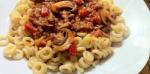 Palermo and it the only form of pasta originating from Sicily. Anelleti are most often served in families (rather than restaurants), especially on feast days.
Speaking of rings, what about cheerios? A breakfast product born in 1941, the hole in this food was designed to enhance the taste of cereals soaked in milk. The shape allows the milk to pass inside, giving greater softness compared to traditional cereals. And what about onion rings? In the United States they are served heavily breaded and fried at fast-food restaurants; they receive a more delicate treatment at high-end restaurants. And then there are rings of fried calamari (anelli di calamari fritti). Calamaro is the Italian 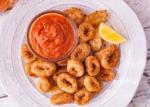 word for a squid. It has become a common appetizer in American restaurants. It dates from an article in the New York Times in 1975, which spurred its popularity into the 1980s and beyond. Before then, it was a dish offered only in exclusive restaurants in cities like New York and Boston.
Common in the United States and Italy are ciambelle or donuts. As a youth, I remember ciambelle being fried on Mulberry Street during the Festival of San Genaro in New York. They originate from Medieval Italy although different regions of Italy lay claim to the  origins. The meaning can be traced back to an Easter tradition because its shape represents the circle of life and the rebirth of the Lord. A ciambellone (“large donut”) is a simple, sunny Italian cake with lemon zest baked in a tube pan. In America, the donut is a highly caloric breakfast food often decorated with more sugary substances. Its origin is debated: some argue that the inventor was the captain of the navy, Hansen Gregory, in the late nineteenth century. The idea was to simply pierce a cake dough to make it more manageable.
Another common breakfast food today in the United States and central-northern Europe is  the bagel,which dates back to the work of a Jewish community in Krakow, Poland in 1610. The bread was given as a tribute to the women who gave birth because its circular shape represents the circle of life that begins with the birth of a child.
The pretzel was most probably invented in the monasteries of Italy and southern France.  But it is associated with German tradition and is generally accompany by typical German sausages. The symbolic meaning of pretzels is that the three typical holes represent the Holy Trinity, while its shape recalls the arms of the crossed monks. Initially consumed almost raw, legend has it that the current cooking preparation is due to a baker who fell asleep at work.
Similar in texture to a bagel, pretzel or breadstick is the Italian taralli, a common snack  in Southern Italy, particularly in Puglia. They are formed into rings or ovals anywhere from 1 inch to 5 and can be sweet or savory. Savory taralli may be flavored with onion, garlic, sesame seeds, poppy seeds, fennel, pepper, chili, or salt. Sweet and plain taralli are often dunked in wine.
 Let’s end on a sweet note: Lifesavers, in particular the British product Polo, which became famous for its motto: “Polo, the hole with the mint around.” The bonbon was specially designed with this particular shape in order to let in the air that gives a sense of freshness to the whole mouth. In 2010 it was probably the best-selling candy in the United Kingdom.
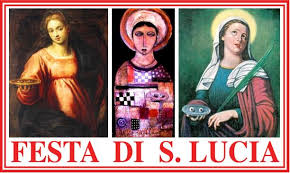 Una delle canzoni più belle che associamo al Natale è “Santa Lucia”. Era una canzone
 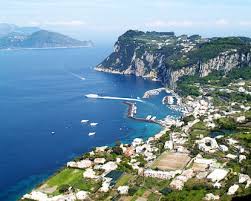 tradizionale napoletana che fu tradotta dal dialetto in italiano durante le prime fasi del Risorgimento. È la prima canzone napoletana ad essere tradotta in italiano. È una barcarola, che è una canzone popolare tradizionale cantata dai gondolieri veneziani. Il testo celebra il pittoresco quartiere sul lungomare, Borgo Santa Lucia, nel Golfo di Napoli, in cui un barcaiolo invita le persone a fare un giro nella sua barchetta per godersi il fresco della sera sul mare.
 Anche se non lo si sa per certo, “Santa Lucia” probabilmente è diventata una canzone stagionale per due motivi: Santa Lucia era una martire cristiana, e la sua festa è celebrata il 13 dicembre. Il suo nome condivide una radice (luc-)con la parola latina lux (luce). Molte canzoni natalizie mescolano tradizioni pagane e religiose per celebrare la luce nell’oscurità dell’inverno. Alcune versioni della storia di Lucia nel IV secolo narrano che durante la sua persecuzione i suoi occhi vennere rimossi, da se stessa o dai suoi tormentatori. Lucia è la santa patrona dei ciechi, oltre che degli autori, dei vetrai, dei braccianti, dei martiri, e dei contadini. È la patrona di Siracusa in Sicilia e una dei santi protettori di Perugia in Umbria.
 L'Olivo Santa Barbara