
 Last week I wrote about Charging Bull, a bronze statue by Artura Di Modica that stands near the New York Stock Exchange. Travelers to the big apple not only pose for pictures with the bull but also stroke its nose, horns and testicles for good luck and success in business. There are monuments, columns, fountains, tiles and trees throughout the world, particularly in tourist cities, where ancient traditions inspire passersby to rub or caress the surface in search of prosperity, health or money. Here are 6 bronzes in Italy where this tradition holds sway and where parts of the bronzes are polished to a bright sheen.
Florence: Il Porcellino
 “Piglet” is the nickname for this bronze fountain of a wild boar which stands in the loggia of the Mercato Nuovo, in the historic center of Florence, near the Ponte Vecchio. Il Porcellino has a long history. The original was a Hellenistic marble statue supposedly of the Calydonian Boar, one of the monsters in Greek mythology. According to legend, Artemis sent the boar to ravage the region of Calydon because its king had failed to honor Artemis in his rites to the gods. A marble Italian copy of the original is on display at the Uffizi. The fountain figure, which has now eclipsed the marble original, was sculpted and cast by Baroque master Pietro Tacca around 1634. It was intended for the Boboli Garden, then moved to the Mercato Nuovo. The present statue is a modern copy placed there in 2008; Tacca’s bronze is sheltered in the Museo Stefano Bardini in Palazzo Mozzi.
Visitors to Florence and Il Porcellino rub the boar’s nose to ensure a safe return to Florence. In the complete ritual, however, one puts a coin into the boar’s gaping jaws, with the intent to let it fall through the underlying grating, where the water flows, for good luck.
Verona: The statue of Juliet
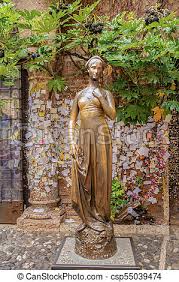 In the historic center of Verona is an early 14th-century house, which is claimed to be that of the Capulets (in Italian, Cappelletti), a noble family. The original bronze statue of Juliet, the work of Nereo Costantini from 1972, has been moved for conservation purposes to the internal atrium of Juliet’s house-museum. For many years, a copy of the bronze statue has been placed under the famous balcony.
According to tradition, touching the right breast of the statue of Shakespeare’s heroine brings happiness in love. For years visitors also wrote their names and the names of their loved one on the wall of the entrance, Juliet’s wall, with the hope of making their love everlasting. It is also a tradition of put small love letters on the walls or to write names on a lock (for everlasting love) and attach it to the nearby ornamental gate. This tradition is seen on bridges and gates in Cinque Terre and other Italian cities.
Turin: Rampant Bull
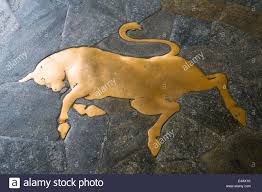 Embedded in the pavement under the arcades of Piazza San Carlo is the symbol of the city—the rampant bull of Turin—dating from 1930. According to local legend, stepping on the bull’s testicles will bring good luck. While the Torinese deeply believe this superstition, they are also quite reserved and prefer to do this ritual unnoticed. Best to sit at one of the outdoor tables of Caffè Torino and observe the scene in question.
Milan: Bull in the Galleria Vittorio Emanuele II
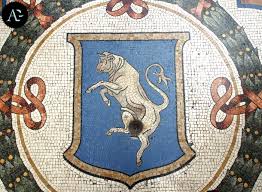 Once again the lucky charm is the bull (and its testicles). Designed in 1861 by architect Giuseppe Mengoni, the beautiful Galleria Vittorio Emanuele II contains four distinct mosaic designs in the floor. Each portrays the coat of arm of the three capitals of the Kingdom of Italy (Rome, Florence and Turin) and the symbol of Milan. Representing Rome is the she-wolf together with Romulus and Remus; the lily flower represents Florence; for Milan is a red cross on a white background. And for Turin is the dancing bull. Legend has it that spinning around three times with your eyes closed and your heel on the bull’s testicles will bring good fortune. And now Eataly Las Vegas has paid homage to its birth city by installing a mosaic of a dancing bull inside the store. I don’t know if the tradition accompanied the store to Las Vegas.
Bergamo: The three balls of Colleoni
 The Colleoni Chapel is the Renaissance structure built next to the Romanesque Basilica of Santa Maria Maggiore in the Piazzetta del Duomo in Città Alta of Bergamo. The chapel houses the mausoleum of Bartolomeo Colleoni, a mercenary and feudal gangster whose vanity knew no bounds. All around the chapel’s façade and iron fence are the gangster’s crest / shield. On the entrance gate, the crest includes three kidney shapes that are supposed to be “Colleoni’s three balls.” Whether or not he had polyorchidism is unknown; but he certainly liked to brag that he was stronger than mere mortal men.
Pisa: The Lizard
 The rare, two-tailed lizard on the portal of the Baptistery next to the Cathedral of Pisa has been good luck for centuries. Stroking the lizard 100 days before high school exams are supposed to bring luck. Another lucky ritual is a tour of the Baptistery on one leg. But university students should refrain from climbing to the top of the leaning tower of Pisa or making a complete tour around it.
 Era una notte di dicembre del 1989 quando lo scultore italiano Arturo Di Modica, dotato di camion e gru, collocò senza autorizzazione una scultura di 3,2 tonnellate di fronte alla Borsa di New York. Aveva lavorato instancabilmente e a proprie spese per tre anni alla creazione del Charging Bull. L’artista siciliano, insieme alla complicità di alcuni amici, impiegò solo quattro minuti per collocare l’opera nella Grande Mela, sotto lo sguardo distratto dei poliziotti.
 La scultura divenne immediatamente un’attrazione turistica. Insieme alla Statua della Libertà, è diventata forse la statua più amata, riconosciuta e fotografata di New York. Oltre alle foto scattate nella parte frontale del toro, i turisti di tutto il mondo posano nella parte retro del toro vicino ai simboli della virilità. Per attirare la buona fortuna, i passanti strofinano il naso brillante, le corna e la parte retro dell’animale, per essere delicati.
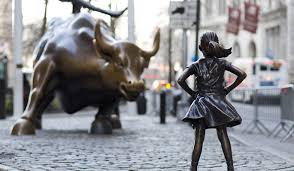 toro sulla copertina di un libro che parlava del crollo di una società di servizi finanziari. Nel 2011 i manifestanti di “Occupy Wall Street” hanno usato il toro come figura simbolica attorno alla quale indirizzare le loro critiche sull’avidità corporativa. E nel 2017 in previsione della Giornata internazionale della donna, una scultura in bronzo, Fearless Girl, è stata incollocata di fronte al toro, sfidando così il Charging Bull. Secondo il sindaco de Blasio di New York, “è un potente simbolo della necessità di un cambiamento nell’America corporativa”.
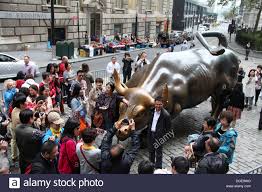 addition to selfies taken at the front end of the bull, tourists from all over the world pose at the back of the bull near the symbols for virility. For good luck and good financial fortune, passers-by have rubbed to a bright gleam the bull’s nose, horns, and the part of the anatomy, to be delicate, that “separates the bull from the steer.”
 L'Olivo Santa Barbara