
I t was 1988 when Francesco Lotoro, a pianist and composer from Barletta in Puglia, first heard about the music composed in the death camps. He felt that the music should be heard, and he embarked on a very ambitious project to collect as much as he could find. More than 30 years later, he is building a citadel, which is known formally as the Istituto di Letteratura Musicale Concentrazionaria—to house and play the more than 8,000 works he has collected and catalogued.
Lotoro has been all over the world and has found symphonies, operas, folk songs, and many other genres. On a visit to Prague in 1990, he discovered a five-act fairy tale opera, “Three Hairs of the Wise Old Man,” by Rudolf Karel, a Czech composer. Karel wrote the opera with medicinal charcoal (to treat dysentery) on sheets of toilet paper, which were later smuggled out of the camp in laundry sacks. Karel died at Terezin Theresienstadt just north of Prague, a camp the Nazis had set up as a model community to try to trick the world, through propaganda films, that they were treating the Jews humanely.
Other prisoners wrote their music on food wrappers, potato sacks, newsprint or whatever they could find. It was a testament to their resourcefulness, but also to their need for 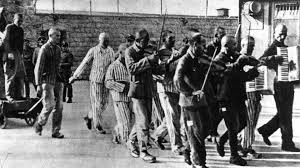 music to soothe the soul, to escape, to remember their former lives, and to comment on their experiences. Being in an orchestra in a concentration camp saved some lives, but the experience was often humiliating. Musicians were forced to play “command music” as prisoners were marched off to forced labor, and they also were forced to play concerts for SS officers and visiting “dignitaries.” But when the prisoners played music on their own initiative, it gave them consolation and hope.
Other musicians and historians have joined in Lotoro’s passion to preserve the musical history of the Holocaust. Some are staging performances, while others are searching for music banned by the Nazis as “degenerate,” much of which was composed by Jews. Also expanding is the search for musical instruments, books about music, and original or  printed scores stolen by the Nazis.
But Lotoro’s vision is perhaps the broadest. He has also arranged and recorded works composed in the camps. In some cases, he is writing music to finish incomplete works. Even his collection has expanded to include works from political and religious prisoners in many countries and from musicians of any national, social or religious background.
Lotoro’s citadel – Istituto di Letteratura Musicale Concentrazionaria — will include a museum, a library and a theater at a cost of about $45 million. The city of Barletta donated a two-acre site of an abandoned brandy distillery and  is also providing an additional $2.7 million for the construction of a 30-room hotel nearby for students, scholars and others to study the music. The Italian government has provided $5 million in funds so far, and Lotoro is hopeful of receiving up to $36 million more. He is also raising money through an international fund-raising campaign.
Helping him on this project is his wife Grazia. Raised Catholic, they converted to Judaism in 2004. Then Francesco discovered that his grandfather’s grandfather was Jewish and had converted to Christianity because it was difficult to be a Jew at that time in Barletta. For this modest musician who has lived in this small Adriatic town all his life, the completion of the citadel will be a lifetime dream to leave a musical legacy.
 Sempre più gelaterie aprono negli Stati Uniti, e di conseguenza abbiamo bisogno di imparare dall’Italia come distinguere il vero gelato da quello finto o di scarsa qualità o anche dall’ice cream. In generale, il gelato italiano autentico ha meno grassi e zuccheri rispetto all’ice cream e viene centrifugato a una velocità inferiore in modo da incorporare meno aria. Anche se non è scontato per gli americani, il gelato ha una consistenza più densa dell’ice cream e viene servito ad una temperatura più elevata. Inoltre per gli italiani il gelato ha un sapore più intenso e naturale.
 sovraffollate poichè sono trappole per turisti. Un indizio è un cartone enorme con un cono grande ed una lunga lista di gusti. In generale, i posti migliori sono conosciuti con il passaparola. In estate cerca le lunghe code piuttosto che le pubblicità acchiappa turisti. Quindi, controlla i segnali all’interno del negozio. Le gelaterie italiane devono mostrare gli ingredienti che usano e le migliori sono orgogliosi di farlo; i negozi americani dovrebbero fare altrettanto. Gli ingredienti freschi e naturali sono un requisito per la qualità. Se vedi olio vegetale o colori o aromi artificiali, vai oltre.
 Poi, controlla i contenitori per il gelato. Le vaschette di plastica non mantengono il gelato alla giusta temperatura. I contenitori piatti in metallo sono molto meglio. I coperchi indicano che il gelato viene conservato con cura alla giusta temperatura e che la qualità è più importante del corteggiare i clienti con colori e decorazioni. Inoltre, le palette piatte e in metallo sono strumenti migliori per servire il gelato più denso delle tradizionali palette curve per ice cream americano. Secondo i miei amici Cesare e Agnese Maganzani, proprietari della pluripremiata La Gelateria Loggetta di Mantova, “la maggior parte delle gelaterie in Italia espone il gelato in contenitori aperti, che sicuramente attirano l’attenzione sia dei bambini sia degli adulti e probabilmente aumentano gli acquisti d’impulso. Ma l’aria rovina la consistenza del gelato in un’ora o due. Pertanto, servono il gelato da pozzetti coperti in cui sono fatti i quali vengono posti in un banco refrigerato che viene mantenuto a meno 11-12 gradi centigradi”.
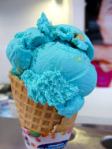 Mentre osservi i contenitori, nota anche i colori dei vari gelati. Senza coloranti aggiunti, un gelato di qualità non avrà mai colori accesi, ma solo naturali. Il pistacchio, ad esempio, non sarà verde ma piuttosto marrone. La menta sarà bianca, anziché verde e il limone sarà bianco anziché giallo. I vari frutti di bosco dovrebbero avere colori rossi profondi e smorzati … mai rosa shocking.
 la frutta di stagione. In una buona gelateria non troverai alcun gusto alla frutta che non si possa trovare sul mercato locale. Ad esempio, in qualsiasi momento, la Loggetta di Mantova vende 24 gusti diversi in base alla stagione e alla disponibilità del prodotto. I gusti classici includono fior di latte, nocciola, cioccolato e gianduia (una combinazione di nocciole e cioccolato). I sapori primaverili ed estivi includono fragola, lampone, melone, anguria e pesca. Il fico è disponibile in agosto e settembre; la pera, la mela e il melograno sono disponibili in ottobre, novembre e dicembre. La Loggetta produce anche specialità gastronomiche, come un gelato alla pesca / all’amaretto / al cioccolato, alla mela verde con cannella e un bellissimo sorbetto al lime e zenzero. La Loggetta serve anche sorbetto vegano.

 L'Olivo Santa Barbara