Denim and Jeans

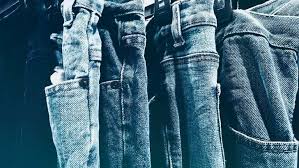
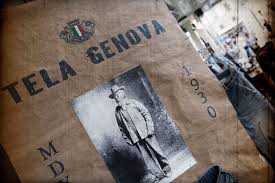
Today the words “denim” and “jeans” are used almost interchangeably in the United States.  But this wasn’t always so.  Their origins date back more than 400 years to Genoa, Italy, and Nimes, France.  At the time the port city of Genoa was part of France and was known by its French name “Geane” or “Jeane.”  It produced an industrial-grade fabric for work clothes called fustian “jean,” which was similar to corduroy.  Dyed with indigo, the fabric made strong work pants for harbor workers.  Back then, Genoa was a superior naval power, and the Genoese navy equipped its sailors with jeans, as they needed a fabric that could be worn both wet or dry.
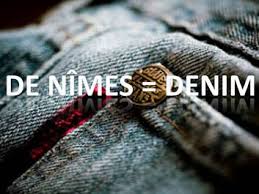
Around that time, weavers in Nimes, France tried to reproduce the famous fabric made in Genoa but with no luck.  Through trial and error, they developed another fabric that became known as denim because it was “de Nimes.”  It was a cotton twill textile in which the weft passes under two or more warp threads.  Warp threads were dyed in indigo while weft threads remained white.  It was highly durable and used by people that needed clothes that would last a long time.

By the 17th century, jean was a crucial textile for the working class in northern Italy. This is seen in a series of genre paintings from that period attributed to the mysterious artist now nicknamed “The Master of the Blue Jeans.”  Recently discovered, this series of 10 oil paintings depict poor people in simple domestic settings.  Every painting has food or crockery in it and at least one child.  Great attention is paid in the paintings to the blue clothing or pieces of cloth, which are often torn, wrinkled or soiled.

In 1853 in America, Levi Strauss moved to San Francisco to establish a western branch of the family’s dry goods business.  Among other things, he sold a durable denim cloth to miners in the Gold Rush.  One of his customers was Jacob W. Davis, a tailor from Reno, Nevada, who made functional items like tents, horse blankets and wagon covers.  In response to a customer order for sturdy pants, Davis made them from denim he had purchased from Strauss and made them stronger by placing copper rivets at the places that pants rip most often—pockets and flies.  When he wanted to patent these pants, Davis wrote to Strauss, and they went into business together.

Thus was born the American version of blue jeans, which has defined the clothing culture for more than 150 years. Originally designed for miners, modern jeans were popularized as casual wear by Marlon Brando and James Dean in their 1950s films, particularly The Wild One and Rebel without a Cause.  This led to the fabric becoming a symbol of rebellion among teenagers as well as a symbol of sympathy with the working classes.  Nowadays, they are worn by everyone, and they have become the most popular specialty pant in Western culture.  Today, 75% of the designer jeans in the world come from California.

Posted in Abitudini, California, English, Film, Foto, Genova, Italia, La Moda, Storia | 3 Comments

The Sopranos (in italiano)

The Sopranos è stata elogiata da molti critici come la serie televisiva più rivoluzionaria di tutti i tempi. Ha vinto innumerevoli premi ed è stato scelto per la sceneggiatura, che la recitazione e la regia. La serie è anche nota per il suo contenuto, la musica, la cinematografia e la capacità di affrontare argomenti controversi tra cui la criminalità, i ruoli di genere, le malattie mentali e la cultura italo-americana. La serie è stato anche spesso criticata per aver perpetuato gli stereotipi negativi sugli italo-americani. È durata sei stagioni dal 1999 al 2007.

La serie è incentrata sulla vita di Tony Soprano, interpretato da James Gandolfini (1961-2013), un mafioso italo-americano mentre cerca di bilanciare la sua vita familiare con quella di capo mafioso. Le sue vite vengono esplorate durante le sessioni di terapia con la psichiatra Jennifer Melfi, interpretata da Lorraine Bracco. A volte Tony sembra essere un orso, un uomo incline alla violenza; altre volte sembra piccolo e vulnerabile, poiché è anche soggetto ad attacchi di panico e crisi depressive. La dottoressa Melfi si scontra spesso con Tony, ma è razionale e umana, in contrasto con la personalità di Tony. Tony, un donnaiolo seriale, le rivela la sua attrazione sessuale che prova per lei; Il dottor Melfi, d’altra parte, è più attratta dal potere, dal pericolo di Tony e dalla sfida di trattare un paziente così insolito

La serie è stata creata da David Chase, che attribuisce ai drammaturghi americani Arthur Miller e Tennessee Williams l’influenza per la sceneggiatura dello show e cita il regista Federico Fellini come un’influenza importante sullo stile cinematografico dello spettacolo. Chase è stato affascinato dalla criminalità organizzata e dalla mafia sin dalla tenera età. The Sopranos è stato ispirato in parte dalla famiglia DeCavalcante e dalla famiglia Boiardo, due famiglie della criminalità organizzata del New Jersey. In effetti, la maggior parte delle scene esterne della serie sono state girate in New Jersey. Nella scena iniziale della serie, Tony Soprano sta guidando lungo il Lincoln Tunnel e l’autostrada del New Jersey prima di entrare nel vialetto della sua casa di periferia. La sequenza è stata creata al fine di mostrare come questo particolare spettacolo sulla mafia sia ambientato in New Jersey, e non a New York, dove erano stati invece ambientati la maggior parte dei precedenti film mafiosi.

È l’episodio finale che ha dato il via a uno dei finali più controversi nella storia della televisione. Tony è in una tavola calda in attesa di sua moglie Carmela e sua figlia Meadow. Un uomo al banco nota Tony e poi va in bagno. La tensione sale. La porta del ristorante si apre con un campanello che suona. Tony guarda in alto e lo schermo diventa nero. Dopo pochi secondi, i titoli di coda scorrono in silenzio. Alcuni spettatori pensano di aver subito un guasto al cavo della tv. La questione se Tony sia stato assassinato o no è continuata per anni e ha generato siti web dedicati a scoprire la vera intenzione di Chase.

Posted in Foto, Italoamericani, Mafia, New York, Storia, Uncategorized | 1 Comment

The Sopranos

The Sopranos has been praised by many critics as the most groundbreaking television series of all time.  It has won countless awards and has been singled out for the writing, acting and directing.  The series is noted for its content, music, cinematography and its ability to deal with controversial subjects including crime, gender roles, mental illness and Italian-American culture.  The show has also been frequently criticized for perpetuating negatives stereotypes about Italian Americans.  It ran for six seasons from 1999 to 2007.

The show centers on the life of Tony Soprano, played by James Gandolfini (1961 – 2013), an Italian-American mobster as he attempts to balance his family life with that of being a mafia leader.  These are explored during therapy sessions with psychiatrist Jennifer Melfi, played by Lorraine Bracco.  At times Tony seems to be a giant bear of a man prone to violence; at other times he seems small and vulnerable, as he is also prone to panic attacks and bouts of depression.  Dr. Melfi often clashes with Tony but she is rational and humane, in contrast to Tony’s personality.  A serial womanizer, Tony divulges his sexual attraction to her; Dr. Melfi, on the other hand, is more attracted to Tony’s power and danger and to the challenge of treating such an unusual patient.

Like the characters they portray, many of the actors on The Sopranos are Italian-American.  The series shares 27 actors with the 1990 Martin Scorsese gangster film, Goodfellas, including Bracco, Michael Imperioli, and Tony Sirico.  In fact, some of the episodes of the series were based on the real life of Tony Sirico who, when he was young, joined a gang and ended up being arrested 28 times for weapons possession, robbery and other crimes.  He agreed to play the role of Paulie Walnuts in the series as long as the character wasn’t a “rat.”

The series was created by David Chase, who credits American playwrights Arthur Miller and Tennessee Williams for influence on the show’s writing and film director Federico Fellini as an important influence on the show’s cinematic style.  Chase was fascinated by organized crime and the mafia from an early age.  The Sopranos was inspired in part by the DeCavalcante family and the Boiardo family, two New Jersey organized crime families.  In fact, most of the exterior scenes for the series were filmed in New Jersey.  At the outset, Tony Soprano drives through the Lincoln Tunnel and onto the New Jersey turnpike before he pulls into the driveway of his suburban home.  The sequence is designed to show that this particular mafia show is set in New Jersey, as opposed to New York, where most previous mafia dramas had been set.

It is the final episode that sparked one of the most controversial finales in television history.  Tony is in a diner waiting for his wife Carmela and his daughter Meadow.  A man at the counter notices Tony and then goes to the restroom.  The tension mounts.  The diner door opens with a bell ringing.  Tony looks up, and the screen cuts to black.  After a few seconds, the credits roll in silence.  Some viewers thought that they had experienced a cable outage.  The question of whether Tony was murdered has continued for years and has spawned websites devoted to finding out Chases’ true intention. 

Posted in English, Foto, Italoamericani, Mafia, Storia, Uncategorized | 1 Comment