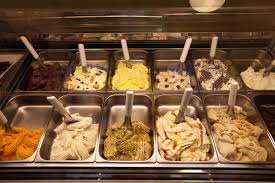
Crazy Pizza

When it comes to food, don’t mess with the Italians.  When it comes to pizza, know that any creative interpretation can generate outrage … and not just among Neapolitans.  In fact, pizza is one of the most discussed foods on the web.  It is common knowledge that Italians blame Americans for horrors like pineapple on pizza; in fact, Italians would probably like to pass an international law banning this barbaric culinary practice.  But other atrocities have recently come to light, which makes pineapple on pizza seem like the minor leagues.

The latest scandal is a breakfast pizza from Fong’s Pizza in Iowa.  Called “Fruit Loops Pizza,” it is made with a base of mozzarella and sweet cream cheese, followed by the sugary, multicolored breakfast cereal, and covered by a sauce of condensed milk and Greek yogurt.  Comments ranged from the bewildered to the disgusted with one respondent lamenting, “As an Italian, I am formally declaring war on Iowa.”  Fong’s Pizza offers other unconventional taste combinations like “Crab Rangoon,” which combines surimi (a paste made from fish), green onion, mozzarella, asiago, crispy wonton and sweet chili sauce.  Mamma mia.
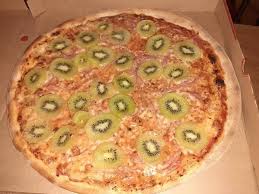
Moving to Europe, a Swedish citizen created a pizza with kiwifruit which drew over 400 comments on social media including one that called it an “abomination against nature.”  British Chef Gordon Ramsay says that pineapple, like kiwi, is acidic and so is tomato sauce: “Too many acidic foods at once and you might melt your insides.”  A magnet for controversy, Ramsay in the past stirred up a hornet’s nest with vegan-shaming comments like “I am a member of PETA*, that is, People Eating Tasty Animals. Now at his “Gordon Ramsay Street Pizza” restaurant in London, he offers a plant-based pizza covered in pine nuts, pesto, tomato sauce and eggplant.  The internet had a meltdown with comments like “Gordon, please stop pretending to know Italian cuisine” and “If you’re being held hostage by a vegan, give us a signal.”

Even in Italy, straying from the tried and true is risky.  Celebrated chef Carlo Cracco serves his version of a margherita at his bistro in Milan’s famous Galleria.  Cracco dared to add healthier whole grains to the crust, left off the requisite basil, and charged 16 euros for the honor.  The pizza was immediately renamed “Scraccorella” and as one diner noted, “Every time Cracco bakes his pizza Margherita, a Neapolitan pizza maker dies of a broken heart.”  Others pleaded for an intervention from San Gennaro (the patron saint of Naples).  The craziest pizza price of all belongs to Sirani, a gourmet pizzeria in Brescia.  For 95 euros (about $115), you can get a “4+4,” which is garnished with Carabineros prawns, a rare crustacean considered the best in the world.  Red and almost 30 centimeters (about 12 inches) in length, the four prawns on the wedges can weigh up to half a kilo (about 1 pound).
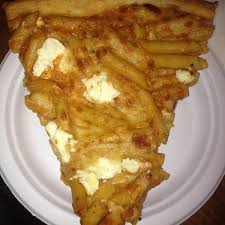
Returning to North America, Rocky’s Pizzeria in New York offers a penne, cream and vodka specialty, dubbed “an orgy of carbohydrates,” and “the usual American….” Rocky’s offers a pineapple and ham specialty too.  Maybe because Hawaii produces many pineapples and maybe because pineapple pizza was a favorite of President Barack Obama (who came from Hawaii), most people think this often-ridiculed version of pizza originated in the United States.  In fact, it originated in Canada.  Sam Panopoulos, a Greek-born Canadian cook, is credited with the idea of adding canned pineapple to pizza at his Ontario restaurant in 1962.  It has earned the disdain of pizza puritans. When Iceland’s president suggested it should be banned in 2017, Canadian Prime Minister Justin Trudeau tweeted: “I have a pineapple.  I have a pizza.  And I stand behind this delicious Southwestern Ontario creation.”

Guess what?  At a highly respected Milanese restaurant, Crosta, chef Simone Lombardi and baker Giovanni Mineo decided to challenge gastronomic prejudices by offering their daring pineapple, ventricina (a pork sausage commonly found in Abruzzo) and cilantro pizza.  Comments?  “Really balanced,” “Fantastic,” and “Well, I hate to admit it, but the pizza is really interesting.”

*People for the Ethical Treatment of Animals is the official name of the organization.

Posted in Abitudini, Cucina italiana, Differenze culturali, English, Formaggio, Foto, Italia, Milano, Napoli, New York | 2 Comments

Gusto o sapore?

Quando scrivo in italiano, invariabilmente confondo la parola “gusto” con la parola “sapore”. Spesso sono usate come sinonimi e talvolta possono essere usate in modo intercambiabile, ma in realtà hanno due significati distinti, come in inglese. Grazie a Eleonora Vieri, esperta e insegnante di lingua italiana a stranieri, nonché  mia redattrice, che conosce la parola corretta per ogni contesto., mi ha aiutato anche questa volta. Per cercare di migliorare il mio italiano scritto e parlato, ho fatto un po’ di ricerca.

Quando mangiamo, molte sensazioni piacevoli percettivamente diverse provengono sia dal naso, che dalla bocca. La bocca rileva il gusto e il naso coglie gli aromi. È la combinazione tra gusto e aroma che costruisce un sapore. Esistono infatti solo cinque gusti: dolce, acido, salato, amaro e, più recentemente, umami. A differenza di quanto abbiamo appreso a scuola, i recettori del gusto non sono concentrati in zone specifiche della bocca ma sono sparsi in maniera casuale. La dolcezza è causata da una forma di zucchero o alcol. I cibi dolci, come torte, miele, frutta e succhi di frutta, sono spesso ricchi di carboidrati e forniscono carburante per il corpo. L’acidità è il gusto degli acidi presenti in alimenti come aceto, succo di limone e yogurt. La salinità deriva dal sodio presente nel sale da cucina, nella salsa di soia e nella carne lavorata. L’amarosi trova in cibi come caffè, vino, cioccolato fondente e rucola.

Il quinto gusto è saporito, che è tecnicamente chiamato “umami”. Gli scienziati hanno identificato i recettori del gusto umami sulla lingua umana nel 2002. È il gusto del glutammato, un amminoacido che è uno dei mattoni delle proteine. In effetti, l’umami è stato scoperto più di 100 anni fa in Giappone da uno scienziato di nome Dr. Kikunae Ikeda. Mentre stava gustando una ciotola di brodo di alghe, il dottor Ikeda notò che il gusto saporito era distinto dai quattro gusti fondamentali, cioè dolce, acido, amaro e salato. Ha chiamato questo gusto aggiuntivo “umami”, che significa “l’essenza della prelibatezza” in giapponese. Alla fine scoprì che il gusto dell’umami era attribuito al glutammato. Infatti si trova in alimenti come carne, formaggi stagionati, pesce, pomodori e funghi. 

Sebbene esistano solo 5 gusti, siamo capaci di rivelare migliaia di sapori a causa del nostro senso dell’olfatto. Infatti si dice spesso che si mangia prima con il naso e poi con la bocca. Si dice che una persona media sia in grado di riconoscere 10.000 aromi distinti. Quindi, la nostra sensibilità olfattiva fa sì che i profumi diventino una parte importante del nostro apprezzamento dei sapori. Se ci tappiamo il naso o prendiamo un raffreddore o un altro virus, tutto ciò che saremo in grado di rilevare sono i cinque gusti. In tali momenti i cibi sembrano quasi insapore. Capire cosa succede mentre assaggiamo e annusiamo il cibo ci aiuta ad analizzare un piatto e migliorare il modo in cui lo cuciniamo, trasformando la cucina in un ambiente ancora più interessante e divertente. 

Ma la domanda rimane: tutto ciò migliorerà l’uso corretto di “gusto” e “sapore”? Ne dubito. Sono ancora propenso a tradurre “i gusti del gelato …” come sapori, quando, appunto, dovrebbe essere “gusti”.

Posted in Uncategorized | 2 Comments

Taste versus Flavor

When I write in Italian, invariably I confuse the word gusto meaning “taste” or “flavor” with the word sapore meaning “taste” or “flavor.”  Often, they are used synonymously and sometimes can be used interchangeably, but in reality, they have two distinct meanings, as in English.  Thank goodness for Eleonor Vieri, an Italian language expert and my editor, who knows the correct word for each context.  To try to improve my written and spoken Italian, I did a little research in both languages.

When we eat, many pleasant sensations come from both the nose and the mouth, which perceive different characteristics.  The mouth detects the taste, and the nose captures the aromas.  It is the combination between taste and smell that creates a flavor.  In fact, there exists only 5 tastes:  sweet, sour, salty, bitter, and more recently, savory.  Unlike what we may have learned in school, taste receptors are not concentrated in specific zones in the mouth but are scattered randomly throughout.  Sweetness is caused by a form of sugar or alcohol.  Sweet foods, like cake, honey, fruits and fruit juice, are often high in carbohydrates which provide fuel for the body.  Sourness, or tartness, is the taste of acids found in foods like vinegar, lemon juice and yogurt.  Saltiness is from sodium found in table salt, soy sauce and processed meat.  Bitterness is found in foods like coffee, wine, dark chocolate and arugula.

The fifth taste is technically called “umami.”  Scientists identified umami taste receptors on the human tongue in 2002.  It is the taste of glutamate, an amino acid that is one of the building blocks of protein.  In fact, umami was discovered more than 100 years ago in Japan by a scientist named Dr. Kikunae Ikeda.  While he was enjoying a bowl of kelp broth, Dr. Ikeda noticed that the savory flavor was distinct from the four basic tastes of sweet, sour, bitter and salty.  He named this additional taste “umami,” which means “the essence of deliciousness” in Japanese.  He eventually found that the taste of umami was attributed to glutamate.  It is found in foods like meat, aged cheese, fish, tomatoes and mushrooms.

While there are only 5 tastes, we detect thousands of flavors because of our sense of smell.  In fact, it is often said that you eat first with your nose and then with your mouth.  An average person is said to be able to recognize 10,000 distinct aromas.  Hence, our olfactory sensitivity means that scents become a large part of our appreciation of flavors.  If we hold our nose or catch a cold or other virus, all we will be able to detect are the five tastes.  At these times, foods seem almost tasteless.  Understanding what happens as we taste and smell food helps us analyze a dish and improve the way we cook it, transforming the kitchen into an even more interesting and fun environment.

But the question remains:  Will all of this improve the correct usage of gusto and sapore? I doubt it.  I’m still inclined to translate “the flavors of gelato…” as sapori, when, in fact, it should be gusti.

Posted in Uncategorized | Leave a comment