
This post will be in 2 parts. The second part will appear next week. The entire article is a collaboration with my friend Jean Perloff, lawyer and italophile. She wrote 2 long essays on Falcone and Borsellino. These posts are abbreviated versions.
 Their lives were woven together from the beginning, as was their destiny. Both were born in Palermo, Sicily: Giovanni Falcone in May, 1939, and Paolo Borsellino 8 months later. Both grew up in Kalsa, the ancient Arab neighborhood of Palermo. They lived near each other and were childhood friends. They played “calcio” together in the piazza della Magione — oblivious to any mafia presence or the fact that some of their schoolmates would become criminals.
Giovanni and Paolo attended the same liceo (high school) and were model students. After graduation their paths diverged for awhile. Falcone enrolled in the Military Academy of Livorno, but then he reconsidered and enrolled in law school. Borsellino opted immediately to study law. Both graduated with honors (a pieni voti).
Their careers took them to different parts of Sicily where they each came into contact with the reality of the mafia. In 1969 Borsellino moved to Monreale, near Palermo; as a hearing officer, he worked side by side with the captain of the carabinieri Emanuele Basile, who was killed by the mafia in 1980. Borsellino investigated the homicide. In the meantime, Falcone also moved back to Palermo where he worked on the trial of building contractor Rosario Spatola, who was accused of mafia connections.
In the early 1980s a mafia war broke out that caused a death every 3 days in the Sicilian capital. In the end there were 1,200 victims, which thinned the enemy ranks of the boss of bosses, Totò Riina. About this time, Riina’s violence also turned against the State. In April 1982 Pio La Torre, regional secretary of the communist party and member of the anti-mafia commission, was killed in his car in Palermo. In response, the government sent to Sicily as anti-mafia prefect the general of the carabinieri, Carlo Alberto Dalla Chiesa. For the Cosa Nostra it was a serious threat. In September Dalla Chiesa and his wife were gunned down.
After a car bomb killed another judicial public official, Antonino Caponnetto was appointed anti-mafia magistrate. He did not have experience in legal proceedings with the mafia, but was known for his professional gravitas. He recognized the need to have a pool of magistrates to try to lessen the risks to individuals and to have a unified vision in combatting the mafia. The first to be chosen was Falcone and, at Giovanni’s advice, Borsellino was added to the team. As the anti-mafia team worked tirelessly, there was another development— “the season of penitents.”
Leading the way was the informant Tommaso Buscetta, “don Masino,” a drug trafficker. In the war that had been unleashed by Totò Riina, Buscetta lost 2 sons, a brother, a son-in-law, a brother-in-law, and 4 nephews. He wanted to collaborate with the authorities, but wished to speak only with the number one in the Palermo pool: Giovanni Falcone. According to Gianni De Gennaro, the vice police commissioner, in his book, Cose di Cosa Nostra, Buscetta said to Falcone: “I warn you, judge. After this interrogation, you will become a celebrity. But they will try to destroy you physically and professionally. Don’t forget that the door that has opened with the Cosa Nostra will never be closed. Do you still want to question me?”
End of Part I. The second part will appear next week.
 Nel 1610 Galileo fu il primo a individuare Saturno attraverso un
  telescopio. Più tardi quel secolo, un altro astronomo italiano, Giovanni Domenico Cassini, scoprì quattro delle lune di Saturno e la divisione degli anelli del pianeta. Trecento anni dopo, l’Agenzia Spaziale Italiana, insieme alla NASA e all’Agenzia Spaziale Europea, ha inviato a Saturno una nave spaziale senza pilota.
 Saturno nel 2004. Cassini, che ha accumulato 4 miliardi di miglia spaziali, ha circumnavigato Saturno e dintorni per gli ultimi 13 anni. Questa parte dell’universo si è rivelata essere più strana, più varia, e più promettente di quanto previsto. Ad esempio, gli anelli che hanno intrigato l’umanità per secoli sono formati da fili sottilissimi di ghiaccio, roccia, e polvere che erano stati persi da comete e collisioni meteoritiche e poi intrecciate in iridescenti trecce, nodi, e pareti.
 luna del sistema solare con un’atmosfera più spessa di quella della Terra. La sonda di Huygens di Cassini sbarcò in un mondo
 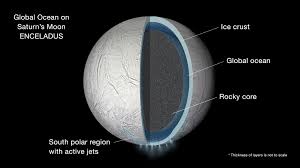 congelato di dune e di letti fluviali di metano. Cassini ha anche scoperto che cosa molti astronomi credono sia il luogo più probabile per trovare la prova della vita al di là della Terra…la misteriosa luna Enceladus. È formata principalmente da acqua, un cosiddetto “mondo dell’oceano” che spara pennacchi di acqua salata dalle crepe nel ghiaccio della sua superficie. I dati hanno rivelato la presenza di idrogeno.
 apertura tra Saturno e il suo anello più interno. Penetrerà questo spazio 22 volte prima del 15 settembre 2017, quando si scontrerà in Saturno e sarà incenerito. Questo tuffo di cigno completerà la parte di navigazione della missione congiunta di successo delle agenzie spaziali italiane, americane, e europee.

