
In 2000 the World Health Organization ranked the Italian healthcare system the second-best on the planet, a ranking that was based solely on access to care and health outcomes such as life expectancy. In 2019, the Bloomberg Healthiest Country Index, which had ranked Italy the world’s healthiest country, just announced that Spain had surpassed Italy. The United States ranks 35th. The index grades nations based on variables including life expectancy while imposing penalties on risks such as tobacco use and obesity. It also takes into consideration environmental factors such as access to clean water and sanitation.
In fact, Italians are much healthier than Americans in terms of everything from overall health longevity, infant mortality, obesity, cancer, diabetes, suicide, drug overdoses, homicides, and disability rates. But the rankings do not take into account on-the-ground realities of the healthcare systems like waiting times, emergency room efficiency, surgical statistics, prices, etc. In these areas there is good news and bad news for both countries.
It is said that health heaven is where the funding, hospitals, and doctors’ education are American, and lifestyle and access to care are Italian. Health hell? Italian budgets, medical education, and intensive care units; American prices, insurance coverage, Big Mac diets, drunk driving, and street-corner opiates. Ironically, Americans like to say that their medical care is the best in the world, while Italians consider their National Health Service to be hopelessly dysfunctional. Yet, Italians are healthier.
Why? The primary reason is access to medical care. The year before the Affordable Care Act, one in six non-elderly American adults had no medical insurance at all, and 44% of all Americans were uninsured or underinsured. Even in late 2016 at the peak of Obamacare’s success, 10.9% of Americans had no insurance at all, a rate that has risen to 13.7% under the Trump administration.
In Italy, a National Health System funded by taxes and based on the British model provides everyone with doctors’ visits, medications, testing, and hospital care at virtually no out-of-pocket cost. Even if you venture outside the National Health Service to go to private doctors and hospitals, Italian healthcare is far less expensive. In Italy prices are kept down by hard bargaining—for pharmaceuticals, among other things. And Italians, who rarely contribute more than a few euros for a co-pay, have been shown to be 60% more likely than Americans to take their medications as ordered.
Italians’ health also benefits from a more uniform distribution of income and wealth, which has repeatedly been shown to improve health outcomes. In the United States, the world’s most unequal country, the average income of the top 10% is nearly 20 times the average income of the bottom 10%; in Italy the ratio is only 11 to one.
Even educated, insured, well-off Americans are sicker than their peers in other rich nations. Most research points to lifestyle issues—diet and exercise. Too many Italians smoke (22% of adults versus 15% in the U.S.) but they also walk more and their diets are rich in fruits and vegetables and low in animal fats, snacks, and desserts. Only 10% of Italians are obese compared to a whopping 38% of Americans.
Now that Spain has surpassed Italy on the Bloomberg index, maybe Americans should consume more gazpacho and paella—in any case, the Mediterranean diet seems to be a major factor in health.
 La settimana scorsa ho descritto la serie di francobolli che l’Italia ha emesso per onorare Il Comando Carabinieri per la Tutela del Patrimonio Culturale (Tpc). Cinque dei sei francobolli rappresentano opere recuperate da questo Comando speciale—uno per ogni decennio dalla sua fondazione nel 1969. I francobolli sono in un foglio con uno sfondo che mostra La Natività con i Santi Lorenzo e Francesco d’Assisi di Michelangelo Merisi, meglio conosciuto come Caravaggio. Il dipinto scomparve dall’Oratorio della Compagnia di San Lorenzo a Palermo nel 1969, sei mesi prima che il Comando dei Carabinieri fosse istituiti. Il dipinto rimane il Santo Graal dei Carabinieri ed è fra le 10 opere più ricercate dal Federal Bureau of Investigation e ha catturato l’immaginazione di appassionati d’arte e teorici della cospirazione.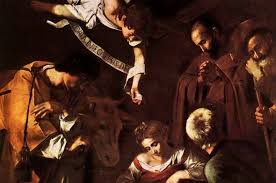
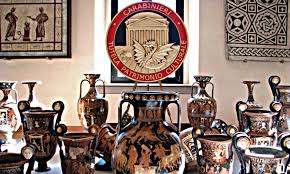 Nonostante il record di successo dei Carabinieri, che hanno recuperato più di 3.000 oggetti d’arte e di reperti archeologici, ancora oggi più di un milione rimangono da trovare. Secondo un bollettino dei Carabinieri, nel 2018 sono scomparsi oltre 8.000 oggetti, tra cui reperti archeologici, armi antiche e testi medievali oltre ai dipinti e alle statue sempre più popolari. La metà di questi furti proveniva da luoghi di culto, secondo Lt. Col. Massimiliano Quaglierella dei carabinieri: “Molte chiese italiane sono bona fide musei, che sono luoghi di culto accessibili e non sempre dotati di sufficienti misure di sicurezza”.
 disposizione un database con circa 6 milioni di opere. I loro metodi variano: per esempio, nel marzo 2019 i ladri hanno fracassato una teca nella chiesa di Santa Maria Maddalena nel comune di Castelnuovo Magra (Liguria) per rubare la Crocifissione di Bruegel il Giovane. Ma i Carabinieri erano stati avvisati e lo avevano sostituito con un falso. L’originale rimane in custodia. Vedete il post, “The Trap” (27 giugno 2019). Per quanto riguarda la Natività di Caravaggio presa dalla chiesa di Palermo, Quagliarella ha dichiarato: “Non ci arrenderemo, la Natività è la nostra priorità assoluta”.
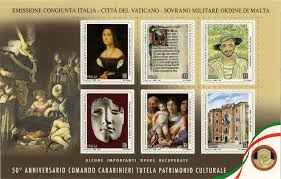 Last week I described the set of stamps that Italy issued to honor Il Comando Carabinieri per la Tutela del Patrimonio Culturale (Tpc), the special branch of the Carabinieri dedicated to the protection of Italy’s artistic heritage. Five of the six stamps represent works recovered by this special Command—one for each decade since its founding in 1969. The stamps are held in a folio with the background showing the Natività con i Santi Lorenzo e Francesco d’Assisi, or Nativity with Saints Lawrence and Francis of Assisi, painted by Michelangelo Merisi, better known as Caravaggio. It disappeared from L’Oratorio di San Lorenzo Church in Palermo in 1969, six months before the Carabinieri Command was established. It remains the Holy Grail of the Carabinieri, is among the FBI’s 10 most wanted works, and has captured the imagination of art enthusiasts and conspiracy theorists.
 L'Olivo Santa Barbara