
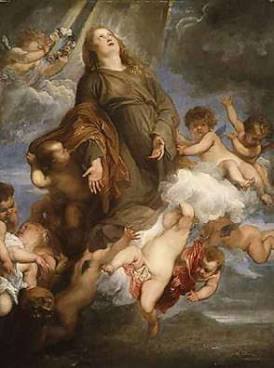
 Recently, art critic Jason Farago wrote a story in The New York Times entitled “The Saint Who Stopped an Epidemic Is on Lockdown at the Met.” In it he tells of his lonely visit to the Metropolitan Museum of Art in New York City to contemplate the Anthony Van Dyck painting, “Saint Rosalie Interceding for the Plague-stricken of Palermo.” This 400-year old painting was to be a centerpiece in the exhibition “Making the Met: 1870-2020,” the museum’s 150th birthday celebration. It was scheduled to open in late March before the city’s lockdown.
The first story begins in 1599. Anthony Van Dyck was born in Antwerp (modern-day Belgium) and began painting at an early age. He became a court portraitist, revolutionizing the genre. Although he did paint mythological and biblical subjects, he is best known today for his portraits of European aristocracy. He traveled to London to work for King James I, and then in 1621 he left for Italy where he remained for 6 years. There he studied the Italian masters while honing his career. He drew on the styles of Veronese and Titian, as well as Rubens. Mostly based in Genoa, he painted the Genoese aristocracy in full-length style, where extremely tall, graceful figures look down on the viewer with great hauteur.
In the spring of 1624, the 25-year-old van Dyck set sail for Sicily, where he had been invited to paint the island’s Spanish viceroy. He completed the portrait, and then disaster struck: In May, Palermo reported the first cases of a plague that would soon kill more than 10,000 people, 10% of the city’s population. The viceroy, whom van Dyck had painted, declared a state of emergency; he died five weeks later. A quarantined Van Dyck watched in horror as the port closed, the city gates slammed shut, and the hospital overflowed.
Now the second story. Rosalia had been born in 1130 in Palermo to a Norman noble family that claimed descent from Charlemagne. She was devoutly religious and retired to live as a hermit in a cave on Mount Pellegrino in Sicily, where she died in 1166. During the plague in 1624, she appeared first to a sick woman and then to a hunter, to whom she indicated where her remains were to be found. She asked him to bring her bones to Palermo and have them carried in procession throughout the city. The epidemic abated, and the grateful citizens worshipped her as La Santuzza, the Little Saint, for saving the city.
In response, a grateful van Dyck began to paint Rosalia. He had to invent an iconography for her and decided to paint her as a young woman with long, curly, blond or red hair, cheeks blushing, eyes wide with ecstasy. Beneath her in the painting, “Saint Rosalie Interceding for the Plague-stricken of Palermo,” lies the harbor of Palermo, and in the background is Monte Pellegrino, the hill where her relics were found. One putto bears a wreath of pink and white roses, as a reference to her name; another putto holds her skull. Floating over the city, Rosalie seems to promise that the epidemic will lift eventually, and that beauty will triumph.
This painting is one of 5 surviving paintings of Rosalia that van Dyck created in his days in Palermo. Surely, he could have relied on his royal connections to escape the plague and return home. But he found amid the pestilence a subject more urgent than the courtly portraits that would eventually frame his legacy. This painting was one of the Met’s very first acquisitions, bought a year after the museum’s founding in 1870. It will have even more elevated importance after the current epidemic lifts, and people can once again appreciate art together.
Saint Rosalia is the patron saint of Palermo, and the Festino di Santa Rosalia, which takes place every July, is one of the largest festivals in Italy. It’s a mix of sacred and secular, rock concerts and prayer. Let’s hope the Palermitanos can celebrate with joy this year.
 In Francia e in Italia oggi, il primo aprile si chiama poisson d’avril e, ovviamente, pesce d’aprile. I bambini attaccano un pesce di carta alle spalle dei loro ignari amici e gridano “poisson d’avril” o “pesce d’aprile” quando scoprono lo scherzo. Oltre la storia del vescovo, perché il pesce? Una spiegazione ci riporta indietro nel tempo fino a Cleopatra e alla burla sul suo amante romano Marco Antonio durante una gara di pesca. Antonio, per non correre il rischio di una umiliante sconfitta, aveva incaricato uno schiavo di attaccargli di nascosto le prede all’amo, che stava sott’acqua. Quando la Regina d’Egitto scoprì l’inganno, fece attaccare all’amo un gigantesco pesce finto rivestito di pelle di coccodrillo, un pesce non tipico del fiume Nilo.
 1857: I cittadini di Londra sono invitati a recarsi alla Torre di Londra, il primo aprile, per assistere al lavaggio dei leoni bianchi che vivono lì. Si raduna una grande folla … e così lo scherzo viene ripetuto per secoli.
 1957: Un documentario della BBC rivela agli spettatori una notizia sensazionale: gli spaghetti crescono sugli alberi. Mostra una piantagione di spaghetti a Lugano in Svizzera, dove i contadini stendevano sul terreno enormi fili di pasta da essiccare. Gli agricoltori erano preoccupati per un gelo imminente. Gli spettatori, incuriositi, chiamano l’emittente britannica per chiedere istruzioni su come far crescere questo speciale albero.
 1998: Il quotidiano USA Today riporta la sensazionale notizia che Burger King ha trovato la soluzione per quasi un milione e mezzo di clienti mancini che si recano al ristorante ogni giorno: il Whopper per sinistrorsi, più facile da impugnare e mangiare con l’altra mano, e con meno sgocciolature.
 2015: YouTube offre un video del Reclinomax, una rivoluzionario modo di fare fitness da una comoda poltrona in cui allenarsi mentre si dorme.
 L'Olivo Santa Barbara