
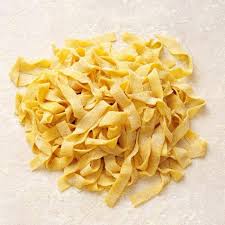
 During quarantine, many people are discovering or returning to ancient practices like bread making and pasta making, which is why it has become difficult to find flour and eggs in the supermarket. Years ago, I discovered that the tactile experience of making fresh pasta was soothing to my soul. In relearning the technique today, I found many YouTube videos to guide me.
Of course, there are many recipes, many techniques, and many teachers out there. For me, the least helpful teachers were those who do everything by touch and intuition; they probably learned pasta making from their nonne. Because so much of Italian cooking is regional, pasta recipes range from the rustic, eggless pasta of the south to the rich, egg-yolk-only pasta of Piemonte. You don’t have to have a pasta machine—you can roll it out by hand, which is easier if you use “00” flour. Here are some tips, based on research and on my own mistakes.
Ingredients and Proportions
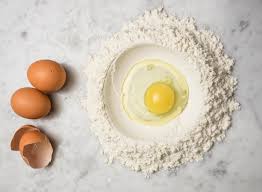 According to many, you can use American all-purpose flour, or “00” flour from Italy by itself, or blended with some semolina, which will impart a grainier texture. Type “00” is more powdery than all-purpose flour. The rule of thumb is to use 1 egg for every 100 grams of flour. To be more precise, you can weigh the ingredients.
The following will make enough for about 8 portions: 300 grams of flour and 185 grams of “wet” ingredients starting with 2 whole eggs plus 3 egg yolks, and water or another egg. (Another option is to use one egg for every 100 grams of flour or an egg for every 80 grams of “00” flour plus 20 grams of semolina and a spritz of lemon juice if you want a stronger egg flavor.) Most recipes call for about a teaspoon of salt and a few drops of olive oil, but they are optional.
While you can use a food processor, most recipes recommend the “well” method of incorporating the eggs into the flour: You place the flour on the counter or pastry board and make a depression in the center with your hand. You pour the eggs in the center and scramble them with a fork, gradually incorporating the flour around the edges. When the mixture becomes too heavy to use the fork, then you incorporate the rest of the flour using your hands until the dough becomes homogenous.
Kneading and Resting
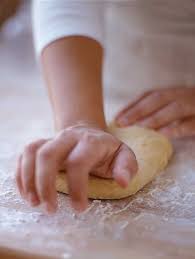 This step is very important to develop the gluten and the elasticity of the dough. There are different kneading techniques described sometimes as “folding and rolling” or “folding, pressing, and rotating.” It’s best to watch the videos if you are inexperienced. But the rule of thumb here is constant kneading for 10 minutes. Set your timer; you will also have a great triceps workout! Knead until your dough is smooth and elastic. When you give it a little poke, the dough should spring back.
Now, sprinkle flour on your ball of dough and wrap in plastic. Let it rest at least 30 minutes—some say in the refrigerator, but I keep it unrefrigerated depending on when I plan to use it.
Rolling and Cutting
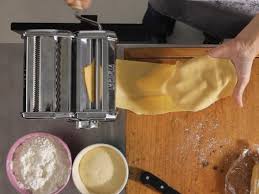 Cut your flour ball into 2, 3, or 4 parts depending on the amount you have made. Sprinkling flour on your dough during the following stages is very important to prevent sticking. Every chef has a different recommendation on how to use the pasta machine, but, quite frankly, I think they all work well. Don’t worry about how many times you pass the dough through the machine at each setting. Rule of thumb: maybe 3 or 4 times on the widest setting down to one at the thinnest setting. The point is that in the end you should be able to see your hand through the dough or “read a love letter through it.” The dough will expand in boiling water.
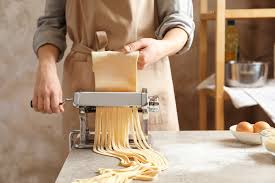 You may have to cut the pasta so that you are working with into 12” to 14” strips. Dust the strips with flour before you run them through the cutters (my machine makes fettuccine and spaghetti) or manually roll up the pasta and use a knife to make pappardelle or fettuccine, for example. Know that if you choose the second option, it will require a little “elbow grease” and also a good technique. Dust again with flour and place on parchment paper or on a tray. You can cook immediately, or wrap in plastic to keep in the refrigerator for about 2 days, or place in a plastic bag and freeze for about 2 months.
Cooking
It’s very important to salt the water – “the taste of the sea” — after it comes to a boil. Fresh pasta cooks in a minute or so and doesn’t have the same amount of time as dried pasta to absorb salt. Rule of thumb: ¼ c. of table salt for 6.5 quarts of water. Taste the pasta for “al dente” and then lift out with tongs or drain in a colander. Remember to reserve some of the starchy pasta water in case you want to mix it with your pasta sauce.
I am still a beginner, but as I get the “touch and feel,” I hope that continued practice will create the intuition that so many Italians have in their DNA.
 Ormai da anni più volte ci è capitato di ascoltare quella canzone toccante e accattivante che è “Bella Ciao”, cantata non solo in Italia, ma anche in tutta Europa. Secondo Wikipedia, “Bella Ciao” è una canzone popolare italiana, adottata come inno della resistenza antifascista. Fu cantata durante la guerra mondiale dai partigiani italiani durante la guerra civile italiana, tra il 1943 e il 1945, nella loro lotta contro la Repubblica socialista fascista italiana e gli alleati nazisti tedeschi.
 Tuttavia, ci sono due versioni del testo di “Bella Ciao”, un “partigiana”, l’altro “mondana” (vedi entrambi alla fine di questo post). Secondo Wikipedia, “Bella Ciao” era originariamente cantata dai lavoratori stagionali nelle risaie della Pianura Padana, del nord Italia, dalla fine del XIX secolo alla prima metà del XX secolo. I lavoratori facevano la monda (cioè estirpavano le erbacce nelle risaie), che ha aveva luogo durante l’inondazione dei campi, da fine aprile a inizio giugno. Durante quel periodo i delicati germogli dovevano essere protetti da sbalzi di temperatura, a volte molto forti. La monda era svolta principalmente dalle cosiddette “mondine”, donne che provenivano dalle classi sociali più povere. Trascorrevano le giornate con le gambe in acqua, a piedi nudi fino alle ginocchia e la schiena piegata per molte ore, con una retribuzione molto bassa. Le dure condizioni di lavoro e la lotta contro i padroni portarono sia al canto, che alla ribellione.
 Ora che tutte le nostre divagazioni romantiche sulle origini di “Bella Ciao” sono state tratteggiate, chiediamoci perché la sentiamo cantare così spesso? È un canto di resistenza che viene ripreso frequentemente nel corso del tempo, dagli anni ’60 al recente Movimento delle Sardine del 2019. Conosciuto anche come Sardine contro Salvini, questo movimento politico si è manifestato generalmente in
 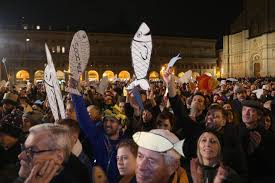 modo pacifico per protestare contro la destra leghista di Matteo Salvini. Il nome “Sardine” deriva dalla riunione in piazza di moltissimi partecipanti, tanti e stretti come le sardine. Il movimento ha preso piede in tutta Europa, anche a Londra e Parigi. I partecipanti intonavano, come è possibile vedere nei video, la famosa “Bella Ciao”.
 dell’Italia a questa crisi. Molte persone si aggrappano ancora alle origini partigiane dell’inno; quindi, quando è stato cantato in Baviera per sostenere lo spirito italiano, Fred Sidon, che è un altro amico di Santa Barbara, ha osservato: “Mi chiedo se sapessero che stavano cantando la canzone dei ragazzi che gli hanno sparato.” I suoi amici italiani dissero: “Non dirglielo … potrebbero riprovare.”
 L'Olivo Santa Barbara