Here are the answers to last week’s survey on cats. From Focus.it.
1.a. When the cat rubs your legs or rests his head on your legs, he is showing his 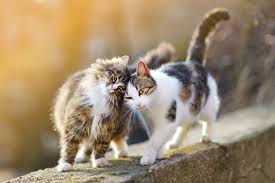 happiness at seeing you. In short, it’s a demonstration of affection and a request for pampering. Some cat owners mistakenly interpret this behavior as a request for food. However, this is a mistaken belief: cats that live with other animals often rub against their legs, while obviously not getting anything in return. However, rubbing the jaw on the hands of those who caress it is different. Food, please.
2.c. The cat’s eyes say a lot about his mood, yet his looks are one of the signs that owners often overlook. When they look at you, slowly blinking, one or both eyes, they are telling you that at that moment, there with you, they are absolutely at ease and relaxed. Give it a try: next time you are on the sofa lounging with your furry friend, look him in the eye and slowly blink at him. If you are lucky the cat will answer you with the same signal.
3. a. The cat stares at his prey or a potential rival with the aim of scaring him to death, or to petrifying him with fear and therefore be able to catch him, or to induce him not to look for a fight. It is therefore a threatening behavior, which suggests approaching the cat with some caution. It is a good idea never to look at kitty with a threatening look if you don’t want to trigger a defensive reaction in him. Some ethologists go so far as to argue that those who wear glasses would do well to remove them before approaching a cat they do not know: in this way the feline does not see the eyes of the human being strangely large and dilated, which would be threatening.
4. c. The movements and position of the cat’s ears are one of its main communication tools. When they move nervously in all directions and continue to contract as if our friend had a tic, it means that something in the surrounding environment is bothering him. It may be a noise or the presence of someone not too welcome nearby, for example, another cat that has invaded his territory. The fact that you hear nothing is insignificant: cats can hear frequencies of up to 60,000 hertz, compared to 20,000 for humans and 40,000 for dogs. What to do in these cases? It is better to leave Micio alone without disturbing him and try to come back after some time, when he has calmed down.
5. a. By paying attention to the signals that our cat sends us, we can avoid unpleasant (and painful) accidents and establish an excellent friendship with him. When kitty’s ears turn outwards, it means that something is bothering him, and he may react with a paw or a bite. If, on the other hand, the ears point in different directions, it means that the cat is trying to identify the direction from which a noise is coming. Once the exact spot is pinpointed, he’ll most likely approach to see what’s going on.
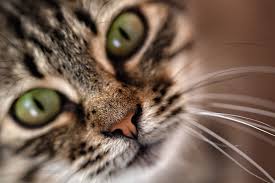 6. c. All felines have long whiskers that are about three times as thick as other hairs needed to explore the surrounding environment. These grow on an area of the muzzle particularly rich in blood vessels and allow cats to capture the vibrations of the air produced by the movement of a prey, even of very small dimensions. Most domestic cats have four rows of whiskers placed on each side of the muzzle, next to the nose: by carefully observing their position and movements we can understand much of the mood of our meowing friend.
7. b. A cat with whiskers facing forward should never be underestimated: whether he is frightened or in the middle of a hunt, he is in any case overexcited and could attack, even just to defend himself against something. The forward-curved “vibrators” are used by the feline to capture any signal from the surrounding environment, both a danger and the movement of a prey.
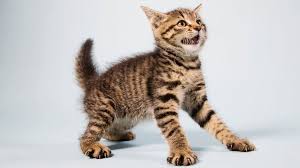 8. a. As with many animals, even for cats, retreating in front of a danger can be difficult: it means turning your back on the enemy and thus exposing yourself to the risk of being chased and captured anyway. So, to look bigger than the opponent and try to put him on the run, the cat’s fur and tail swell and expand.
9. a. Tail movements and position are among the cat’s most effective communication tools. A tail that moves in all directions and whips the air relentlessly is typical of a nervous and frustrated cat. He may have seen another cat that is invading his territory, or some birds in the garden that he is unable to hunt because he is locked in the house. Often this behavior is associated with other signs of impatience, such as ears facing outwards. A word of advice: do not try to pick up a cat in this mood and, if you already have it on your knees, let it go.
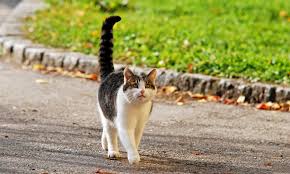 10. b. A straight and tense tail pointing upwards is a sign of openness and desire to make friends, a bit like the outstretched hand of a person who comes to meet you ready to introduce himself. It is a behavior usually reserved for family members and other animals that the cat is used to living with. It is, however, a typical way of acting for domestic cats: feral cats only manifest it as kittens when they communicate with their mother.
11. a. It is the classic position in which, in the collective imagination, we think of the cat: immobile, with the tail wrapped around the body. Even if our friend seems relaxed and absorbed in deep meditation, with this posture he is sending us a message of closure and insecurity. He is probably not comfortable with the people, or the animals, with whom he is sharing the room, or the situation worries him and he then freezes like a statue to try to go unnoticed.
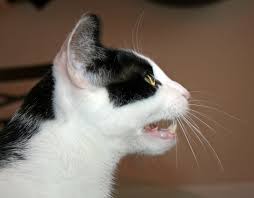 12. b. When your cat’s teeth chatter, do not try to warm him or measure his fever: rather try to remove the cause of the stress or excessive excitement. In most cases, the cats who behave like this have seen some potential prey outside the window or garden fence and are frustrated that they cannot catch it. It is a bit as if we, famished, saw our favorite dishes passing by a closed window, without being able to touch them.
13. c. In nature, cats bury excrements to avoid leaving traces of their passage. A cat that deliberately refuses this behavior, doing its needs in places where it cannot cover them, is showing discomfort. It could be a stress problem, a move, the arrival of a new family member, or a health problem. In any case, it is good to get help from the vet to understand the origins of the disorder.
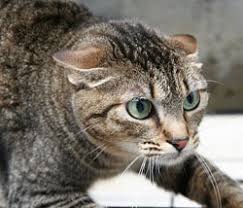 14. b. This is one of the signs that is best to interpret correctly to avoid trouble. A cat with his ears bent backwards is really very scared: if you look carefully at him you will see that all his muscles are tense, ready to sprint, and the senses are alert. In this situation the cat could attack to defend itself. Therefore, it’s better to wait at a safe distance for him to calm down. Often this position precedes the possible fight with another cat that has invaded its territory. Lowered ears are not a sign of danger for all cats: for example, Scottish Fold cats have flattened ears against the head since the age of two weeks.
 15. a. As in humans and in many other mammals, the pupils dilate and shrink depending on the light conditions. Those of cats, when the lighting is very intense, take the form of two pins: their narrowing is a mechanism to protect the retina. But if a cat were to stare at you with pupils dilated even in bright light, it is better to turn away: it is very scared or angry and could react unpredictably.
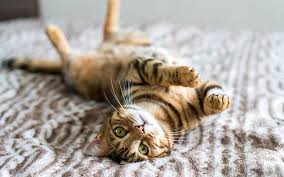 16. b. Exposing the belly to your human friend is a great demonstration of affection and trust on the part of the cat. But be careful how you interact with him at that moment: not all cats love to be touched on the belly and the reaction could be sudden and painful. It is therefore better to approach the cat and caress it on the muzzle or start playing with him with his favorite toy.



 L'Olivo Santa Barbara