Gino Bartali: An Icon of Sports and Humility

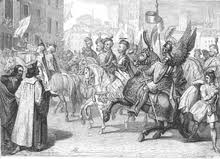
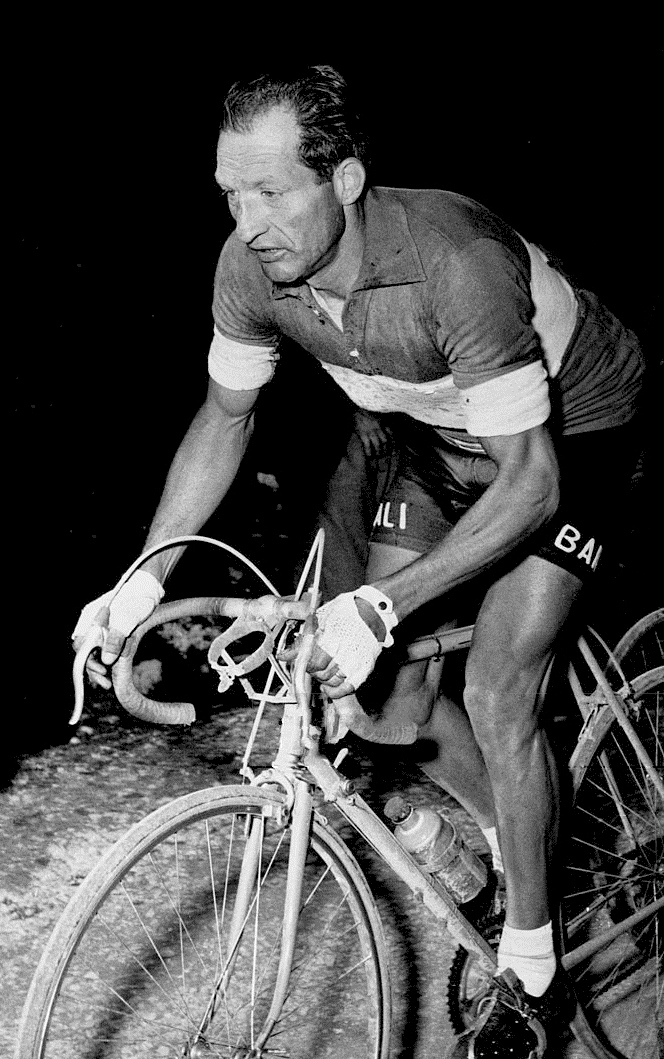
The year was 1937.  Gino Bartali (1914 – 2000) won the Giro d’Italia for the second straight year.  He was Italy’s and Europe’s biggest sports idol.  By this time, Benito Mussolini had ruled Italy with violence and intimidation for 15 years and he would soon lead the country into war.  In 1938, Bartali won the Tour de France.  Mussolini tried to use this triumph on the world stage to prove Italy’s Aryan superiority — that is, that the Italians, like the Germans, belonged to the “master race.”

Bartali rejected the Fascist party patronage.  It was not the last time he defied the party.  In fact, throughout the war he risked his life almost every day to protect Jews and partisans throughout Italy.  Bartali’s story is the framework of the 2014 documentary, “My Italian Secret: Forgotten Heroes,” directed by Oren Jacoby and narrated by Isabella Rossellini. 
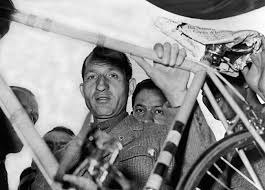
Gino Bartali’s fame as a cyclist enabled him to ride his bicycle not only throughout the countryside of his native Tuscany but also to Genoa, Rome, Assisi, and beyond.  He wore his bicycle uniform with his name emblazoned on the back of his shirt.  He logged about 40,000 kilometers a year during the war.  “I’m training,” he would say, and the Fascists and Nazis didn’t dare stop the sports idol.  Little did they know that he carried secret documents in the frame of his bicycle.  He didn’t want to know what these documents were in case he was stopped and tortured.  Nor did the Nazis discover that he hid a Jewish family in the basement of his home.  Had they discovered either, he would have been immediately shot.
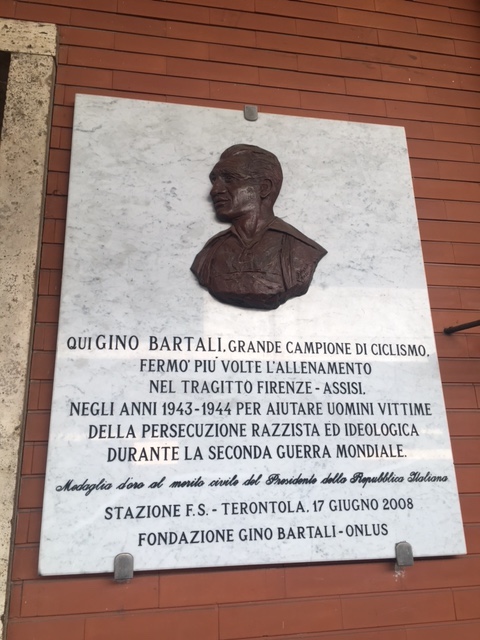
Courtesy of Eleonora Vieri

He also liked to ride to Terentola, a crucial Tuscan town near Castiglione del Lago in Umbria.  The train station there was a transportation crossroad between the North and the South.  Jews and partisans tried to climb unseen onto the trains heading South for asylum.  Hence the station was heavily guarded.  But when Bartoli showed up, crowds gathered around the great cycling champion.  The distracted guards would leave the trains to disperse the crowds, and the refugees would switch trains and head for liberty.
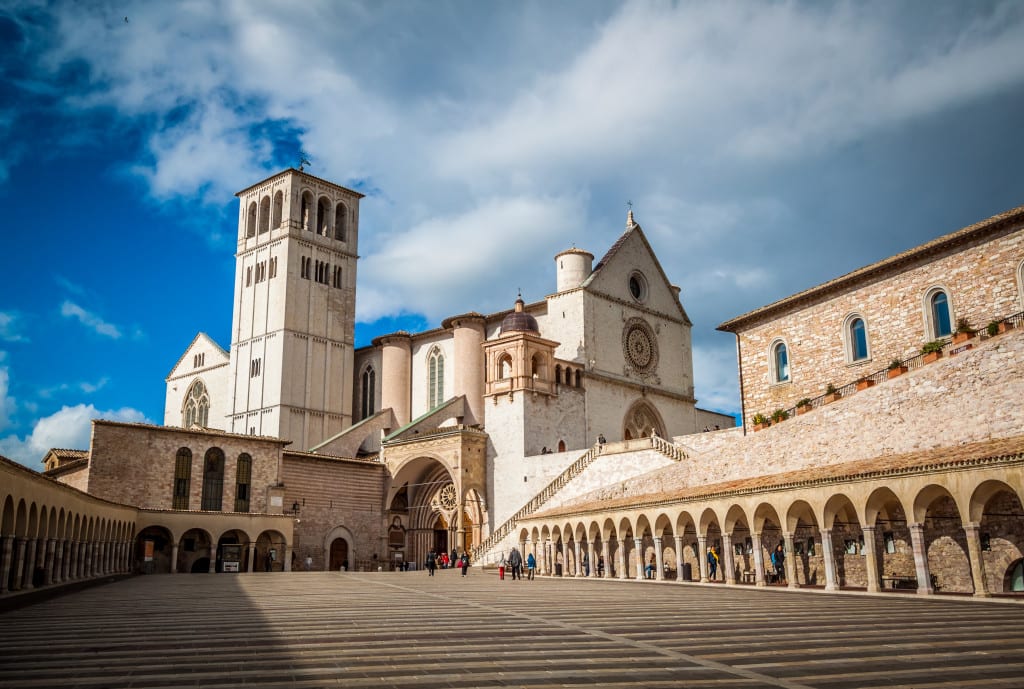
It was Assisi that was the center of underground activity.  Many Jews were hidden there in the monastery and if they were endangered by visiting troops, they were taken to the underground Roman caves where they could escape to the countryside.  Between Florence and Assisi, Bartali was transporting photographs and false identity cards that enabled many Jews to avoid detection and certain death and to flee.
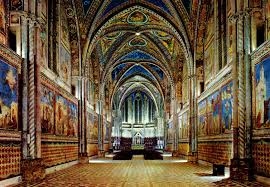
It was also at Assisi that many years later Bartali began to tell his 30-year old son, Andrea, of his wartime activities.  Bartali like to go to Assisi to see the Giotto frescoes and to relive his memories.  A deeply religious man, Bartali never spoke of his deeds.   He told Andrea, “It’s a world in which you must do good but not talk about it.”  He made Andrea swear not to tell anyone.  When his son asked, “Why are you telling me this if I can’t tell anyone?”, his father replied, “Someday you will find the right moment to talk about it.”

Even after Bartali won his second Tour de France in 1948, 10 years after his first victory there, he was silent about his contributions in the war.  He believed that the heroes were those who died, were injured, or who spent endless time in prisons and camps.  He believed that if you talked about your work, you would be taking advantage of others’ misfortunes.  He believed that there is too much injustice in this world spurred on by blind fanaticism.  In his interview in the documentary, Andrea says, “He did what he did because of his character.” 

Bartali’s final resting place further reveals his humility.  The grave simply says his name and the dates of his birth and death.  There is no mention of his cycling championships, no mention of his wartime heroism, no mention of the many medals that he won.  As he himself said, “medals are to be worn on your soul.”

Posted in Comunità ebrea, English, Film, Firenze, Foto, Italia, Lo Sport, Storia, Toscana, Umbria | Leave a comment

Le origini del balletto

Si potrebbe pensare che il balletto sia nato in Francia, poiché la maggior parte dei movimenti hanno nomi francesi, come plié, jeté, rilevé ed échappé.  In realtà il balletto ha avuto origine nelle corti del Rinascimento italiano, come forma di arte al pari di altri arti come la pittura, la musica o la poesia.  Gli spettacoli di danza, come quelli di altre arti, si svolgevano nelle corti per affermare il potere e il prestigio della propria famiglia nobile.  Gli artisti erano vestiti secondo la moda del tempo. Per le donne questo significava abiti formali fino alle caviglie. I balletti potevano essere sia di partecipazione, a cui poteva partecipare il pubblico, sia di presentazione.

Il balletto si diffuse dall’Italia alla Francia quando Caterina de’ Medici, un’aristocratica italiana amante delle arti, sposò Enrico II di Francia nel 1533. Un primo esempio dello sviluppo del balletto di Caterina fu “Le Paradis d’Amor”, un’opera presentata al matrimonio di sua figlia. Il primo balletto formale di corte fu il “Ballet des Polonais”, commissionato da Catherine per onorare gli ambasciatori polacchi che erano in visita a Parigi in quel periodo. I suoi intrattenimenti spesso accopagnavano la politica di corte e di solito erano organizzati attorno a temi mitologici.

L’etimologia della parola “ballet” riflette la sua storia. La parola francese “ballet” ha origine dal italiano “balletto”, una forma diminutiva di “ballo” che, a sua volta, deriva dal verbo italiano “ballare”.

Alla fine del XVII secolo, Luigi XIV fondò l’Acadèmie Royale de Musique (l’Opera di Parigi), dove nacque la prima compagnia di balletto teatrale professionale, il Balletto dell’Opera di Parigi. Il balletto divenne presto una forma d’arte indipendente, sebbene mantenne uno stretto legame con l’opera. Il balletto si diffuse presto dal cuore dell’Europa ad altre nazioni.

L’Italia oggi è ancora di fondamentale rilievo quando si tratta di balletto. Il Teatro alla Scala di Milano è una delle principali compagnie di balletto del mondo. Il balletto può essere visto nei teatri d’opera di tutta Italia, tra cui il Teatro Massimo di Palermo, il Teatro di San Carlo di Napoli, La Fenice di Venezia e L’Arena di Verona.

Posted in Uncategorized | Leave a comment

The Origins of Ballet

One would assume that ballet originated in France.  After all, most of the movements in ballet have French names, like plié, jeté, relevé and échappé.  But ballet originated in the courts of the Italian Renaissance as a form of art on a par with other arts like painting, music and poetry.  Dance performances took place in the courts to affirm the power and prestige of a particular noble family  Performers danced in the fashions of the times.  For women that meant formal gowns down to their ankles.  Ballets were participatory with audience members joining the dances toward the end.

Ballet spread from Italy to France when Catherine de’ Medici, an Italian aristocrat with a love of the arts, married Henry II of France in 1533.  An early example of Catherine’s development of ballet was “Le Paradis d’Amor,” a work presented at her daughter’s wedding.  The first formal court ballet was “Ballet des Polonais,” which was commissioned by Catherine to honor the Polish ambassadors who were visiting Paris at the time.  Her entertainments often supported court politics and were usually organized around mythological themes.

The etymology of the word “ballet” reflects its history.  The French word “ballet” has its origins in the Italian “balletto,” a diminutive form of “ballo,” which, in turn, is derived from the Italian verb “ballare,” which means “to dance.”

In the late 17th century, Louis XIV founded the Acadèmie Royale de Musique (the Paris Opera), from which emerged the first professional theatrical ballet company, the Paris Opera Ballet.  Ballet soon became an independent art form, although it maintained a close association with opera.  Ballet soon spread from the heart of Europe to other nations.

Italy today still has a major claim to fame when it comes to ballet.  Milan’s Teatro de La Scala is one of the premier ballet companies in the world. Ballet can be seen at opera houses throughout Italy, including Teatro Massimo in Palermo, Teatro di San Carlo in Naples, La Fenice in Venice and L’Arena in Verona.

Posted in Uncategorized | 1 Comment