“Italian food” doesn’t really exist much as we use the term in the United States. As in other countries, food in Italy is regional. It is the same for pasta. Local specialties of pasta in Tuscany differ from those in Campania and Puglia. What is fun about pasta are the colorful names and sometimes the colorful stories behind them—whether true or apocryphal.
 According to legend, Marco Polo brought pasta to Italy from China in the 1200s. In reality, pasta dates back to the ancient Romans. However, the type of pasta used then was cooked instead of boiled. At the end of the first century, boiled pasta became the customary cooking method. Dried pasta became popular in medieval times, particularly with mariners and explorers because of its long shelf life and its capacity to feed a large number of people.
Today there are more than 350 forms of pasta in Italy. Here are some examples of the regional origins of pasta.
 Campania: Naples is considered the capital of Italian pasta. It is an ideal place for the cultivation of durum wheat. Naples is also the home of the first pasta machine and the first four-pronged fork.
Penne comes from this region of Campania. The pasta is cut at an angle that resembles the tip of a quill or pen. There are several variations of penne: penne rigate (ridged), pennette (smaller penne), and pennioni (larger penne). Like other tubular pasta, penne works well with thick and chunky sauces. Penne rigate holds more sauce because of the ridges, while smooth penne works better with oil-based sauces.
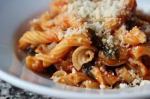 Torchietti (“little torches”) also come from Campania. This pasta, in the shape of a bell, is traditionally served with a simple tomato sauce.
Probably the most famous pasta of all—Lasagne—is said to have 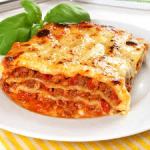 originated in Campania. Lasagne al forno (baked lasagna) is arranged in various layers—each separated by a filling that varies according to local tradition. Despite many local recipes, there are two distinct types: The older is from central-southern Italy, and the more recent one is from central-northern Italy, particularly from Emilia-Romagna. The Neapolitan version of the recipe contains a tomato ragù, milk products like Mozzarella or Provolone, small meatballs and Roman ricotta. The Emiliana tradition has layers with Bolognese ragù, beschamel sauce, and Parmigiano-Regiano. In the Marche region and in some areas of Umbria, “vincisgrassi” is found, in which other ingredients are added to the ragù, such as chicken livers, sweetbreads, marrow, or truffles.
 Lazio: One of the most popular pastas in Rome is bucatini, which means “little holes.” Bucatini resembles large spaghetti but with a small hole in the middle. (Please see my post of March 5, 2015 for a recipe of bucatini all’amatriciana.)
 Sicilia: Anelletti (“small rings”) al forno is a pasta from Palermo that is also found throughout Sicily. According to Giuseppe Crisà, the anelletto is the only form of pasta originating from Sicily. They are served from restaurants to bars with delis, but they are most often served in families especially on feast days.
Liguria: Who has not heard of pasta al pesto or, on menus in Genoa, trofie al pesto? Trofie are small shapes of rolled pasta. They are traditionally served in the Genovese tradition with pesto, green beans, and potatoes.
One unusual form of pasta that comes from Liguria is the corzetto. Two types exist: those with the characteristic form of the figure 8, and those that are “stamped.” A wooden stamp is used to decorate the pasta with a medallion that helps to prepare the pasta to absorb a sauce.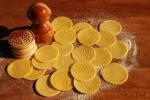
The stamped corzetti appeared in medieval times. Noble families ordered their cooks to make this pasta to showcase the family crest, with the goal of reminding guests of the importance of their family and of its prominence in the territory. The name comes from the stylized image of a small cross, which originally decorated one side of the medallion.
Today in small artisanal shops in the historical center of Genoa, you can still find these stamps, which are composed of two parts: one part works to imprint the image, and the other concave, cylindrical form is used to cut the pasta. The best seasonings are a walnut sauce, a mushroom sauce (Tocca de funzi), and also pesto. In some areas, a mushroom and sausage sauce is common; in other areas a pinenut sauce is used.
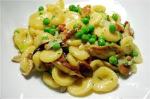 Puglia: Orecchiette come from Puglia, which is in the heel of Italy’s boot. The small and curved shape, which at times has the thumbprints of the pasta maker, inspired the name “small ears.” Orecchiette is best served with heavier sauces because its concave form serves as a little bowl. (Please see my post of June 26, 2014 about “The Foods of Puglia.”)
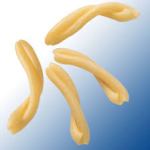 Emilia-Romagna: Strozzapreti were invented in the region of Romagna, together with an interesting, if morbid, story. A long time ago, priests could eat free in restaurants and in people’s homes. The restaurant owners joked that they hoped that the priests would choke on the pasta before the more expensive second course was served. This form of twisted pasta could get caught in the throat, resulting in a sad end. The name means “priest stranglers.” Today, a typical dish of this region is strozzapreti served with a sauce of vegetables, a sausage ragù, or porcini mushrooms.
Tagliatelle are popular in central and northern Italy. The name comes from the verbs  “tagliare” (to cut) o “affettare” (to slice); after stretching the pasta in thin strips and then rolling it up, you cut it to form strips similar to, but thinner than, fettucine. The classic sauce is Bolognese.
The history of tortellini involves the Roman goddess of love, Venus. According to the 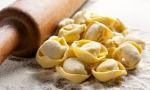 myth, a chef tried to sneak a peek of the goddess through a keyhole in her room. But all that he could see was her belly button. He raced back to the kitchen and made tortellini, which reminded him of her navel.
Tortellini is a pasta stuffed with anything from minced meat to prosciutto, cheese, or spinach. It is generally served in a broth or with a light tomato or cream sauce.
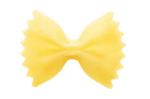 Farfalle (“butterflies”) were “invented” in the 1500s. They are a versatile pasta that go well with most sauces.
Molise: Fusilli supposedly began in Molise. They were made in the kitchens of wealthy families who brought in women who specialized in this art and were known for their fast dexterity in forming the spirals. In some cities in Molise today fusilli are still made by hand by rolling spaghetti on wires and then hanging them to dry.
Veneto: Bigoli are thick noodles, similar to spaghetti but wider. This pasta is traditionally served with a light fish-based sauce. Jacopo Giacopuzzi tells me that the pastas most often served in Verona are farfalle, fusilli, and tagliatelle. Of course, pasta knows no borders. Nowadays, you pretty much find many types of pasta throughout the country, even if a specific type had originated in one region.
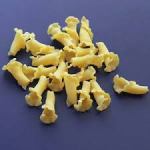 Toscana: Gigli means “lilies”. This fluted pasta is specific to Florence where the lily if the local emblem. Gabriella Geri-Schooley tells me that she remembers in Tuscany that her family often had spaghetti or tagliatelle with fresh ragù.
Abruzzo: Chitarra (“guitar”) is long and thin pasta that is cut  with a utensil that resembles a harp. The fresh pasta dough is pushed through the fine strings to cut it into strands. It is often served with a silky cream- or oil-based sauces.
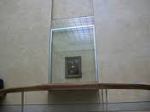
 Leonardo da Vinci. È stata acclamata come “la più nota, più visitata, più parodiata opera d’arte nel mondo.” Fu dipinta tra il 1503 e il 1506. Leonardo poi la portò con sè a Parigi intorno al 1516, quando fu invitato a lavorare lì dal re Francesco I. Contrariamente alla credenza popolare, non era stata rubata da Napoleone e le sue truppe. L’allievo e assistente di Leonardo, Salaì, presumibilmente ereditò il dipinto alla morte di Leonardo. Allora il re acquistò il dipinto per 4 mila scudi d’oro e lo tenne al Palazzo di Fontainebleau, dove rimase fino a quando Luigi XIV spostò la pittura al Palazzo di Versailles. Dopo la Rivoluzione Francese, fu spostato al Louvre. È stato anche per un breve periodo nella camera da letto di Napoleone nel palazzo delle Tuileries.
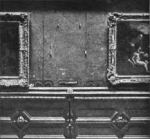 Nell’agosto di quell’anno, un copista, che aveva avuto il permesso di riprodurre l’opera a porte chiuse, andò al Salon Carrè del Louvre, dove la Gioconda era stata in mostra. Tuttavia, dove la Gioconda sarebbe dovuto apparire, invece il pittore trovò quattro pioli di ferro. Le guardie pensarono che il dipinto fosse stato rimosso per ragioni fotografiche. Non fu così. Il Louvre chiuse il museo per una settimana per andare in cerca del ladro.
 Vincenzo Peruggia, rubò il famoso dipinto. Entrò nell’edificio durante l’orario normale, si nascose in un armadio di scope, e uscì dal museo con tutta calma dopo aver chiuso la porta con il dipinto nascosto sotto il suo cappotto. Peruggia era un patriota italiano che credeva che il dipinto di Leonardo dovesse essere riportato in Italia. Riteneva, infatti, erroneamente, che l’opera fosse stata rubata durante le spoliazioni napoleoniche.
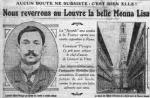 Peruggia mise la tela in una valigia e la pose sotto il suo letto in una pensione di Parigi. Dopo aver tenuto il dipinto nel suo appartmento per due anni, Peruggia cresceva impaziente. Infine fu catturato quando tentò di venderlo alla Galleria degli Uffizi di Firenze.