
The Mafia evolved over centuries in Sicily, an island in the Mediterranean Sea between North Africa and the Italian mainland. Until the mid nineteenth century, Sicily was ruled by a long line of foreign invaders, including the Phoenicians, Romans, Arabs, Normans, and Spanish. The residents of the island formed groups to protect themselves from the hostile invaders. These groups developed their own system of justice and retribution.
By the nineteenth century amidst chaotic conditions in Sicily, the mafia evolved into private armies that extorted protection money from landowners. The Sicilian Mafia became a collection of criminal clans or families carrying out their actions in secret. They all shared omertà, an ancient Sicilian code of conduct, which says that a person never goes to govenment authorities to seek justice and never cooperates with authorities investigating a crime.
 By the early 1980s, times were changing. Piersanti Mattarella — the brother of Sergio Mattarella, the current President of the Republic — was the President of the Regional Govenment of Sicily at the time. He wanted to clean up public contracts that benefited Cosa Nostra. He passed a law requiring that the same building standards be used in Sicily as in the rest of Italy. He was assassinaed by the Mafia in Palermo in 1980.
 Then magistrates, such as Giovanni Falcone and Paolo Borsellino, initiated a campaign against Cosa Nostra. A big break came when when an arrested mafioso became an informant; others followed. In the late 1980s, 474 mafiosi were put on trial in a fortified courthouse in Palermo; 342 were convicted.
The mafia retaliated violently. Falcone and Borsellino were killed by bombs in 1992. Other anti-mafia prosecutors, judges, and businessmen were also murdered. This led to a public outcry and a massive government crackdown. The mafia took their terrorism campaign to tourist locations on the mainland. When the Catholic Church openly condemned the mafia, churches were bombed and priests were murdered.
In 1990 Father Giuseppi “Pino” Puglisi returned to his former, dangerous neighborhood,  Brancaccio, in Palermo and became the priest of San Gaetano’s Parish. He opened a shelter, school, and playground for children to take them off the street where the mafia had recruited them. He tried to change the mindset of the people, which was conditioned by fear, passivity, and omertà. He refused money from the Mafia on traditional feast day celebrations and would not let them march at the head of religious processions.
He declined to award a contract to a construction firm of the mafia for the restoration of the church where the roof was collapsing. On his 56th birthday, Father Puglisi was shot at point-blank range in front of his parish church. One of the hitmen later confessed and revealed the priest’s last words: “I’ve been expecting you.”
The people of Palermo adore Father Puglisi who was beatified in 2013. More than 80,000 people attended the ceremony. Efforts are underway to make the martyred priest a patron saint of Palermo. On the walls of Brancaccio are written the priest’s favorite saying: “If everyone does something, then we can do a lot.”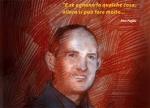
Today, with stricter laws, intense prosecution, and the help of informants, the Mafia is greatly weakened. In addition, there has been a social movement among the people to decry the work of the mafia. Children as young as 6 are taught in school about the crime and violence of the mafia. They even go on field trips to locations of murders. Former mafioso families are changing their names to mitigate the stigma. While the mafia has not been eradicated, the progress is indeed impressive.
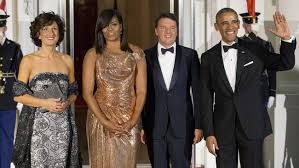
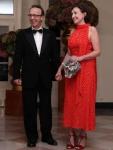 Giorgio Armani, John Turturro, Bebe Vio, medaglia d’oro in scherma alle paraolimpiadi, e John Elkann, il presidente di Fiat Chrysler Automobili, oltre a molti esponenti politici di entrambi i paesi.
 italiano era presente in tutto, tra cui oggetti di vetro fatti a mano, sottopiatti neo-fiorentino, e la musica che comprendeva un brano d’opera di Puccini. Naturalmente, il menu, con il contributo dello chef Mario Batali, includeva molti sapori italiani: agnolotti di patata dolce, insalata di zucca con il pecorino di New York, braciole con cremolata di rafano e friarielli, il tutto annaffiato da Vermentino e Sangiovese. Il dolce consisteva in una crostata di mele verdi con gelato al timo caramello e latticello.
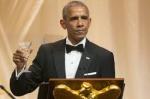 Il buon umore aleggiava nell’aria. Quando Obama ha salutato
 Renzi (che indossava uno smoking di Armani) presso il portico della Casa Bianca, ha scherzato dicendo: “Non preoccuparti di come si siamo vestiti, tutti sono interessati solo agli abiti delle signore”. Durante la cena, Obama ha rassicurato gli ospiti che “Benigni ha promesso di non saltare sui tavoli”. E Renzi si è complimentato con Michelle per le verdure dall’orto e ha aggiunto “il tuo ultimo discorso di sostegno a Hillary Clinton è stato ancora meglio dei tuoi pomodori”.

