
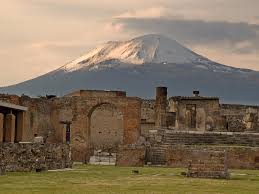
 Pompeii is spread out over 110 acres; about 2/3 of the city has been excavated. The streets
  are laid out in polygonal stone in the traditional Roman grid pattern. Houses and shops line both sides of the streets. Wealthier homes are contained in the interior or could occupy up to an entire insula, or city block. Pompeii has been divided into nine regions called Regio; maps, like the Bellum Catilinae,detail the 17 insulae within the regions as well as the houses, shops, and apartments in each insula (see http://users.ipa.net/~tanker/pompeii.htm). The forum, baths, some houses, and some out-of-town villas like the Villa of the Mysteries, remain well preserved. Others were in dire need of restoration.
The Great Pompeii Project included the restoration of many houses, particularly in Regio  VI, an area of about 20 acres in the northwest sector of Pompeii. In late 2016 the House of the Vettii was reopened. This was a domus or house of the union of two families of freed slaves. A famous fresco of Priapus with a giant phallus is in the entrance vestibule to keep the evil eye away. (Erotic imagery was quite
 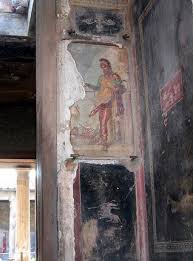 common in this era.) In the atrium there are two safes raised on stone blocks and covered with iron; they confirmed to the visitor that one was in the home of a rich family. In the triclinium (formal dining room) are several frescoes, including the famous “Ariadne abandoned by Theseus at Naxos.” Other houses reopened in Regio VI are the House of Adonis, in which there is a large fresco of the dying Adonis rescued by Venus, and the House of the Anchor, which takes its name from a beautiful black and white mosaic.
But it was during 2018 that many new discoveries were made mostly in Regio V, which was a largely unexcavated area in the northeastern sector of Pompeii. The first victim was  discovered in May – the skeleton of a man who survived the initial explosion of Mount Vesuvius but was then crushed by a massive rock as he attempted to flee. The team also found the cavity left by a horse’s body and was able, for the first time, to make a complete cast of the body of a horse killed in the eruption. The experts think the horse, short by today’s standards, was exceptionally large for its time. Traces of a harness in iron and bronze were found nearby, which suggests that the animal was a specially bred parade horse, probably of considerable value.
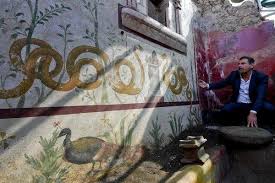 In October excavators uncovered an ancient shrine, known as a lararium, embedded in the wall of a house flanked by images of Roman gods and surrounded by idyllic paintings of plants, snakes, and a lifelike peacock. Beneath the shrine, the altar has traces of burned offerings from almost 2,000 years ago. Every house had a lararium of some kind, but this house also had a garden and a small pool suggesting the wealth of the owner. According to Massimo Osanna, the superintendent of Pompeii, the House of the Garden was exceptional not only because of the incredible decoration of the wall painting but also because it was all very well preserved.
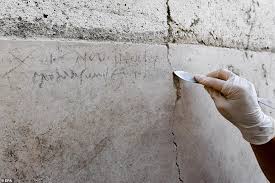 A week later there was an extraordinary discovery in the House of the Garden. On the wall of a room under renovation at the time, there was an inscription in charcoal with a date corresponding to October 17. Therefore, the eruption of Mount Vesuvius could not have occurred in August as has been reported for centuries, but perhaps in October or November of 79 A.D. Further support for a later eruption is found in the heavier clothing that the people buried in the ash were wearing. The fresh fruit and vegetables in the shops are typical of October, and summer fruit was already being sold in dried form. Coins found in a woman’s purse could not have been minted before the middle of September.
A week later…another discovery in the House of the Garden: the remains of five people, most likely two women and three children who had taken refuge in a bedroom in a desperate attempt to save themselves from the rain of ash and pumice. They tried to seal the door by placing a piece of furniture in front of it. It’s another dramatic scene, testimony of the last terrible hours in Pompeii.
 And then in November 2018 came the announcement of another extraordinary discovery: an exceptionally well-preserved fresco depicting the mythological scene of Leda and the swan. It shows the rape of the queen of Sparta by Jupiter (Zeus to the Romans) in the form of a swan. It was unearthed in the bedroom of a house being excavated on the Via del Vesuvio. Osanna said that the fresco suggested that the owner was most likely showing off his family’s power.
 And finally, in December another purebred horse was discovered; wearing a bronze-plated military saddle and appeared ready to go when the eruption occurred. Along with the remains of two other horses, this horse was discovered in the remnants of a stable attached to a sumptuous suburban villa in Civita Giuliana, outside the walls of Pompeii. According to Osanna, the villa had richly frescoed and furnished rooms and a servant’s quarter. A farmyard, and olive oil and wine warehouses were also situated on the sloping terraces facing the Gulf of Naples and Capri.
 dell’Italia romana. Nel 2012 le autorità del sito hanno ricevuto una sovvenzione di emergenza di 75 milioni di euro dall’Unione europea e altri 30 milioni di euro dal governo italiano. Il professor Massimo Osanna, un archeologo visionario, è stato nominato sovrintendente nel 2014. Sta applicando un approccio chiamato “archeologia globale”, che arruola un vasto team interdisciplinare di competenze scientifiche, accademiche e pratiche nello studio di siti antichi.
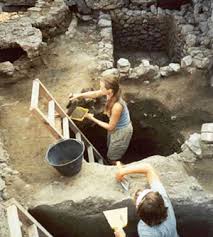 Considerando che solo circa 3 archeologi avevano lavorato a Pompei in passato, ora ci sono più di 200 esperti al lavoro, inclusi 12 architetti e 12 archeologi. Il team comprende anche muratori, elettricisti, idraulici, pittori, carpentieri, fotografi, dentisti, antropologi, radiologi, biologi, geologi, tecnici di mappatura, informatici, ingegneri medici, idro-ingegneri ed esperti nel restauro artistico.
 resina invece del gesso perché è più resistente e non distrugge le ossa, permettendo ulteriori analisi. Gli esperti oggi usano anche tecnologie avanzate per compilare i profili genetici delle vittime – non solo sesso ed età, ma anche dove sono nati e quali occupazioni hanno tenuto. Studiano i resti del cibo per ottenere ulteriori indizi sulle abitudini alimentari e stanno studiando case e affreschi restaurati per ricostruire la vita quotidiana degli abitanti. Stanno anche raggruppando risultati medici con altri dati per costruire un censimento della comunità scomparsa.
 Pompei potrebbe essere uno specchio dei nostri tempi anche in altri modi. Le loro diete erano simili a quelle della California di oggi con cereali, tra cui grano, avena e orzo, accompagnate da ceci, frutta e noci, e accentuate da spezie e prelibatezze importate da aree lontane come l’Egitto e la penisola arabica. Eppure i locali spesso pranzavano nei ristoranti “fast-food” nei negozi chiamati thermopolia, che avevano banconi in pietra con recipienti di terracotta scavata che contenevano pasti precotti.
 encased the dead, yielding evocative casts of their corpses. Today they use a resin instead of plaster because it is more durable and does not destroy the bones, allowing further analysis. The experts today are using advanced technology to compile precise genetic profiles of the victims—not only gender and age, but also where they were born and what occupations they held. They are studying food remnants for clues on eating habits, and they are studying restored houses and frescoes to piece together the daily lives of inhabitants. And they are collating medical findings with other data to construct a census of the vanished community.
 L'Olivo Santa Barbara