The Leaning Tower of Pisa starting leaning almost from the get-go … nearly 900 years ago. Begun in 1173, the bell tower took nearly 200 years to complete. It was, in fact, the delays along the way, as well as natural and man-made interventions, that saved it from totally collapsing throughout its long history. And then in the 21stcentury a miracle happened in the Piazza dei Miracoli.
Let’s start at the beginning. The tower’s tilt began during construction of the second floor in 1179 and was caused by an inadequate foundation on soil that was too soft to properly support the structure. But construction was halted that year because the Republic of Pisa was almost continually engaged in battles with Genoa, Lucca, and Florence.
When construction resumed nearly 100 years later, the underlying soil had settled. The tilt remained, and the engineers of the time built the upper floors with one side taller than the other. Construction was halted again in 1284 for another battle. The seventh and final floor was completed in 1319, and the bell-chamber was added in 1372.
At least four strong earthquakes shook the area since 1280. What researchers understood centuries later was that the height and stiffness of the tower, together with the softness of the foundation soil, protected the tower from vibrating with earthquake ground motion. The same soft soil that caused the tilt and near collapse of the tower helped it to survive over the centuries.
The tilting increased over time and seemed to be at its worse in the 1830s. Numerous efforts were made to restore the tower’s vertical orientation, but most failed. During World War II, the Allies suspected that Germans were using the tower as an observation post. An army sergeant who was sent to investigate was so impressed by the beauty of the cathedral and its campanile that he refrained from ordering an artillery strike, thus sparing the tower from destruction.
Then by the 1960s, while the government of Italy was concerned for the structure’s stability, it also knew that the tilt played an important role in the tourism industry. In 1987 UNESCO declared the tower, cathedral, baptistery and cemetery a World Heritage Site. But three years later, after the collapse of the Civic Tower of Pavia (near Milan), the Tower of Pisa was closed to the public.
Between 1993 and 2001, various methods were undertaken to stabilize the structure. The bells were removed to relieve some weight. Cables were cinched around the third level and anchored several hundred meters away. Tons of soil were removed from the raised end. A system of counterweights and micro tunnels were built under the lawn. These were reversed in 2001 and replaced by a network of sensors that today give hourly readings of many measurements, including external and internal temperatures, wind velocity, micro fissures in the stone, and soil movement.
The results were impressive. The tower was straightened by 41 centimeters (about 16 inches) bringing it back to its status of 200 years earlier. The tower reopened to the public in 2001. The number of visitors who climb the bell tower is restricted to about 400,000 annually, and the tower remains “the most monitored monument in the world.” But now the Leaning Tower of Pisa has lost its status as the world’s most off-kilter building. Two churches in Germany have a greater tilt; and structures in Abu Dhabi and New Zealand were deliberately built at far greater slopes.
But the miracle in Pisa today is that nearly two decades after engineers completed consolidation work, it has been found that the tower tilts even less (by 1.5 inches). The tower is continuing to straighten, which had not been foreseen. And the reason is not entirely known. It doesn’t mean that it would ever be completely upright—for at the current rate, that would take about 4,000 years.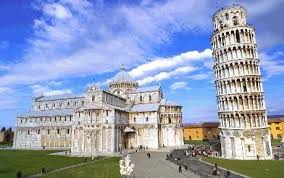
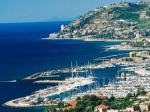 Sanremo è una bellissima città sulla costa ligure, una destinazione turistica e popolare sulla riviera italiana. Ospita l’annuale Festival della Musica Italiana, fondato nel 1951, diventato così popolare tra gli italiani da venire spesso definito semplicemente “il Festival”. Fu a malapena conosciuto fino al 1958, anno in cui
  Domenico Modugno portò al Festival “Nel blu dipinto di blu”. Era l’ultimo giorno del Festival e fu dichiarato vincitore, stupendo la donna che fino a quel momento era la presunta vincitrice. Modugno scrisse la canzone con Franco Magliacci, e si dice che Modugno non volesse portarla al Festival, maaccettò solo perché fu rifiutato da tutti i
 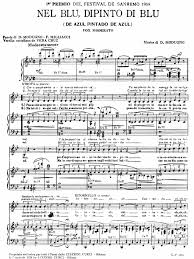 cantanti ai quali era stata proposta.
 la Song of the Year. Fu tradotta in molte lingue e interpretato da diversi artisti, tra cui Dean Martin, David Bowie, e Paul McCartney e perfino Pavarotti e Bocelli.
 Modugno, ma mentre aspettava il suo arrivo iniziò a bere vino finendo per addormentarsi. Ebbe sogni vividi (forse, incubi) e quando si svegliò, guardò le due riproduzioni di Marc Chagall sul muro della stanza. In “Le coq rouge” un uomo giallo è sospeso a mezz’aria e in “Le Peintre et la modelle” metà del viso del pittore è colorata di blu. Così iniziò a scrivere una canzone su un uomo che sognava di dipingersi di blu e di essere in grado di volare. Diversi anni più tardi, la moglie di Modugno ricordò che dopo un temporale Domenico fu costretto ad aprire la finestra e come da ciò trasse ispirazione per modificare il ritornello della canzone, introducendo la parola “Volare”, che ora è il titolo popolare della canzone. La canzone ha un inizio quasi surreale: “Penso che un sogno così non ritorni mai più. Mi dipingevo le mani e la faccia di blu; poi d’improvviso venivo dal vento rapito, e incominciavo a volare nel cielo infinito”. Solo alla fine si rivela come una canzone d’amore: “Ma io continuo a volare negli occhi tuoi belli, che sono blu come il cielo trapunto di stelle” e “nel blu dipinto di blu, felice di stare quaggiù…con te”.