
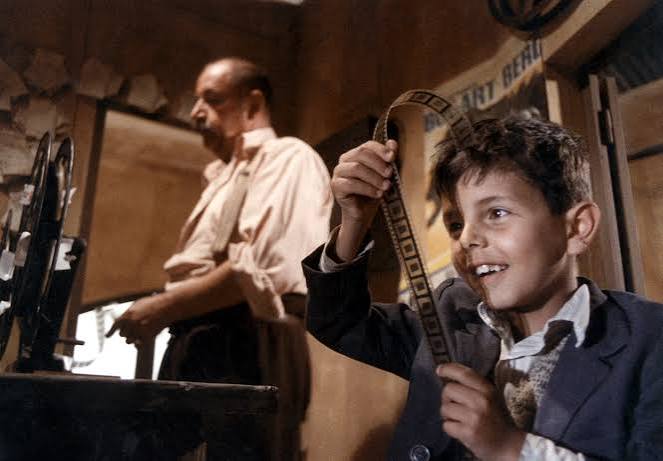
Fueled by the soaring score of Ennio Morricone, the film is sugary, nostalgic, and at times melodramatic. It is also a lovely film in so many ways. Told mostly in flashback, it primarily takes place in a post-war Sicilian town similar to the one director Giuseppe Tornatore grew up in outside of Palermo.
The star of the film is young Salvatore Di Vita (Salvatore Cascio), nicknamed Totò, who is a smart and impish 8-year-old fascinated by the movies projected in the piazza’s theatre. He routinely visits Alfredo (Philippe Noiret), the upstairs’ projectionist, to watch him work and to collect scraps of celluloid. He is also routinely banned but always finds a clever way to return. Eventually Alfredo not only accepts him but also becomes his mentor and father figure. It is this relationship that is the crux of the film.
At first, Alfredo dissuades Totò from becoming a projectionist: “You see a film 100 times. You’ve nothing else to do. You talk to Greta Garbo and Tyrone Power like an idiot. You work like a dog. Even holidays — Easter, Christmas. You only get Good Friday off. And if they hadn’t stuck Christ on a cross, we’d even work then.” Realizing Totò’s potential, however, he later encourages him to go to Rome where, in fact, Salvatore will become a successful filmmaker.
For me, one of the funniest scenes in the film is when both Alfredo and Totò are taking a grade school graduation exam. Alfredo is stumped and Totò, who at this point had been banned from the projection room, won’t share his answers. Then through gestures, they come to an agreement: in return for the answers, Totò can return to the theatre. The other funny scenes involve the town’s priest, who also serves as the movies’ censor. As an audience of one, he previews all the films and rings an altar boy’s large bell when a couple is about to kiss. Although the priest is clearly enjoying every moment, Alfredo must cut those carnal scenes.
Cinema Paradiso is an homage to film. You see snippets of films from many genres and eras—and familiar stars from Charlie Chaplin in black-and-white, to John Wayne on horseback, to Kirk Douglas in colorful blockbusters. Going to the theatre in those pre-television days of the ‘40s and ‘50s was the Sicilian town’s only entertainment. Kids and adults do everything in the theatre—scream, cry, whistle, and hiss, to be sure—but also smoke, drink wine, sleep, breastfeed, have sex, masturbate, and pick their noses. It was home for them.
I learned recently that there are actually two versions of this film. The first, called the Director’s Extended Cut was 173 minutes and focused more on Totò’s relationship with Elena. It was and is called Nuovo Cinema Paradiso in Italy, where it was not well received at first. The Theatrical Cut, reduced from almost 3 hours to 2, is simply Cinema Paradiso, the one we see today and the one that received many awards, including Oscars’ Best Foreign Film in 1990.


