
 This is the third and last post of an interview, in three parts, of my Italian teacher and the editor of my posts, Eleonora Vieri. In the first part, she gave a first-hand account of the pandemic in Italy. Last week she spoke about her childhood, education and how she became a teacher of Italian for foreigners. This week she talks about her approach to teaching both in person and via Skype, which is particularly important during this period of social distancing.
If you are interested in learning Italian or having exclusive conversations in Italian with an interesting and charming native speaker, take a look at Eleonora’s web site: www.italianviaskype.net or send her an e-mail at the following address: eleonoravieri@gmail.com.
“I have had students from many parts of the world, both in person and on Skype, mostly adults, but also teenagers and children, of every language level. They are students who are passionate about the Italian language and culture, have Italian origins, love la bella lingua, the beautiful language, and they often use it to travel in Italy. I have Italian students for professional reasons: diplomats, religious, university, interpreters.
“I started teaching on Skype about 10 years ago (I was already working as a teacher in several schools before). I started alone, completely alone, I didn’t know which way to go, what materials and which methods to use; then there was the difference in time zones, the payments … the embarrassment of a new thing, etc. But I am still here, and I continue to give lessons online, even with the first students who had the courage and curiosity to undertake this journey with me.
“The advantage of online lessons is that it is not necessary to travel 10,000 km to have a native speaker, the world becomes really small, from the armchair of your home we can comfortably have a “chat” … and even a little grammar of course 😉 …. while keeping the liveliness in discovering different cultures. Another advantage is that there is no need to buy materials, I send all the homework by email, unless the student is ambitious enough to want to buy his own books personally.
“It is a good to practice a foreign language, and you do not always have the opportunity to find native teachers in the place where you live. If you live in a metropolis, ok! But for those who live in a village, in a countryside or suburban area … I don’t think it’s easy. And so, I who live in Castiglione del Lago, can easily speak with my student from Berettyòùjfalu in Hungary.
“I teach on all levels. The requests are, for the vast majority, individual lessons, but if requests for group lessons arrive, they are always a good learning opportunity. That the teacher is a native speaker, I think it is a fundamental, necessary and desirable requirement. How can an apple communicate the taste, aroma, scent of an orange? How can a guitar reproduce the sound of a piano?
“Italian, as for those who speak English, French, or Bengali … is part of my DNA, it is the linguistic-cultural system to which I belong. It is my competence as a native speaker. Of course, living in Italy is no small feat. You participate live (not remotely) in the social, cultural, political, family life of the country … you can perceive the details, the nuances … you breathe the air. But you become more aware of it only by being in contact or communicating with others. So I know more and more about Italy through people from other countries. The differences bring about awareness. Since I was at university and started traveling abroad to learn languages, I realized that my knowledge of Italy and Italian has expanded thanks to the knowledge of other languages and cultures.
“For many years I have interacted with Americans for both work and friendship. Their ease in relating, their sociability, is remarkable. Perhaps because the United States has always been used to living with different nationalities, they are flexible and open to the diversity of others. They are good companions, we would say in Italian. They are welcoming. Generous.
 “In fact, I was hosted in Santa Barbara by my student friends: Joel, Michelle, Tama and Barbara. I got to know a little about this part of America, the territory, the habits and, not least, the wine. And I repeat what I stressed above. I had a great time, like a niece.
“Of course, as an Italian, it is hard to adapt to coffees that are not Italian or to certain schedules, such as dinner, which are much earlier than in Italy. But this is also a reason to smile. It is a sacrifice, but we are beautiful for this. Everyone is different.
“As for learning Italian, Americans, as for all native English speakers, the greatest difficulty lies in the “linguistic inflection” of Italian. To be clear, the inflection allows one to express in general, through endings, grammatical categories such as gender, number, etc. For example: -o, is the ending indicating the singular masculine gender. English is almost gender-free, so for a native English speaker it takes some time for this gear to work.
“Another critical point is the pronunciation of certain phonemes such as / r /, / t /, or the pronunciation of double consonants. Then there is the challenge of the use of prepositions, of verb tenses—but not only for Americans.
“And then, as it happens to everyone who is learning a foreign language, is the understanding of cultural concepts related to appropriate expressions. So if I get a package from a courier, I won’t greet him saying: ciao tesoro, amore mio! “hi honey, my love!” just because Italians tend to use warm expressions of this type. No! There are different situations and expressions appropriate for them. It’s just a little example.
“Another key point is to go beyond stereotypes. For example, not all Italians speak loudly, and the Italian family is not always a “paradise.” Each language is an expression of a specific culture, therefore learning a foreign language means absorbing its culture, understanding it and expressing it adequately in different situations.
 “Finally, I would like to thank Barbara, who made me discover and rediscover the pleasure of writing. Thank you for giving me the opportunity to share the experience of the pandemic, making us all feel a little closer on a human level, for the possibility of speaking about my work to an American audience, one that has always shown an interest in Italy. I usually read other people’s writings, such as Barbara’s blog on Italian culture, whose liveliness, freshness and agility I appreciate, with which she constantly manages to find different and interesting themes about Italy.”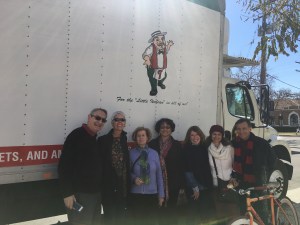
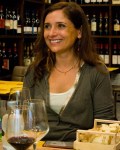 Questo è il secondo articolo di una serie in 3 parti, basata su un’intervista con la mia insegnante e curatrice dei miei articoli, Eleonora Vieri. La scorsa settimana, Eleonora ha fatto un resoconto di prima mano sulla pandemia in Italia. Questa settimana parla della sua infanzia, della sua istruzione e di come è diventata insegnante di italiano per stranieri, non solo per americani, ma anche per tanti altri studenti di diverse nazionalità. La prossima settimana parlerà del suo approccio all’insegnamento via Skype, che è particolarmente importante durante questi periodi di distanziamento sociale.
 “Sono nata in Umbria a Castiglione del Lago, sul lago Trasimeno, ci vivo ancora, e mi ritengo fortunata, non solo per la storia e le tradizioni, evidenti come in ogni angolo d’Italia, ma anche per la natura bellissima. Ma certo, io sono di parte ;). Una natura presente, evidente ancora di più da quando viviamo la pandemia.
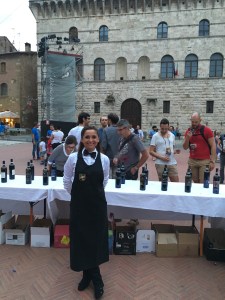 “Nel tempo libero mi diletto con il vino. Impossibile vivere qui e non bere o non sapere almeno un po’ di questo “signore del territorio”, che abita l’Italia tutta, da nord a sud, fin dal tempo dei Greci e degli Etruschi. Allora ho fatto un corso con FISAR, e adesso, quando la federazione ha bisogno, noi sommelier prestiamo servizio in eventi, feste o cene di gala. Impartisco lezioni di vino, teoria e degustazione, anche ai miei studenti.
 This is the second article in a 3-part series based on an interview with my teacher and editor of my articles, Eleonora Vieri. Last week, Eleonora gave a first-hand account of the pandemic in Italy. This week she talks about her childhood, education, and how she became a teacher of Italian for foreigners, not only for Americans but also for many others of different nationalities. Next week she will talk about her approach to teaching via Skype, which is particularly important during these times of social distancing.
 L'Olivo Santa Barbara