Covid-19 Detection Dogs

Using their incredible sense of smell, dogs today do many types of work for humans.  They detect signs of diabetes, Parkinson’s disease, and cancer, among many other ailments.  They are allies in military operations, smelling out hidden explosives.  They partner with customs officials searching for contraband, such as drugs and elephant ivory.  They find truffles and mushrooms for our culinary pleasure.  And, as I have written about before, dogs are invaluable partners in search and rescue teams following natural disasters.  (See posts on “Search Dogs” from February 2018 and “The Search Dog Foundation” from August 2021.)

Dogs have 300 million olfactory receptors versus 6 million in humans.  The part of the brain devoted to analyzing smells is 40 times greater than ours.  Hence, a dog’s sense of smell is between 10,000 and 100,000 times more acute.  Let’s say it’s only 10,000 times better.  If you make the comparison to vision, then what we can see at a 1/3 mile away, a dog could see more than 3,000 miles away—that’s clear across the United States.

It is no wonder that dogs have been called upon in the war on Covid-19.  As early as spring 2020, researchers at the University of Pennsylvania began training dogs to sniff out the virus from urine and saliva samples.  And now researchers there and from countries around the world, including Italy, Germany, Finland and France have launched sniffer dog trials based on human sweat.

One of the first trials to achieve excellent results was based in Milan.  It is an ongoing collaboration between the University of Milan, the Carabinieri (the national military police) and the Sacco Hospital.  The hospital provided gauze soaked in sweat taken from hospitalized Covid patients.  (The virus itself cannot be transmitted to humans or animals through sweat.)  The dogs are then trained in two phases:  olfactory conditioning to recognize the volatile organic compounds in Covid, and then olfactory discrimination to distinguish positive and negative samples. 
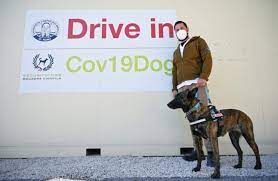
A similar project is being conducted at Rome’s Campus Bio-Medico University Hospital.  If these experiments are found to be reliable, using trained Covid dogs could prove to be a faster and cheaper method of detection in crowd situations, such as a football match or a rock concert.  “If we have 1,000 people to screen with an antigen swab, it would take about 20 minutes for each person,” says Massimo Ciccozzi, a professor of epidemiology at the university.  “A dog, using its olfactory senses, would take 30 seconds maximum.” Rome’s project plans to focus next on patients at a drive-through testing center on the campus.

Covid detection dogs could offer an extraordinary resource where there is an influx of large masses of people, such as sporting events, demonstrations, and airports.  In fact, dogs have already been deployed at Finland’s Helsinki-Vantaa international airport to detect infected passengers.  Trained dogs could also be used to complement other efforts.  For example, they could provide an initial screening that a laboratory test could later confirm, allowing a potentially infected person to take immediate precautions.

What’s next?  Testing whether canines can detect the variants of COVID-19.

Posted in Animali, English, Foto, Italia, Medicina, Milano, Roma, Uncategorized | 2 Comments

L’Italia: Il paese dell’anno

Il 2021 è stato un anno difficile in tutto il mondo. Il Covid-19 ha continuato a diffondere miseria con nuove varianti, e i vaccini sono stati distribuiti irregolarmente.  Le libertà civili e le norme democratiche sono state minate in Cina e in molti altri paesi. Il principale leader dell’opposizione russa è stato incarcerato. I sostenitori di Donald Trump hanno preso d’assalto il Campidoglio degli Stati Uniti. Le guerre civili sono scoppiate in Etiopia e Myanmar. E la Russia sta accumulando forze militari lungo il confine con l’Ucraina.

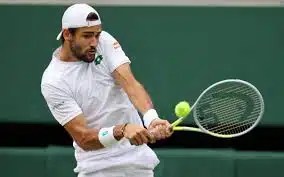
In mezzo all’oscurità, un paese brillava in molti modi. L’Italia ha iniziato l’anno con molti successi sportivi: la Luna Rossa è stata la sfidante nella competizione di vela della Coppa America in Nuova Zelanda; Matteo Berrettini è arrivato alle finali di tennis a Wimbledon; L’Italia ha conquistato il record di 40 medaglie alle Olimpiadi estive di Tokyo; e l’Italia ha vinto la Campionati Europei di calcio. Giorgio Parisi ha vinto il premio Nobel per la fisica, e l’Italia ha ancora vinto l’Eurovision Song Contest.

Nel dicembre 2021, un’altra onorificenza è stata conferita all’Italia. La rivista britannica, The Economist, ha incoronato l’Italia “Paese dell’anno”. Questo riconoscimento annuale assegnato dal settimanale di fama internazionale “non va al più grande, al più ricco o al più felice” dei paesi, “ma a quello che è migliorato di più” quell’anno. In passato, la Tunisia è stata premiata per aver abbracciato la democrazia, e l’Uzbekistan è stato onorato per aver abolito la schiavitù.

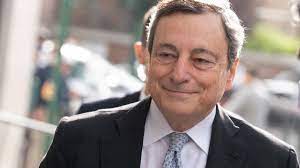
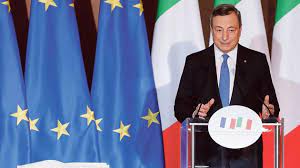
L’Economist ha riconosciuto le molte altre vittorie dell’Italia quest’anno, ma ha conferito questo premio alla politica italiana. Al centro dell’onore c’è il presidente del Consiglio Mario Draghi, ex presidente della Banca Centrale Europea: l’Italia “ha acquisito un primo ministro competente e rispettato internazionalmente”. Inoltre, la rivista ha osservato che Draghi gestisce bene i conflitti interni a livello esecutivo e incoraggia la cooperazione fra i politici italiani “per sostenere un programma di riforme complessive che dovrebbe permettere all’Italia di ottenere i fondi ai quali ha diritto in base ai piano di Recovery europeo”. L’Economist ha anche citato come il tasso di vaccinazione dell’Italia superiore alla media europea e come ci sia una ripresa economica più rapida di quelle di Francia e Germania. Le prospettive di crescita prevedono un aumento del PIL superiore al 6%. 

Il “giornale” londinese – come si definisce l’Economist – non è sempre stato benevolo con l’Italia. Negli anni ’90, descrisse Silvio Berlusconi come “inadatto” a guidare il governo del Paese. Nel 2014 ritrasse Matteo Renzi come “inconsapevole”, mostrandolo a bordo di una barchetta di carta europea intento a mangiare un gelato mentre la barca affonda. Certo, la Gran Bretagna è attualmente alle prese con i propri problemi, da una Brexit confusa, a una gestione irresponsabile della pandemia, a un Boris Johnson buffone e dilettante come primo ministro. 

L’Economist conclude il suo plauso all’Italia con un monito a Draghi: “C’è il rischio che questo inusuale sussulto di governo razionale subisca un arretramento” se Draghi diventasse presidente della Repubblica, lasciando il posto a un successore meno competente come primo ministro. Il settimanale londinese ha espresso la preferenza per Draghi a restare fuori dalla corsa per il Quirinale. E recenti sondaggi dicono che circa tre quarti degli italiani vogliono che Draghi resti presidente del Consiglio almeno fino alla fine della legislatura nel 2023, invece di salire al Quirinale. E ciò si è avverato!

Posted in Foto, Italia, Italiano, la politica, Roma | Leave a comment

Italy: Country of the Year

2021 was a difficult year throughout the world.  Covid-19 continued to spread misery as new variants emerged, and vaccines were unevenly distributed.  Civil liberties and democratic norms were undermined in China and many other countries.  Russia’s main opposition leader was jailed.  Donald Trump’s supporters stormed the United States Capitol.  Civil wars erupted in Ethiopia and Myanmar.  And Russia is amassing military forces along the border of Ukraine.

Amid the gloom, one country shined in many ways.  Italy began the year with many successes in sports: the Luna Rossa was the challenger in the America’s Cup sailing competition in New Zealand; Matteo Berrettini made it to the tennis finals at Wimbledon; Italy earned a record 40 medals at the summer Olympics in Tokyo; and Italy won the European Cup in Soccer.  Giorgio Parisi won a Nobel Prize in Physics, and Italy again won the Eurovision Song Contest.

In December 2021, another honor was bestowed on Italy.  The British magazine, the Economist, crowned Italy the “Country of the Year.”  This annual accolade given by the internationally reputed weekly “does not go to the largest, the richest or the happiest” of countries, “but to the one that has improved the most” that year.  In the past, Tunisia was recognized for embracing democracy, and Uzbekistan was honored for abolishing slavery.

The Economist acknowledged the many other victories of Italy this year, but bestowed this award for Italy’s politics.  Central to the honor is Prime Minister Mario Draghi, former president of the European Central Bank:  Italy “has acquired a competent and internationally respected prime minister.”  Moreover, the magazine noted that Draghi manages well internal conflicts at the executive level, and he encourages cooperation from Italian politicians “to support a program of comprehensive reforms that should allow Italy to obtain funds to which it is entitled under the European Recovery Plan.”  The Economist also cited Italy’s vaccination rate that is above the European average and a more rapid economic recovery than that of France and Germany.  Growth prospects foresee an increase in GDP of more than 6%.

The London “newspaper” — as the Economist refers to itself — has not always been benevolent toward Italy.  In the 1990s, it described Silvio Berlusconi as “unfit” to lead the country’s government.  In 2014, it portrayed Matteo Renzi as “clueless,” showing him on board a European paper boat intent on eating a gelato while the boat sinks.  Of course, Great Britain is currently struggling with its own problems, from a confused Brexit, to an irresponsible management of the pandemic, to a clownish and amateurish Boris Johnson as prime minister.

The Economist concludes its accolade to Italy with a warning to Draghi: “There is a risk that this unusual surge of rational government will suffer a setback” if Draghi becomes president of the Republic, a more ceremonial post, making way for a less competent successor as prime minister.  The London weekly expressed its preference for Draghi to remain out of the running for the Quirinale.  And recent opinion polls say that about three quarters of Italians want Draghi to stay on as prime minister at least until the end of the parliamentary term in 2023, instead of taking the role at the Quirinale.  And so it came true!

Posted in English, Foto, Italia, la politica, Lo Sport, Roma | 3 Comments