
 1. Perhaps Leonardo was not Italian. Leonardo’s Italian father, Piero, was a respected notary well connected in the Florentine world (counting even the Medici among his clients). The mother was, according to some, originally from the East. The name of Caterina was in fact common among slaves converted to Catholicism. Moreover, the fingerprints of Leonardo showed a similarity to a type common among the
 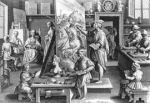 Arabs. In any case, it was the father, around 1470, who accompanied his illegitimate son, still an adolescent, to one of the most important workshops of the time, that of Andrea Verrocchio.
2. He understood how the heart functions. In Leonardo’s times, it was believed that the 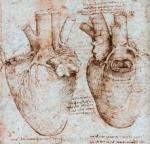 heart served to warm the circulating blood. Leonardo was the first to realize, instead, the heart’s function as a pump. Because of this, some anatomical cardiac structures were given his name—for example, the “fascio moderatore di Leonardo da Vinci” and the “trabecola arcuate di Leonardo.”
3. It was Leonardo who took the Mona Lisa to France. It is still a  widespread belief that the Mona Lisa (la Gioconda) was taken to the Louvre by Napoleonic troops. It was instead Leonardo who brought it to France, and King Francis I paid 4,000 scudos of gold (2 years’ worth of a stipend for Leonardo). The Napoleonic troops took instead, and without returning them, some manuscripts—today called “Codici dell’Istituto di Francia.”
4. He was a committed vegetarian. Leonardo was a passionate lover of animals. He even went into the marketplaces and freed birds from cages birds that were ready to be sold. The Tuscan navigator, Andrea Corsali, a contemporary of Leonardo’s, said of him, “He would not live on anything that contained blood.” To Leonardo is attributed the saying,
“The day will come when it will be judged a crime to kill an animal like it is now to kill a man.”
 5. He had a taste for the grotesque. His attention was drawn to not only the beautiful but also to the “deformed,” so that many consider him the inventor of the genre of caricature. At least one folio exists with designs of male heads in which the physical characteristics are accentuated to a grotesque effect.
6. He liked to experiment. The most famous “experiment” occurred when Leonardo received from Ludovico il Moro the task of painting the fresco of the Last Supper on the wall of the refectory of the convent annexed to the basilica of Santa Maria delle Grazie.  Leonardo did not like the fresco technique, so he planned to work quickly on the fresh plaster. He invented a technique that allowed that allowed him to go occasionally to give a quick brush stroke, while continuing at the same time to pursue his other studies and works. Too late he discovered the painting, done in this fashion, deteriorated quite rapidly. Even during his life, because of the humidity in the environment, il Cenacolo was reduced to a blob of indistinct color.
7. Was he a molester? The homosexuality of Leonardo has been addressed at length, including psychoanalytical interpretations, such as that of Freud who wrote of a dream of Leonardo as a child: a kite (bird of prey) had visited him touching him repeatedly on the lips with its tail.
In 1476, there are papers of a trial for sodomy that list him among the defendants, together with other students from the workshop of Verrocchio. The injured party was Jacopo Satarelli, a Florentine goldsmith apprentice of 17 years. After a brief incarceration, Leonardo and the others were acquitted because the complaint, given anonymously, could not be accepted. The dark matter (homosexuality in Florence at the time was common) was reviewed at a later time, but the judges decided not to prosecute, and the case was closed.
8. He had an unusual writing style, to say the least. Leonardo used a strange way of  writing, which went from right to left, and often began from the last page to the first. This peculiarity was often interpreted as a way for Leonardo to keep his works secret. Those who considered him a heretic called it “writings of the devil.”
In reality, it was a natural way for him to write. Neurologists in fact have shown that his style of writing was a habit acquired in infancy and natural for left-handers who were never corrected. He knew how to use “normal” handwriting, but only with difficulty and only if necessary, as for example he did on some topographical maps.
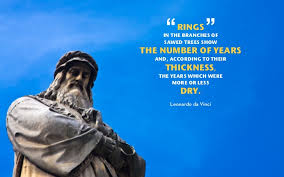 9. He discovered the growth rings of trees. Leonardo was the first person to observe the growth rings of trees and to understand, that by counting them, you could determine the age of the plant. From this came in recent years a new science, dendroclimatology, that studies past climates according to traces left in the rings of trees.
10. He understood what fossils were. At that time it was believed that “niche,” as fossils 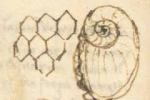 were then called, were remnants of the Flood or forms of life to which God had not given a soul. Leonardo was the first (after the ancient Greeks) to understand that they were the remains of animals and plants petrified by geological processes and brought to light by movements of the earth’s crust.
 Amadeo Pietro Giannini (San Jose, 1870 – 1949) era un banchiere statunitense. I suoi genitori erano immigrati italiani, che provenivano da Favale di Malvaro vicino a Genova in Luguria.
 ammontarono a 8.780 dollari; in un anno i depositi erano arrivati a oltre 700.000 dollari. La prima sfida della banca da sormontare fu il terremoto di San Francisco del 1906. Subito il signor Giannini trasferì i soldi della banca a casa sua a San Mateo. I soldi erano nascosti sotto frutta e verdura marcia in un carro per proteggerli da furti. Il terremoto e l’incendio distrussero in tre giorni 50.000 abitazioni private, oltre agli uffici, agli alberghi ed agli edifici pubblici. Le altre banche non poterono aprire le loro camere blindate per mesi perchè il caldo avrebbe bruciato i soldi.
 Nel frattempo, Giannini prese un tavolo, lo piazzò in mezzo alla folla dei feriti, ci mise sopra il cartello Banca d’Italia: aperto ai clienti, ed incominciò a dare in prestito soldi per la ricostruzione. Faceva il banchiere da soli 4 anni e la sua clientela era formata da umili artigiani e commercianti di origine italiana che non trovavano credito in nessun’altra banca. Il terremoto di San Francisco gli offrì l’occasione di estendere anche al di fuori della colonia italiana la sua fiducia nel lavoro della gente semplice. Si dice che una stretta di mano rivelava a Giannini se il cliente aveva calli e quindi era una persona che aveva lavorato duro.
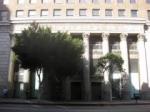 Olive e 7th. Ha 12 piani, colonne doriche, e pavimenti di marmo. Era una grande banca, ma oggi è stato rinnovato con uffici, ristoranti, un albergo, un centro commerciale, e anche una piscina sul tetto. A San Francisco una piazza vicina alla Bank of
  America è intitolata a suo nome. Il servizio postale americano lo ha onorato con l’emissione nel 1973 di un francobollo con il suo ritratto. La rivista Time ha qualificato Giannini come uno dei costruttori e titani del Novecento.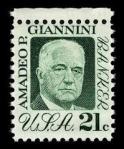

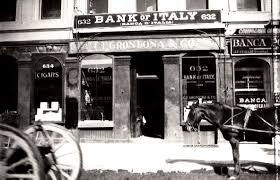 amounted to $8,780. In a year, the deposits had grown to more than $700,000. The first challenge for the bank was to survive the San Francisco earthquake of 1906. Giannini immediately transferred the money from the bank to his home in San Mateo. The money was hidden under rotten fruit and vegetables in a horse-drawn garbage wagon to protect it from theft. The earthquake and subsequent fires in three days destroyed 50,000 private residences, besides offices, hotels, and public buildings. The other banks in the city could not open their vaults for many months for fear that the heat would burn the money.

