A New Concept in Italian Restaurants

Italian food varies wildly throughout Il Bel Paese.  Tourists who visit only Rome, Florence or Venice will sample only a tiny share of the abundance that the entire country offers.  Traditional recipes vary not only by Italy’s 20 regions, but also within each region. 

Hence, a new concept in Italian restaurants was born in London:  La Mamma Mia.  Real Italian mothers and grandmothers are recruited from one of Italy’s 20 regions for a three-month stint.  They bring their own traditional recipes based on their local cuisine.  Some are ancient recipes that have been passed on from generation to generation. 

The concept began when Peppe Corsaro, a Sicilian by birth who moved to London when he was 16, started yearning for his mother’s cooking.  He was already a restauranteur, and one night, his friends jokingly suggested that he bring his mother to London to cook.  When he called her, she said, “I’ll come tomorrow.”

A pop-up eatery was launched in 2018; today there are two restaurants and a deli.  Anna Famà, Corsaro’s mother was the original mamma and has remained ever since, overseeing the operations and serving as ambassador for incoming mammas.

Each restaurant has three mammas, who are first screened in Italy.  Selected candidates are then flown to London for a trial, after which they are given accommodation, a transportation card and a salary, comparable to that of a sous chef.  The candidates are not professional chefs, but rather mammas and grandmammas, usually in their 60s and retired, who have loved to cook for their families and have never lived abroad before.

The mammas in residence bring their own menus, which are executed to perfection with the help of experienced kitchen staff.  When the region of Emilia Romagna was featured, the menu included dishes prepared with tortellini, tagliatelle, ragù, prosciutto crudo and parmigiano reggiano.  When Lazio was in the spotlight, the Eternal City’s four classic pasta dishes appeared: carbonara, amatriciana, cacio e pepe, and gricia.  Lesser-known dishes filled out the menu: coda alla vaccinara (an oxtail stew), baccalà romana and saltimbocca alla romana.

The kitchens of the restaurants are visible from the street, so that passersby can see the mammas at work…possibly making pasta, which is made fresh daily on site.  They mingle with customers and even dance with the guests.  They serve delicacies to the customers and talk to them in their regional dialects, often exhorting them to finish their pasta.

La Mamma Mia serves a four-course meal: antipasti, pasta, second, and dessert.  The 38-pound sterling price (about 45 euros or $50) includes an Aperol Spritz on arrival and a coffee on departure.  Buon appetito!
Posted in Bologna, Cucina italiana, English, Foto, Italia | 2 Comments

Le eredità di Papa Pio XII

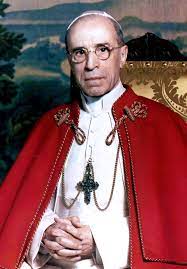
Eugenio Maria Giuseppe Giovanni Pacelli (1876 – 1958) divenne Papa Pio XII nel marzo 1939, capo della Chiesa cattolica e sovrano dello Stato della Città del Vaticano fino alla sua morte. Presiedeva la chiesa durante la seconda guerra mondiale e l’Olocausto, e il suo papato è rimasto controverso. Mentre il Vaticano era ufficialmente neutrale durante la guerra, c’è chi crede che non si sia espresso abbastanza forte contro i nazisti, e c’è chi loda il suo lavoro dietro le quinte per aver aiutato gli ebrei e le altre vittime dei nazisti. Le potenze alleate consideravano la sua condanna del genocidio del tutto inadeguata, mentre i nazisti lo consideravano il Vaticano un simpatizzante alleato che aveva violato la sua politica di neutralità.

Papa Pio XII, durante la seconda guerra mondiale, ebbe come responsabilità primaria di garantire la continuazione della missione divina della Chiesa.  Fece pressioni sui leader mondiali per prevenire lo scoppio della guerra. Nella sua prima enciclica papale, emessa nell’ottobre 1939, fissò alcuni dei temi del suo pontificato: denuncia dell’antisemitismo, della guerra, del totalitarismo, dell’attacco alla Polonia e della persecuzione nazista della Chiesa. Durante e dopo la guerra fu lodato da molte organizzazioni, molte ebraiche, per il lavoro che aveva compiuto nel proteggere gli ebrei.

Negli ultimi 25 anni sono stati innumerevoli libri che hanno analizzavato il ruolo di Papa Pio XII in questo periodo. Un resoconto notevole è venuto dall’autore britannico John Cornwell nel suo libro del 1999, Hitler’s Pope, in cui afferma che il papa era debole e vacillante nei confronti del nazismo e che subordinava la sua opposizione a Hitler per cercare di aumentare il potere del papato. Ha accusato il papa di antisemitismo e ha affermato che il papa ha fatto poco per sfidare l’evolversi dell’Olocausto per paura di un’invasione nazista della Città del Vaticano. Molti critici ritengono che il libro riporti “errori di fatto”, faccia “un uso selettivo delle fonti” e che “ignori il contesto”. Cornwell in seguito ha detto che era impossibile giudicare i motivi del silenzio del papa durante la guerra, “mentre Roma era sotto il tallone di Mussolini e poi sotto l’occupazione tedesca”.

Nel 2019, in occasione dell’80° anniversario dell’elezione di Papa Pio XII, Papa Francesco ha annunciato che il materiale d’archivio vaticano relativo al pontificato di Pio XII sarebbe diventato disponibile nel 2020. Molti studiosi hanno chiesto l’accesso agli archivi, tra cui il professor David Kertzer della Brown University, che aveva già scritto I papi contro gli ebrei nel 2001 e Il papa e Mussolini nel 2014. Nel suo ultimo libro pubblicato nel 2022, Il papa in guerra, Kertzer afferma che la paura prevalente di Pio XII era verso il comunismo, la sua convinzione che le potenze dell’Asse avrebbero vinto la guerra e il suo desiderio di proteggere gli interessi della chiesa lo spinsero a evitare di offendere Hitler e Mussolini. Rivela inoltre dal nuovo materiale d’archivio che un principe tedesco e un fervente nazista agirono come un canale segreto tra Pio XII e Hitler, e che il massimo consigliere vaticano del papa per le questioni ebraiche lo esortò a non protestare contro gli ordini fascisti di arrestare e inviare a campi di concentramento molti ebrei italiani.

I difensori di Pio XII (la cui santità è ancora in fase di valutazione) hanno a lungo sostenuto che si  pronunciò spesso per condannare la falsa teoria della razza e che lavorò dietro le quinte per salvare centinaia di migliaia di ebrei. In effetti, i veri eroi potrebbero essere stati i preti e le suore che si rifiutarono di consegnare i disperati che nascondevano. Molte organizzazioni ebraiche hanno scoperto che le deboli proteste del papa contro il nazismo in realtà proteggevano gli ebrei da persecuzioni più intense. 

È difficile superare le argomentazioni emerse da entrambe le parti durante e dopo la guerra. Alcune persone accusano gli ebrei di sostenere l’eredità di Pio XII per cercare di ottenere consensi allo stato di Israele. Alcuni accusano i cattolici nel criticare il papa nel tentativo di portare una riforma in Vaticano. Ma la maggior parte degli studiosi concorda sul fatto che stia emergendo un ritratto più sfumato del papato. Con milioni di pagine negli archivi vaticani, ci vorranno anni per rielaborare il tutto. Nel frattempo, Papa Francesco deve lottare con forza per condannare un dittatore come Vladimir Putin e il costo dia tacere sugli omicidi di massa.

Posted in Comunità ebrea, Foto, Italia, Italiano, la politica, Libri, Politica, Storia, Vaticano | 1 Comment

The Legacies of Pope Pius XII

Born Eugenio Maria Giuseppe Giovanni Pacelli (1876 – 1958), Pope Pius XII became head of the Catholic Church and sovereign of the Vatican City State from March 1939 until his death.  He presided over the church during World War II and the Holocaust, and his leadership remains controversial.   While the Vatican was officially neutral during World War II, there are those who believe that he didn’t speak out strongly enough against the Nazis, and there are those who praise his behind-the-scenes work to aid the Jews and other victims of the Nazis.  The Allied Powers considered his condemnation of genocide as completely inadequate, while the Nazis viewed him as an Allied sympathizer who had violated his policy of Vatican neutrality.

Pope Pius XII saw his primary obligation during World War II as ensuring the continuation of the Church’s divine mission.  He lobbied world leaders to prevent the outbreak of war.  In his first papal encyclical issued in October 1939, he established some of the themes of his pontificate: he denounced antisemitism, war, totalitarianism, the attack on Poland and the Nazi persecution of the church.  During and after the war, he was lauded by many organizations, including many Jewish ones, for the work he had accomplished in protecting the Jews.

In the last 25 years, there have been countless books analyzing Pope Pius XII’s role during this period.  A notable account came from British author John Cornwell in his 1999 book, Hitler’s Pope, in which he claimed that the pope was weak and vacillating toward Nazism and that he subordinated his opposition to Hitler in favor of his goal of increasing the power of the Papacy.  He accused the pope of antisemitism and asserts that the pope did little to challenge the progressing Holocaust out of fear of provoking the Nazis into invading Vatican City.  Many reviews criticized the book for “errors of fact” “selective use of sources” and “ignorance of context.”  Cornwell later said that it was impossible to judge the motives for the pope’s silence during the war, “while Rome was under the heel of Mussolini and later occupied by Germany.”

In 2019 on the 80th anniversary of the election of Pope Pius XII, Pope Francis announced that Vatican archival material pertaining to the Pius XII’s pontificate would become available in 2020.  Many scholars applied for access to the archives, including Brown University Professor David Kertzer, who had already written The Popes Against the Jews in 2001and The Pope and Mussolini in 2014In his latest book published in 2022, The Pope at War,” Kertzer claims that Pius XII’s overriding dread of communism, his belief that the Axis powers would win the war, and his desire to protect the church’s interests all motivated him to avoid offending Hitler and Mussolini.  He further reveals from new archival material that a German prince and fervent Nazi acted as a secret back channel between Pius XII and Hitler, and that the pope’s top Vatican adviser on Jewish issues urged him not to protest a Fascist order to arrest, and send to concentration camps, most of Italy’s Jews.

Defenders of Pius XII (whose case for sainthood is still being evaluated) have long argued that he often spoke out to condemn the false race theory and that he worked behind the scenes to save hundreds of thousands of Jews.  In fact, the real heroes might have been the priests and the nuns who refused to hand over the desperate people they were hiding.  Many Jewish organizations found that the pope’s weak protests against Nazism actually protected the Jews from more intensified persecution.

It is difficult to wade through the arguments on both sides that surfaced during and since the war.  Some people accuse the Jews of supporting the legacy of Pius XII to try to win support for the state of Israel.  Some accuse the Catholics of criticizing the pope in an attempt to bring reform to the Vatican.  But most scholars do agree that a more nuanced portrait of the papacy is emerging.  With millions of pages in the Vatican archives, it will take years to process the findings.  In the meantime, Pope Francis must wrestle with how forcefully to condemn a dictator like Vladimir Putin of Russia and the ultimate cost of staying silent about mass killings.

Posted in Comunità ebrea, English, Foto, Italia, la politica, Politica, Storia, Vaticano | 1 Comment