
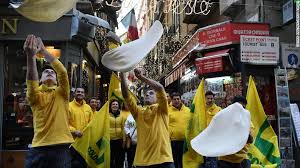
 News came from far away—from the South Korean island of Jeju—late on December 6, 2017. Unesco placed the art of Neapolitan pizzaioli (or pizzaiuoli) on the honored List of Intangible Cultural Heritage of Humanity. Crowds gathered along Via dei Tribunali, the historic pizza thoroughfare in Naples, to celebrate: “We won,” and “The world recognizes our art” could be heard among those who had gathered to party.
Unesco explains its award: “The culinary know-how associated with pizza-making—which  includes gestures, songs, visual forms of expression, local linguistic utterances and the ability to handle pizza dough properly and to transform pizza making into a performance to share—is without a doubt a cultural patrimony. Pizzaiuoli and their guests all participate in a social ritual steeped in conviviality, where counter and stone oven work as a stage. Originated in some of the poorer areas of Naples, this culinary tradition remains still today deeply entrenched in the daily life of its community. To many young apprentices, becoming a pizzaiuolo is also a way to avoid social marginalization.”
Clearly, Unesco is honoring not only the cultural value of pizza making, but also its social value. Becoming a pizzaiuolo has been a path out of poverty for decades and decades. A menial skill only in appearance, pizza making is an art that can be learned without going to university, without spending money, without living in an exclusive neighborhood. But it does require creativity and talent—not only to show off the pizza maker’s abilities but also to unite them with the history, traditions, and soul of the territory. While there are schools and academies to teach the art of pizza making, “the knowledge and skills are primarily transmitted in the bottega, where young apprentices observe masters at work, learning all the key phases and elements,” which include making the dough, baking in a stone oven, and turning the pizza continuously during the process, which I can tell you personally takes a lot of dexterity and practice.
There is also the business side of making pizza. In Italy alone, it employs 100,000 people full time and 50,000 part time. Italians and Americans are not only the biggest pizza makers, but also the biggest pizza eaters: 15 pounds are consumed on average by every Italian each year; not surprisingly, 25 pounds are consumed per capita annually in the United States. What is also not surprising is that many Americans were among the 2 million people who supported Italy’s candidacy for the Unesco award, the most widely supported Unesco campaign in history.
Pizza making is an art that started in Naples more than 300 years ago. On December 7,  2017, the pizzerias of Naples opened early to start baking. Tables were set up in the streets and pizza was served for breakfast—mostly la Margherita, the most Neapolitan of all pizzas, fragrant and colorful, simple and exquisite, and worthy of a true patrimony of humanity.
 La storia dell’acca italiana è antica quanto quella dell’alfabeto che, fu inventato dai fenici. Le prime iscrizioni conosciute risalgono al 1000 a. C. La “het” era l’ottava lettera dell’alfabeto fenicio e si scriveva con un segno a forma di rettangolo con un trattino in mezzo (“acca chiusa”). Corrispondeva a un suono sconosciuto dagli italiani che veniva prodotto con un restringimento della cavità orale all’altezza della faringe.
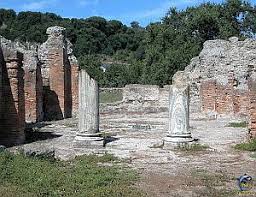 prima era a Cuma (ora un sito archeologico a Napoli), che fu fondata dai greci dell’isola Eubea nell’VIII secolo. Nell’alfabeto dei cumani quel segno continuava a indicare il suono dell’acca aspirata e così passò anche ai romani che adottarono il simbolo nella sua variante aperta proprio per indicare il suono dell’aspirazione all’inizio di molte parole latine (per esempio, homo per uomo, habere per avere), da cui l’acca che sopravvive ancora in italiano—anche se muta—nelle voci del verbo avere.

 L'Olivo Santa Barbara