
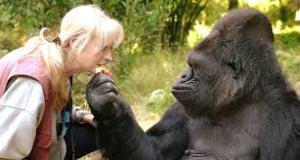
 Koko died in June 2018. I was so sad because I had followed the career of the gorilla and her trainer, Penny Patterson. I have always been fascinated by the bond between animals and humans and by the languages they may have shared. Koko was special because she was taught sign language to communicate with humans. Of course, there are some skeptics along the way.
 Koko was born on the Fourth of July at the San Francisco Zoo and given a Japanese name that meant Fireworks. At about a year old she was taught sign language by Penny Patterson as part of her doctoral thesis, first at the zoo and then at the Gorilla Foundation in Woodside, California, near Stanford University. Koko eventually understood about 2,000 English words and had a human IQ of between 75 and 95 points.
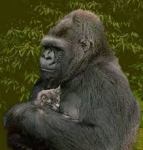 Here is one of my favorite stories about Koko. She loved cats. Her favorite picture books were “The Three Little Kittens” and “Puss ‘n’Boots.” At about the age of 12, Koko asked for a kitten as a Christmas present. The researchers gave her a stuffed animal that looked like a cat. Koko was very upset and refused to play with it. She repeatedly signed “Sad.” Therefore, for her birthday, she was allowed to choose a kitten from a litter. She called her little gray and white Manx kitten “All Ball.” Koko loved to rhyme in sign language.
All Ball was not afraid of Koko who weighed about 230 pounds. They played chase together and Koko loved to hold and pet him. When All Ball grew tired of being cuddled, she would bite (lightly) Koko and escape. Koko would sign, “Obnoxious. Cat.” But Koko also took care of the kitten and was very gentle and loving. At these times, she said in sign language, “Soft. Good. Cat.”
When All Ball was hit by a car and killed, the researchers had to tell Koko. At first, she acted like she didn’t hear them. Then she began to whimper—then with a distinct scream that gorillas make in mourning. Everyone cried together. Then, Koko said, “Sleep. Cat.”
I have another story, and I swear that it’s true. A friend of mine introduced me to a friend of his, who was a professor at Stanford. One Halloween the doorbell rang, and his son answered. He yelled to his father, “the gorilla is here.” The father responded, “Give him some candy.” The son protested that this was not a gorilla costume. The father came to the front door and saw Penny and Koko. Penny asked if Koko could use the bathroom. Koko went into the bathroom…but she didn’t close the door.

 L'Olivo Santa Barbara