
 While many contemporary western cultures see bathing as a private activity conducted in the home, bathing was a communal activity in ancient Rome. Bathhouses were the cultural centers of daily life. The earliest descriptions of western bathing practices came from Greece, but the Romans raised the practice to an art form. They were aided by the construction of the aqueducts, which provided enough water for domestic, agricultural, and industrial uses…as well as for leisurely pursuits.
 The Roman baths varied in size, layout, decoration, and added amenities. In general, a bather proceeded through a series of rooms exposing himself to increasing temperatures. Hence, most bathhouses contained an apodyterium where the bather stored his clothes. Then, the bather entered the frigidarium with its cold water; he then proceeded to the tepidarium (warm room), and finally to the caldarium (hot room). The bather might then return to the tepidarium for a massage with oils and a scraping with a metal implement called a strigil. There were often separate bathing facilities for women and men, although mixed bathing was common at one time.
Inside the bathhouses, marble mosaics tiled the elegant floors. Frescoes of trees, birds, and other images adorned the stucco walls, and celestial imagery adorned the domes. Fountains and statuary decorated the interior and exterior spaces.
 Roman bathhouses often contained a courtyard, or Palestra, which was an open-air garden used for exercise. Libraries, lecture halls, reading rooms, stages for theatrical and musical performances, formal gardens, and gymnasiums were part of some complexes, as well as saunas, steam rooms, hair salons, and places to buy and eat food. Hence, these places became the spas and community centers of Roman daily life.
After work in the morning, many Romans enjoyed spending the afternoon at the public bath. They enjoyed not only the cleansing and restorative powers of the waters, but also the time to meet with friends, to exercise, or to read at the library. Courtship and business deals were conducted, as well as local gossip and political campaigns.
The Romans believed that good health came from bathing, eating, massages, and exercise. The baths were the centers for all of these activities. Bathing was practiced across a wide 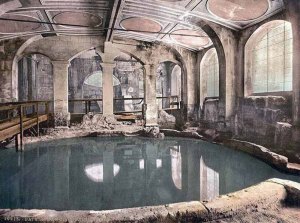 variety of social classes (the fees were very modest), although the wealthy often brought their slaves to carry and watch over their towels, oils, and strigils, as thieves and pickpockets were known to frequent the baths. One of the most famous baths in Rome was the Baths of Caracalla; the largest were the Baths of Diocletian, which could hold up to 3,000 bathers. A catalogue of buildings in Rome documented 952 baths in the city in 354 AD.
As the Roman Empire expanded, the concept of the public bath spread to all parts of the Mediterranean and into regions of Europe and North Africa. The Romans took advantage of natural hot springs in Europe to construct baths at Aix and Vichy in France, Bath and Buxton in England, and Aachen and Wiesbaden in Germany, among other locations.
When asked why he bathed once a day, one Roman emperor is believed to have said, “Because I do not have time to bathe twice a day.” The Romans bequeathed to contemporary society not only the spa concept and a standard of cleanliness, but also a type of community center that housed a library, art gallery, mall, restaurant, gym…and spa.
 Ora guardiamo le colazioni tipiche, prima in Italia. La colazione all’italiana si fa con latte, caffè, fette biscottate, marmellata, yogurt e spremuta d’arancia. Le sostituzioni accettabili includono il tè invece del caffè, pane tostato al posto delle fette, miele invece della marmellata, frutta fresca per lo yogurt.
 ovviamente) oppure, il tè. A volte, il latte viene consumato con i cereali. Al posto del succo d’arancia mediterraneo, preparato con agrumi freschi spremuti, troppo spesso c’è l’orange juice, cioè liquido con sostanze disidratate. Aggiunte. La parte solida è composta da pane e burro, a volte con dolce e torte. Alcuni americani preferiscono i gusti salati: prosciutto cotto, pancetta o salsiccia, formaggio e uova accompagnati con del pane.
 Cosa mangiano gli inglesi ed i tedeschi? L’essenza della colazione in Gran Bretagna e Germania è “uova e pancetta”, sostanze ricche di proteine e grassi. Per di più, gli inglesi e i tedeschi preferiscono le uova fritte in padella con brioche salate, cucinate insieme ai wurstel.
 pane tostato con prosciutto crudo o bresaola o formaggi magri”. Calabrese mette in guardia su un particolare fenomeno che sta prendendo piede in Italia: l’abbinamento di cappuccino e brioche. Il croissant è composto da acidi grassi saturi, oli vegetali di cocco e di palma o strutto. Una sola al mattino basta.
 gli studenti, una colazione all’italiana è giusta: fette biscottate, miele, marmellata, frutta o yogurt, spremute, cereali sotto forma di “corn flakes” e caffè. I centrifugati sono ricchi di fibra e sono sostanze in grado di aiutare a smaltire le scorie della cena precedente. Per l’anziano lui raccomanda una colazione simile, con l’aggiunta di pane e formaggio fresco magro o una fetta di prosciutto crudo o cotto, sempre magro. Per l’operaio che richiede più energia, suggerisce di cominciare la giornata con un cappuccino, un cornetto e 500 grammi di frutta aggiungendo un panino imbottito con miele or marmellata.
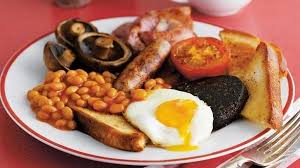 What do the English and Germans eat? The essence of breakfast in Great Britain and Germany is “egg and bacon”, substances rich in protein and fat. Moreover, the English and Germans prefer fried eggs in a pan with savory brioche, cooked with frankfurters.
 L'Olivo Santa Barbara