
 From Venice to Materia and throughout Italy, rain, wind and sea storms have triggered incalculable damage recently. Besides human lives, art masterpieces, and other treasures, shellfish have been damaged. Thousands of beached lupins have washed up along the coasts around Chioggia. At risk is the traditional spaghetti with clams enjoyed by countless Italians and Italian-Americans on Christmas Eve. It is that time of year when clams are harvested in both Italy and the United States.
It has been common lore that one should eat shellfish only in months that contain the letter “R.” This means that you would avoid oysters, mussels, and clams in May, June, July, and August. The R-rule applied generally to North America, but this little pearl of wisdom may not strictly apply in countries whose months are spelled differently from ours (for example, gennaio for January in Italian lacks the requisite letter). Historians trace it to an ancient Latin saying; in 1599 it appeared for the first time in an English cookbook.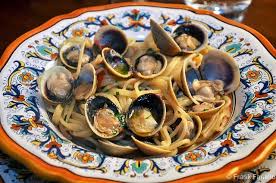
There are several logical theories behind the rule. First, in the days before refrigeration, shellfish were likely to spoil in the heat. Second, the summer months are the spawning season. Since most of the energy in the fish at that time is dedicated to reproduction, the “meat” can become thin and milky. Third, and most compelling, Red Tide most often occurs during the summer months; this refers to the high concentrations of an algae that is highly toxic to humans.
Today, however, the R-rule applies primarily to shellfish you might harvest on your own. Health and sustainability regulations require inspections to safeguard fish from unsafe toxin levels. In general, one can be confident of shellfish purchased year-round at reputable markets and restaurants.
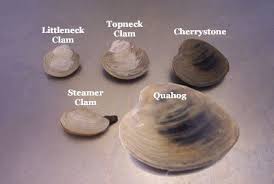 Based on 80-100 grams (3 to 3.5 oz.) of pasta per person, one should buy 250 grams (9 oz.) of clams per person or 1 kilo (2.2 lbs) for 4 people. But what kinds of clams are best? In Italy, the ideal clams are vongole veraci, but they can be difficult to find and are expensive (20-25 euro a kilo). Some chefs prefer lupins (8-10 euros a kilo) for their more pronounced flavor of the sea. Several varieties are available in the United States. Littlenecks and cherrystones (same species, but the latter are larger) come from
  the Atlantic Ocean on the east coast. Manila clams come from the west coast. In Pismo Beach in California, about 85 miles north of Santa Barbara, the Pismo clam was so highly prized that it became almost extinct 20 years ago from over harvesting. Today the clams are returning but they are still too small, and laws prohibit anyone from harvesting them. Yet, one of the traditions that is retained at restaurants in Pismo Beach is to serve clam chowder (using other types of clams) in sourdough bread bowls.
There are at least two methods to clean clams and ensure that they don’t retain sand. Either you can put the clams in salted water (about 1 tablespoon of salt per quart of water) or in a similar mixture using cornmeal. Place in a single layer in a large pan or in the sink and soak for about 2 hours. Then rinse under cold water and scrub the shells with a toothbrush to remove any grime.
To open the clams and begin to make the sauce, put about a half cup of olive oil in a large pot and add 6 cloves of chopped garlic, a little red pepper and some parsley. After the garlic is lightly browned, add a half cup of white wine and simmer gently. Then add the clams and cover the pot. Check frequently and remove the opened clams.
Meanwhile your pot of pasta water is boiling. Which pasta to use? According to Peppe Guida, a foremost pasta chef from the Antica Osteria Nonna Rosa in Vico Equense (a seaside town in Naples), “the pasta with clams for me is vermicelli because they are slightly thicker than spaghetti but less so than spaghettoni. You need a pasta that releases a little bit of starch during the cooking.” What about linguine, which is popular in American restaurants? “Many people love linguine, but for this recipe I prefer the round type. The spaghetti has a diameter that cooks more uniformly. The consistency and the creaminess (due to the release of starch) will be different.”
That said from a connoisseur.
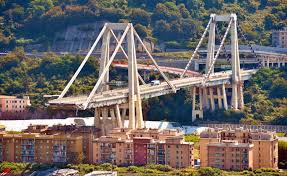 Il ponte Morandi a Genova è crollato nel 2018, circa 50 anni dopo la sua realizzazione. Ponti, strade e altre infrastrutture in tutta Italia e come negli Stati Uniti hanno un disperato bisogno di essere riparati. A seguire vedremo come un ponte che fu concepito più di 5 secoli fa, non ha mai avuto bisogno di alcuna manutenzione … perché non è mai stato costruito.
 Il sultano Bayezid II, sovrano dell’Impero ottomano dal 1481 al 1512, voleva costruire un ponte fisso per unire le due sponde del Corno d’oro, collegando così la città di Istanbul alla cittadina di Galata. Come principale insenatura del Bosforo a Istanbul, il
  Corno d’oro era una delle principali vie navigabili urbane. “Corno” si riferisce alla sagoma dell’estuario all’ingresso; “dorato” si riferisce invece alle ricchezze storiche portate in città attraverso il vivace porto o, più romanticamente, al colore dell’acqua al tramonto.
 Leonardo rispose alla richiesta del sultano. Ma fu solo nel 1952 che la straordinaria lettera di Leonardo fu scoperta negli archivi del Palazzo di Topkapi, residenza del sovrano a Istanbul. Leonardo descrive il ponte, includendovi degli schizzi per rappresentarlo. Era diverso da tutto ciò che era stato costruito fino a quel momento: sarebbe stato il ponte più lungo del mondo – 280 metri; invece di molte baie, sarebbe stato costituito da una sola campata. Leonardo assicurò al sultano che il ponte sarebbe stato abbastanza alto da permettere alle navi a vela di passarvi sotto. Tuttavia, per un motivo sconosciuto, il disegno di Leonardo non fu approvato. Il sultano si rivolse poi a Michelangelo, ma senza accettare le sue proposte.
 I disegni di Leonardo sono attualmente esposti al Museo della Scienza e della Tecnologia di Milano. Recentemente, i ricercatori del Massachusetts Institute of Technology (MIT) hanno voluto esaminare se il progetto di Leonardo sarebbe potuto essere costruito. Gli ingegneri del MIT hanno studiato i suoi disegni, i materiali che avrebbe avuto a disposizione e le condizioni per costruire in quel determinato periodo storico. Per testare la fattibilità del ponte, i ricercatori hanno costruito un modello in scala, lungo ottanta centimetri, usando blocchi 3D, utilizzati poi per assemblarlo. E hanno testato la stabilità del ponte simulando delle scosse sismiche.
 Queste le conclusioni del team: “Leonardo sapeva cosa stava facendo.” Hanno aggiunto, “era incredibilmente ambizioso … il ponte era circa 10 volte più lungo del ponte tipico ponte dell’epoca.” Era anche piuttosto sofisticato geometricamente, con più curvature e tridimensionalità rispetto ai tipici ponti ad arco. Per stabilizzare il ponte contro le oscillazioni laterali e i terremoti, da Vinci aveva progettato monconi di supporto alle estremità da far uscire verso l’esterno. Sebbene da Vinci non avesse specificato i materiali da utilizzare, il legno o i mattoni non sarebbero stati appropriati. Quindi la soluzione per un ponte di tale lunghezza sarebbe stata la pietra, assemblata senza l’utilizzo della malta.
 L'Olivo Santa Barbara