
Once again, the J. Paul Getty Museum in Malibu, California, returns a work of art to Italy.  On January 30, 2015, the “Head of Hades” boarded a plane on its way home to Sicily.
The story begins more than 2,000 years ago. In the Hellenistic era, artists in Southern Italy, where high-quality marble had to be imported, often used terracotta for large-scale work. This terracotta head, probably broken off of a larger statue, resided in Morgantina in central Sicily for centuries. Today considered rare and precious, this head had polychrome red brick hair and a blue beard (traces of which remain), which earned it the nickname “Bluebeard.”
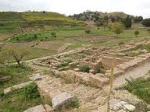 Then in the 1970s, tomb robbers with a flair for masterpieces stole it from the Sanctuary of Demeter, located within the Archaeological Park of Morgantina. Then begins the road to the Getty, a young, ambitious, and very wealthy museum. The terracotta head probably passed through several hands. What we know is that in 1985 the Getty purchased it for $530,000 from New York collector Maurice Tempelsman, who had purchased it from London dealer Robin Symes.
Next…2 archaeologists from Sicily: Lucia Ferruzza had spent 20 years in the service of the Cultural Heritage of the Sicilian Region, and Serena Raffiotta was born and raised a stone’s throw from Morgantina and did her postgraduate thesis at the University of Catania. Her father for 20 years engaged in the fight against grave robbers as Prosecutor  of the Province of Enna (“I was brought up on bread and pottery.”). They met at a convention. Lucia was thumbing through Serena’s thesis and stopped at a page that intrigued her: “an extraordinary blue curl that had been discovered in the suburban sanctuary of San Francesco Bisconti Morgantina.” Lucia thought there might be a connection to an artifact she had seen when she was on scholarship at the Getty in 1987. She returned in 2000, commissioned by the museum to do research on pottery. The mysterious head was correctly labeled at the Getty as coming from southern Italy, but the card in the case said, “probably Zeus.” As Lucia says, “the blue curl in Sicily became our Cinderella’s slipper.” Thus began the long road to restitution.
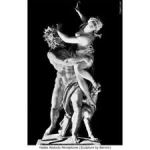
Hades and Persephone
The head had been thought to be that of Zeus, the king of the gods, because he was called “blue bearded” in the Homeric poems. But it is now believed to represent his brother, Hades, Greek god of the Underworld, based on other finds from the ancient city of Morgantina. The religion there centered on the cult of Demeter and her daughter Persephone. According to the Greek myth, Hades abducted Persephone at Lake Pergusa, not far from Morgantina, and required her to return to the underworld several months every year. This was the ancients’ explanation for winter and the changing of the seasons.
Morgantina is the same heavily looted archaeological site in Sicily where the Getty’s former statue of Aphrodite was looted around the same time as the head of Hades. The Getty acquired the statue of Aphrodite from Symes in 1988 for $18 million. Since that statue’s return to Sicily, experts believe that it represents the goddess Persephone or her mother, Demeter.
At a solemn ceremony at the end of January, Antonio Verde, the Consul General of Italy in 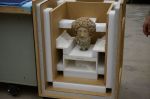 Los Angeles, said proudly, “We need above all the commitment and competence of Italian archaeologists…from a curl of blue pottery found among the remains of illegal excavations, it was possible to check the provenance of the head of the same color at the Getty.” The head will now reside at the Archaeological Museum of Aidone (Enna).
The head is the latest artifact that the Getty has returned to Italy following the museum’s 2007 agreement with the country’s Ministry of Culture. The agreement was made after a protracted legal battle over looted works of art that involved the former Getty curator Marion True. (See post of October 1, 2015.)
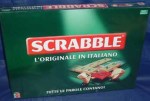 Scrabble in italiano. È stato davvero divertente, ma non facile. Marilyn, un’amica ci ha prestato il gioco, e Lee, un studente nella classe, ho scritto le regole in italiano. Le regole sono molto simili a quelle in inglese. Ma giocando il gioco è differente—la distribuzione delle lettere è diverso e, ovviamente, si deve pensare in italiano! Ecco una storia breve del gioco, e anche alcune differenze tra la versione italiana e quella inglese.
 scorrono orizzontalmente or verticalmente. Le tessere hanno valori diversi, a seconda della loro frequenza o rarità in quella lingua. E alcune delle caselle sulla plancia di gioco hanno valori diversi che indicano quando raddoppiare o triplicare il valore di una lettera o della parola completa. L’obbiettivo del gioco è guadagnare quanti più punti possibile fino a quando tutte le lettere sono state usate, o quando non c’è la possibilità di formare più parole.
 acquistato i diritti per la fabbricazione del gioco in scambio di una royalty su ogni unità che fosse venduta. Brunot ha apportato alcune modifiche nel gioco e ha anche cambiato il nome a quello di “Scrabble,” una vera parole che significa “grattare freneticamente”. L’anno seguente, Brunot e la sua famiglia avevano realizzato 2.400 set in un ex edificio scolastico, ma persero tutti i soldi.
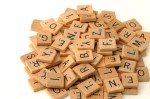 di Macy a New York, giocò il gioco in vacanza. Al suo ritorno, fu sorpreso di scoprire che il suo negozio non vendeva il gioco. Ha fatto una grande ordinazione ed entro un anno, “tutti nedovevano avere uno”. Non in grado di soddisfare la domanda, Brunot vendette i diritti di produzione a Selchow e Righter, una società della Long Island. Nel suo secondo anno, tale società vendette 4 milioni di set. Nel 1986, Selchow e Righter è stata venduta a Coleco, che poco dopo è andata in bancarotta. Hasbro ha acquistato i beni della società, tra cui lo Scrabble e il Parcheesi.
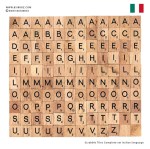 Ci sono almeno due versioni di Scrabble sia in inglese che in italiano. L’edizione in inglese contiene 100 tessere. (C’è anche un gioco chiamato Super Scrabble che ha 200 tessere.) Le 2 versioni italiane hanno 120 tessere. Le lettere J, K, W, X, e Y sono assenti perchè queste lettere non esistono in italiano o esistono solo in linguaggio tecnico e in parole straniere.
 gioco originale. Si gioca con un bordo 17 x 17 e si utilizza 130 tessere.


