It all began here…at the corner of Olive and Cota Streets. At the turn of the 20th century, as Italian immigrants flooded into the east coast of the United States, few people knew that on the west coast in Santa Barbara, California, a town of only about 20,000 then and about 90,000 today, there also was a “Little Italy.” It was built mostly by stone masons originally from the Veneto; their artistry can be seen on edifices and walls throughout the city. Like its counterpart in New York City, not much remains of Santa Barbara’s Little Italy…except for one restaurant.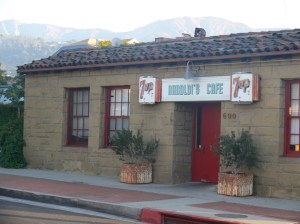
Arnoldi’s Café is the oldest Italian restaurant in Santa Barbara. From its rough-cut stone exterior, you enter into a bustling bar and dining room lined with old photos and other memorabilia. You are immediately greeted by the sights and aromas of linguine alle vongole, trenette al pesto, and the signature gnocchi dishes with a choice of “tricolore” sauces. One can dine al fresco or sip an aperitivo under a pergola on a patio with shimmering lights, and watch bocce players compete on the 2 outdoor courts. It is at Arnoldi’s every Monday evening that a group of Italophiles join in “Parliamo!” (let’s talk). We practice our Italian, exchange travel tips and gossip, and, of course, feast on pasta.
Not far from Arnoldi’s in the heart of Santa Barbara was the old shoe repair shop of Salvatore Ferragamo. From his humble beginnings in the region of Campania, he emigrated to the United States at the age of 16 in the early 1900s and settled in Santa Barbara. His shop was very successful in this city where one of the first film studios flourished. Ferragamo eventually went to Hollywood to pursue his new calling–designing footwear for the movies–and eventually for the rich and famous throughout the world.
But the connection between Italy and Santa Barbara dates back much further than the 20th century. After all, the name that graces our city, county, channel, and Mission comes from the Saint who is venerated in many religions, including Roman Catholicism. Although the facts of her life are not officially documented, it is believed that she died in Italy. Santa Barbara’s feast day is December 4, the day she was martyred because she had converted to Christianity. Santa Barbara is the patron saint (“la patrona”) in many Italian cities, including Colleferro (Lazio), Bellano (Lombardy), Paternò (Sicily), and Salento (Campania). In Santa Barbara, a beautiful wooden statue of her adorns the main altar of the Mission; the earliest known representation of her is from an eighth century fresco in the old Church of Saint Mary at the Roman Forum.
Under Santa Barbara’s watchful eye, I Madonnari, a festival celebrating street chalk artists, is held by the steps of the Mission each May. This ancient practice possibly dates back to as early as the 13th century when artists who had completed their work in the Italian cathedrals reproduced images of the Madonna on packed dirt or paved public squares using chalk, brick, charcoal, and colored stones. Over the years the practice nearly disappeared. It was revived in 1973 in Grazie di Curtatone, a small Italian town southeast of Milan. And its very first appearance in the Western Hemisphere was, in fact, at the Mission Santa Barbara in 1987.
From the Mission we go to another magnet landmark — the Santa Barbara Courthouse (“Il Palazzo di Giustizia”), a stunning architectural masterpiece in the Spanish Colonial Style that is so prevalent throughout the city. Particularly dramatic are the large carved wooden doors at the entrances—some embellished with hammered copper. Inside are graceful arches, spiral staircases, and galleries that open onto balconies. The corridors are lined with tiles from Tunisia, the floors with terracotta tiles and decorative tiles from Seville, Spain; wrought-iron grill work, railings, and lamp fixtures complete the Spanish style.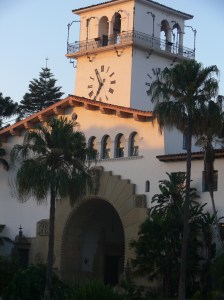
And yet two of the major artists who adorned the courthouse were Italian! Giovanni Battista Smeraldi (1868-1947), who was born in Sicily, painted all the colorful and intricately designed ceilings. He is considered by many critics to be the best decorative artist since the Renaissance. The magic of his brush has touched the walls of some of the most famous buildings in the world, including the Vatican, the White House, Grand Central Station in New York City, the Biltmore Hotel in Los Angeles, and the Breakers in Palm Beach, Florida.
Ettore Cadorin (1876-1952), who was born in Venice, sculpted the famous dolphin fountain at the entrance to the Courthouse called “The Spirit of the Ocean.” Cadorin had been a professor of art and literature at Columbia University before setting up his studio in Santa Barbara. His works also included architectural sculptures, monuments, and statuary in stone, bronze, and ivory. His bronze statue of Father Serra represents the state of California in the Capitol in Washington, DC.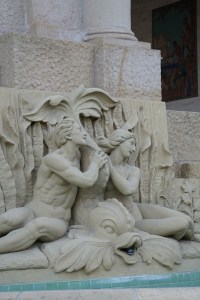
A tour of Santa Barbara would not be complete without a visit to the beautiful beaches here that remind my Italian friends of the beaches of Bel Paese. We even have a little controversy here about the giant cruise ships that enter the harbor…just like in Venice where protest signs read “No grandi navi.” It is the beaches, the mountains, the weather, and the vegetation that attract so many Italians to this beautiful city. In fact, we have 3 “Italo-Americano” service organizations here—and we are all working on earthquake relief for the people of Amatrice.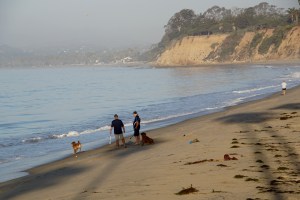
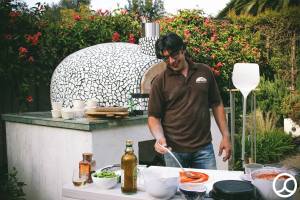
Since we started this tour at an Italian restaurant, let us end at another culinary establishment: a pizza oven. Here is an authentic wood-burning oven that cranks up to 800 degrees Fahrenheit and cooks your margherita pizza in about 1 minute! It was designed by Giuseppe Crisà, a Sicilian engineer from Palermo, who owns a business and workshop here in Santa Barbara and ships ovens all over the world. In fact, if I can brag a little about “il mio amico,” I think he is equal to or better than any oven maker in Italy and certainly the best pizza oven maker outside of Italy!