
I have always envied people who are bilingual—how they can so easily move from one language to another. They seem to think in two languages—despite major differences in vocabulary and idioms, grammatical structure, and syntax. Meanwhile, those struggling to learn a second language tend to think in their mother tongue and then try to bridge over to the new language, invariably making mistakes in prepositions and verb tenses, which are common pitfalls among Americans studying the Italian language.
There have been several scientific studies that have highlighted that bilingualism protects people from senile dementia. Now there is a new Italian study on this subject that was recently published in Proceedings of the National Academy of Sciences. The study was conducted by a team of researchers, directed by Daniela Perani, of a neuroimaging center at the San Rafael Hospital in Milan.
The researchers studied 85 patients with Alzheimer’s dementia from the Alto-Adige region of Italy. Half were monolingual and half were bilingual (probably Italian and German). The researchers used an imaging technique that enabled them to measure cerebral metabolism and the connectivity between different areas of the brain. Like the other studies, this one showed that bilingual patients affected by dementia were, on average, 5 years older compared to the monolingual. The studies also showed that the bilingual patients obtained higher scores on cognitive tests designed to evaluate ability to recognize places and faces.
The Italian study used an imaging technique to examine the frontal metabolic activity and the connectivity between specific areas of the brain that compensate for the damage produced by the disease. The details are too complicated for me to explain, but the results are impressive. According to the research leader, “We discovered that the bilingual patients have a major cerebral reserve. Studying also the bilingual patients that develop a dementia, we discovered that their cognitive control circuits are much stronger.”
The researchers used a questionnaire on the use of languages. The established that the positive effects of bilingualism depends on the level of exposure and use of the two languages: the more that both languages are used, the greater the effects at a cerebral level and the better the performance.
The point is therefore not to know two languages, but to use them actively and during the entire course of one’s life. It is important to promote and maintain the use of languages and dialects in the Italian population. If dialects are not discouraged, many Italians would automatically know 2 languages: standard Italian and the dialect.
For other posts on this topic, see A Language or a Dialect? (August 4, 2016), Dialects and Bilingualism (September 8, 2016), and Maria Crisà (January 12, 2017).
 Sant’Erasmus e le Vignole sono piccole isole nella laguna
  veneziana, a nord del Lido. Sant’Erasmus era un porto attaccato a Murano nel VIII secolo. Oggi queste isole sono conosciute come “giardini di isola”. Forniscono a Venezia i loro famosi carciofi cucinati in molti stili. Le isole hanno una piccola popolazione; la maggior parte degli abitanti sono in pensione o lavorano in agricoltura.
 Normalmente, a Pasqua, gli italiani si riversano a Venezia e dintorni. Ma sembra che questa Pasqua né i visitatori né gli abitanti delle isole non avessero la Resurrezione in mente. Così Don Mario ha attaccato un cartello sul portone della sua chiesa con scritto “La messa è sospesa per mancanza di fedeli”. Ha aggiunto “Don Mario è disponibile su richiesta” insieme al suo numero di telefono.
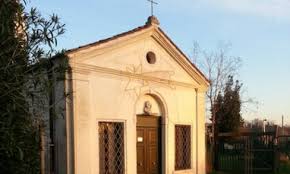 In questa frazione di circa 40 residenti, di solito la domenica, almeno una decina di persone frequentano la chiesa. Ma in inverno a volte non c’è nessuno, secondo il parroco, “perché fa freddo, la gente si ammala e non esce di casa”. Don Mario è rassegnato alla crescita di secolarizzazione in Italia. Quindi per evitare di essere da solo sull’altare questa Pasqua, ha messo il cartello sul portone dicendo che non ci sarebbe stata la Messa. “Sono qui a fare il parroco da oltre 15 anni e non era mai successo che fossi costretto a chiudere, ma così vanno i tempi. Non ci si può fare niente. Quando i fedeli torneranno, io sarò qui ad aspettarli”.
 L'Olivo Santa Barbara