
Italy is known as one of the richest countries in the world in terms of its many dialects. Unified for only 150 years, Italy has been a crossroads of different peoples and cultures throughout its history. Every region has its own unique dialect that differs from standard (Florentine) Italian in sounds and spelling, grammar, syntax, and vocabulary.
What is the difference between a language and a dialect? There is not one universally accepted definition. Popular usage suggests that languages are written, standardized, and have a literature, while dialects are oral, do not have codified rules, and do not have a literature. There are several objections to this distinction. First, there is oral literature; the Iliad and the Odyssey probably originated as memorized poems. Second, the term “dialect” in this context suggests that it is less sophisticated. Yet there are dialects that are more grammatically complicated than languages.
There is a famous aphorism by Max Weinrich, a Yiddish linguist, who said, “language is a dialect with an army and a navy.” This suggests social and political distinctions. Hong Kong claims that Chinese (Mandarin) and English are its official languages. Cantonese, which is widely spoken there, is considered a dialect. Linguists use the distinction of “mutual intelligibility.” If you can understand speech without training, it’s a dialect of your own language. If you can’t, it’s a distinct language. In other words, if two kinds of speech are close enough so that speakers of each can have a conversation and understand each other, they are dialects of a single language. By this criterion, Cantonese is a language as Mandarin speakers cannot understand it. Yet speakers of Swedish, Danish, and Norwegian can converse, each in their native tongues, without taking lessons. Hence, these “languages” look more like dialects of one “language.” But because they are spoken in distinct nations, they are called languages.
Let’s return to Italy where dialects are mostly spoken in villages and rural areas today. They are more vibrant in certain regions, like the Veneto and Southern Italy. Some regions, such as Sardinia and Friuli, have established their local dialects as an official language. The farther you travel from Florence, the home of standard Italian, the more the dialect varies. In the Roman dialect, for example, the definite article “il” becomes “er” and the articulated pronoun “in + il = nel” becomes “ner.” While in standard Italian, most words end in a vowel, in Molise, these vowels are dropped. In the Calabrese dialect, “o” becomes “u.” In both many words are unrecognizable to the uninitiated.
Dialects have important uses in these regions. They are used to express feelings. And they are used in certain contexts. For example, a person who orders coffee at a local bar or greets a friend on the street would appear cold if he used standard Italian. If someone receives a telephone call in the presence of others, he might avoid dialect to convey that he cannot speak openly.
For the most part, the Italian language derives from Latin but is also influenced by northern and southern European countries. Sicily, on the other hand, was more influenced by Greek and Arabic; hence “boys” became not “ragazzi” (standard Italian) but “carusi” from the Greek “kouri.”
 Il Tiramisù è un popolare dolce italiano, che è fatto di savoiardi immersi nel caffè e con strati di un misto montato di uova, zucchero, mascarpone, e aromatizzato con cacao. A differenza di altri piatti italiani tradizionali (le cui ricette devono essere rigorosamente seguite), ci sono molte varianti accettabili di questo dolce…cioè, a meno che non si viva a Treviso o Udine.
 La più antica leggenda della nascita del tiramisù risale alla Siena del diciassettesimo secolo, dove pasticceri, in previsione di una visita del Granduca di Toscana, Cosimo de Medici, decisero di preparare un dolce per celebrarlo. A quel tempo, fu chiamato “zuppa del duca”; presumibilmente Cosimo de Medici portò la ricetta a Firenze e
  divenne nota in tutta Italia.
 nella regione del Veneto presso il ristorante Le
 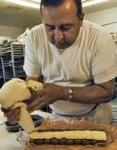 Beccherie a Treviso. Secondo questa teoria, il piatto è stato creato da Roberto Linguanotto, chef e proprietario del ristorante, insieme alla sua apprendista il cui nome da nubile era Tiramisù. Tuttavia,
  Carminantonio Iannaccone sostiene che il tiramisù del ristorante Le Beccherie era
  stato fatto da lui nel suo forno. In ogni caso, ricette chiamate “tiramisù” sono sconosciute nei libri di cucina prima del 1960.
 chiedere il riconoscimento di Specialità territoriale garantia (Stg), un marchio dell’Unione europea che finora è stato assegnato a soli due alimenti in Italia—la pizza napoletana e la mozzarella. E ora un nuovo libro è stato pubblicato che mette l’origine in discussione. Gli autori di “Tiramisù: Storia, curiosità,
  interpretazioni del dolce più amato” presentano prove che Norma Pielli Del Fabbro, ex titolare dell’albergo Roma Di Tolmezzo a Udine l’avrebbe inventato. Norma ha affermato, “L’abbiamo creato noi negli anni 50”. Norma è morta nel 2015, ma suo figlio ha mostrato agli autori un ricevuta di messa in vendita del 1959 con “2 tiramisù e 1 strudel” e anche 2 menù stampati dal 1963 e 1965 relativi a cene dell’Accademia della Cucina Italiana.

