
 In 1610 Galileo was the first to spot Saturn through a telescope. Later that century,
  another Italian astronomer, Gian Domenico Cassini, discovered four of Saturn’s moons and the division of the planet’s rings. Three hundred years later, the Italian Space Agency, together with NASA and the European Space Agency, sent an unmanned spacecraft to Saturn.
Named after the Italian astronomer, Cassini was launched in 1997 and arrived at Saturn in  2004. Cassini, which has racked up 4 billion space miles, has been circling Saturn and its environs for the last 13 years. This part of the universe has turned out to be stranger, more diverse, and more promising than predicted. For example, the rings that have intrigued mankind for centuries are spidery threads of ice, rock, and dust shed by comets and meteorite collisions and then woven into iridescent braids, knots, and walls.
Cassini is the first to explore Titan, the largest of Saturn’s moons and the only moon in the solar system with an atmosphere thicker than Earth’s. Cassini’s Huygens probe landed in a frozen world of methane dunes and river beds. Cassini has also discovered what many astronomers believe is the most likely place to find evidence of life beyond
  Earth…the mysterious moon Enceladus. It is mostly water, a so-called “ocean world” that shoots plumes of salty water out of cracks in the ice of its surface. The data has revealed the presence of hydrogen.
Now Cassini is in its final stages. The spacecraft is on a new path—the narrow gap  between Saturn and its innermost ring. It will penetrate this space 22 times before September 15, 2017 when it will crash into Saturn and be incinerated. This swam dive will complete the successful joint mission of the American, Italian, and European space agencies.
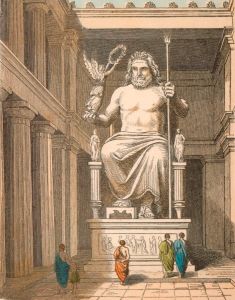 Nel 430 a.C. circa, lo scultore greco Fidia creò una statua di Zeus, alta 40 piedi, fatto di oro e avorio, per il tempio di Zeus ad Olimpia, uno dei più importanti santuari religiosi del mondo greco. Questa statua viene tuttora considerata una delle Sette Meraviglie del mondo antico.
 La statua è stata molti posti nella sua vita, ma dove non è esattamente chiaro. Inizialmente, potrebbe aver servito come statua di culto nel santuario privato di una ricca casa greca o romana. Successivamente, trascorse un periodo sommersa nel mare come mostrano le incrostazioni marine. Per finire quello che sappiamo è che il J. Paul Getty Museum di Los Angeles acquistò la statua nel 1992 da una coppia americana, ma non esiste alcuna documentazione che indichi che fosse stata legalmente esportata.
 scoperto della statua sull’isola di Capri vicino a Napoli, la statua è stata volontariamente restituita all’Italia. Questo è l’ultimo esempio di una lunga serie di opere che il Getty ha restituito all’Italia a causa della provenienza discutibile. Nel gennaio del 2015, il Getty ha restituito la “Testa di Ade” in Sicilia (vedete il post, L’Inferi, del 21 aprile 2016).
 La domanda “A chi appartiene l’arte?” è senza tempo. Così come il dibattito se un paese, che ha curato e tutelato un’opera d’arte che era stata rubata da un altro paese, dovesse essere costretto a restituirla. La domanda moderna di restituzione è cominciata nel 1970 quando archeologi, giornalisti, e funzionari pubblici, si sono resi conto che il saccheggio non è strettamente legato al passato. Il mercato occidentale per l’acquisto delle opere d’arte antiche che stava crescendo, stava causando la distruzione di siti archeologici. C’era molta collusione tra i contrabbandieri—da tombaroli, a restauratori, rivenditori di oggetti di lusso, case d’asta, e collezionisti facoltosi. C’era anche una mancanza di leggi internazionale chiare per regolamentare la divisione delle opere.
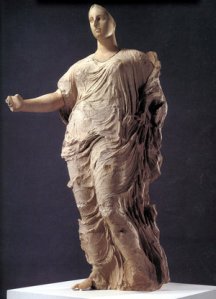 paese. Ciò culminò in un processo penale in Italia nel 2005 di Marion True, la curatrice dell’antichità del museo Getty. Il processo è stato di una lentezza esasperante e non fu mai risolto. Probabilmente non sapremo mai se Marion True sia stata un capro espiatorio o una scofflaw. Ma le richieste sono state così scoraggianti che il Getty a quel tempo ha restituito 40 capolavori, tra cui una grande statua di Afrodite.
 curator of the Getty Museum. The trial was agonizingly slow. In the end, the statute of limitations expired, and perhaps we will never know if Marion True was a scapegoat or a scofflaw. But the demands for returned art were daunting for the Getty, which at that time returned 40 masterworks, including a large statue of Aphrodite.
 L'Olivo Santa Barbara